
The lost dirigible
Ralph Henry Barbour
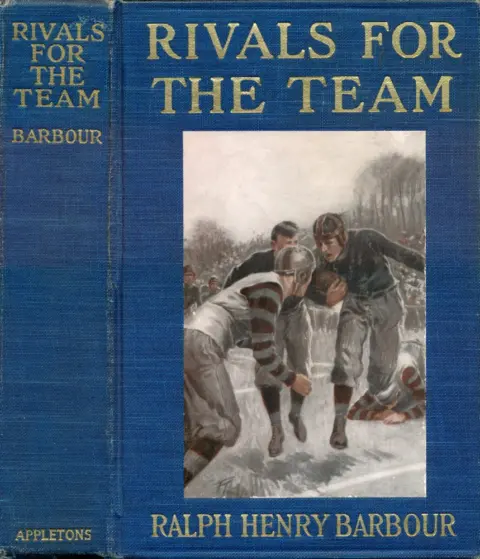
THE CLASSIC COLLECTION · 1916
"Rivals for the Team: A Story of School Life and Football" by Ralph Henry Barbour is a novel written in the early 20th century. This engaging tale revolves around the lives of boys at a prep school as they navigate the challenges of friendship, competition, and, of course, football. The main characters introduced in the opening portions include Ted Trafford, Bert Winslow, and Nick Blake, who form a trio of friends dealing with the trials of school life while preparing for an upcoming football season. The opening of the narrative sets the scene during the pre-season at Grafton School, where the boys are experiencing the heat of late summer and the anticipation of the school term. Conversations between Ted, Bert, and Nick reveal their camaraderie, playful banter, and excitement for the forthcoming football practices. This section establishes the boys' distinct personalities as they discuss their rooms, practice schedules, and upcoming challenges, including the integration of new classmates like Hugh Ordway, who brings a touch of English decorum into their American school life. As they transition from summer relaxation to the structured life of a boarding school, the foundation is laid for both the competitive spirit of football and the deeper themes of friendship and teamwork that will unfold throughout the story.
Introduction adapted from the source catalogue; source summaries may be automatically generated.
Free to read · English · 72,431 words · No account needed
MAKE TIME FOR A GOOD BOOK
On by default. Untick to stop anonymous reading totals. Each page counts after 10 seconds in view. How this works.
Anonymous counting is on unless you have switched it off.
“Where the dickens have you been?” demanded Bert, more loudly. Hugh heard his bed creak and a moment later his bare feet on the floor. And that instant there was a gentle knock on the door.
Hugh flung things from him wildly and dived for his bed. There was silence. Then the knock was repeated, and:
“Winslow!” came Cathcart’s cautious voice from beyond the portal.
After a moment’s hesitation Bert, making a good deal of noise about it, went to the door and flung it open. Hugh, the covers pulled to his chin, held his breath and listened.
“Hello, Wallace.” That was Bert’s voice, surprised and sleepy. “What’s
up?”
“Sorry to disturb you,” said Cathcart, pushing past Bert and closing the door behind him, “but someone just came up the stairs and entered this room.”
“Nonsense,” replied Bert, suppressing a yawn. “You probably heard me coming from the bathroom.”
“I didn’t only hear, I saw,” said Cathcart quietly. “You don’t usually visit the bathroom with all your clothes on, I suppose.”
“Not usually, old man, but I couldn’t find my bathrobe. I suppose it’s somewhere around――――”
“Is Ordway here?” demanded the proctor.
“I suppose so. We went to bed rather early. Oh, Hugh!”
“Yes?” asked Hugh startledly. “Did you call, Bert?”
“Yes, Cathcart asked if you were here. It’s all right, I guess.”
“If you don’t mind,” murmured Cathcart. He crossed to Hugh’s room and looked in. “Would you mind turning on a light, please, Bert?”
Bert obeyed grumblingly and Cathcart viewed the bedroom. Hugh’s coat lay on the floor near the foot of the bed, his trousers were in front of the dresser, one shoe was on top the trousers and the other a yard away and his shirt hung limply from the footrail. Cathcart took it all in silently and gravely. Then:
“How long have you been in bed, Ordway?” he asked.
“Eh? In bed? Oh, really, I can’t say. What time is it now?”
“You just came in, as a matter of fact, didn’t you?”
“Now look here, Cathcart,” interrupted Bert persuasively. “You’re all wrong, old man. You were dreaming, probably. You can see easily enough that Ordway and I have been in bed for a long time.”
“Does he usually leave his things around like that?” asked the proctor.
“I’m afraid he does. He’s an untidy beggar. You are, aren’t you, Hugh?”
“Perfectly rotten,” replied Hugh cheerfully. “Still, you know, they’re awfully easy to find in case of――er――fire or anything.”
Your reading position is saved on this browser. Take it to another device with a library code. Reading pages adapt to text, rather than matching a printed edition.
Ralph Henry Barbour
Ralph Henry Barbour

Ralph Henry Barbour

Ralph Henry Barbour
BEHIND THE BOOK
This eBook is for the use of anyone anywhere in the United States and most other parts of the world at no cost and with almost no restrictions whatsoever. You may copy it, give it away or re-use it under the terms of the Project Gutenberg License included with this eBook or online at www.gutenberg.org. If you are not located in the United States, you will have to check the laws of the country where you are located before using this eBook. Read the source licence.
The original source file, including credits and licence, is retained by this library. Request an original-format copy at no charge. Please include the book title and Project Gutenberg identifier #67805.
KEEP YOUR CURIOSITY GOING
Coulson Kernahan

Maurice Baring
Frances Wright
Cécile Tormay

Frederic Jesup Stimson

W. H. P. (William Henry Pope) Jarvis