
The lost dirigible
Ralph Henry Barbour
THE CLASSIC COLLECTION · 1916
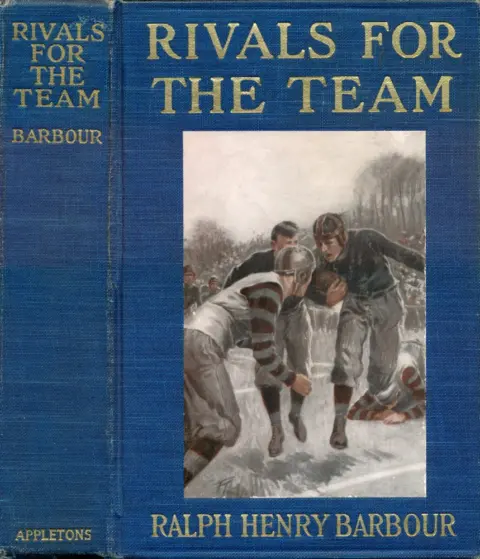
"Rivals for the Team: A Story of School Life and Football" by Ralph Henry Barbour is a novel written in the early 20th century. This engaging tale revolves around the lives of boys at a prep school as they navigate the challenges of friendship, competition, and, of course, football. The main characters introduced in the opening portions include Ted Trafford, Bert Winslow, and Nick Blake, who form a trio of friends dealing with the trials of school life while preparing for an upcoming football season. The opening of the narrative sets the scene during the pre-season at Grafton School, where the boys are experiencing the heat of late summer and the anticipation of the school term. Conversations between Ted, Bert, and Nick reveal their camaraderie, playful banter, and excitement for the forthcoming football practices. This section establishes the boys' distinct personalities as they discuss their rooms, practice schedules, and upcoming challenges, including the integration of new classmates like Hugh Ordway, who brings a touch of English decorum into their American school life. As they transition from summer relaxation to the structured life of a boarding school, the foundation is laid for both the competitive spirit of football and the deeper themes of friendship and teamwork that will unfold throughout the story.
Introduction adapted from the source catalogue; source summaries may be automatically generated.
Free to read · English · 72,431 words · No account needed
MAKE TIME FOR A GOOD BOOK
On by default. Untick to stop anonymous reading totals. Each page counts after 10 seconds in view. How this works.
Anonymous counting is on unless you have switched it off.
“This must be it, Bowles,” said a voice. “Yes, twenty-nine. Oh, I beg
your pardon!”
Bert sat up and slid his feet to the floor. In the doorway stood a slim, pleasant-faced youth, and behind him a very serious-looking man held an extremely large kit-bag, an umbrella, and a folded gray overcoat. The youth advanced toward Bert, smiling and removing a gray glove.
“I fancy you are Winslow,” he said. “I’m Ordway. I believe we share these quarters, eh?”
Bert shook hands. “Glad to know you,” he replied. “Beastly hot, isn’t it? That’s your room over there.” He glanced inquiringly at the second arrival who, still holding his burdens, had paused just inside the door. But if he looked for an introduction none was forthcoming. Ordway, who had now removed both gloves and tossed them nonchalantly to the table, evidently had no thought of making his companion known.
“Ripping view from here,” he said, glancing from the window. Then, turning: “In there, Bowles,” he directed, and nodded toward the open door of the bedroom. “Just dump them, will you? I’ll look after them myself.”
Bag and coat and umbrella disappeared, Bert’s gaze following their bearer curiously. Ordway had thrust his hands in his pockets and was leisurely examining the study. His manner was a queer mixture of quiet assurance and diffidence. When he had shaken hands he had reddened perceptibly, but now he was looking the place over just as though, as Bert silently told himself, he had ordered the whole thing. “I like this,” he said, after a moment. “Rather jolly, isn’t it?”
Bert was spared a reply, for just then the mysterious Bowles appeared in the bedroom doorway. “Shan’t I unpack the bag, sir?” he asked.
“No, never mind it, thanks.” Ordway consulted a watch. “I fancy you’d better beat it, Bowles. Your train leaves in fifteen minutes, you know.”
“Yes, sir, but there’s another one, sir, a bit later.”
“Are you sure of that?” Ordway glanced inquiringly at Bert. “He’s
wrong, eh?”
“Yes, the next one doesn’t go until seven-five. If he wants to get this one he will have to hustle. It’s a good ten minutes’ walk to the station.”
“Thanks. This gentleman’s right, Bowles. You’d better start along. You know your way, eh? Tell mother I’m quite all right; everything’s very jolly.” The boy walked to the door with the man and pulled a leather purse from his pocket. “Better treat yourself to a bit of a jinks when you get to town. You’ll have four hours to wait, you know. Good-by, Bowles.”
Your reading position is saved on this browser. Take it to another device with a library code. Reading pages adapt to text, rather than matching a printed edition.
Ralph Henry Barbour
Ralph Henry Barbour

Ralph Henry Barbour

Ralph Henry Barbour
BEHIND THE BOOK
This eBook is for the use of anyone anywhere in the United States and most other parts of the world at no cost and with almost no restrictions whatsoever. You may copy it, give it away or re-use it under the terms of the Project Gutenberg License included with this eBook or online at www.gutenberg.org. If you are not located in the United States, you will have to check the laws of the country where you are located before using this eBook. Read the source licence.
The original source file, including credits and licence, is retained by this library. Request an original-format copy at no charge. Please include the book title and Project Gutenberg identifier #67805.
KEEP YOUR CURIOSITY GOING
Coulson Kernahan

Maurice Baring
Frances Wright
Cécile Tormay

Frederic Jesup Stimson

W. H. P. (William Henry Pope) Jarvis