
The lost dirigible
Ralph Henry Barbour
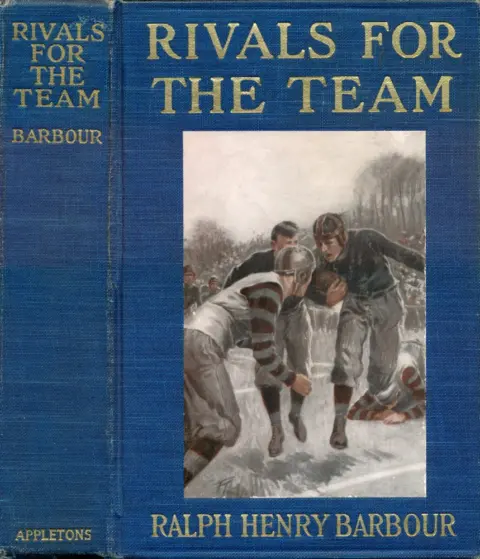
THE CLASSIC COLLECTION · 1916
"Rivals for the Team: A Story of School Life and Football" by Ralph Henry Barbour is a novel written in the early 20th century. This engaging tale revolves around the lives of boys at a prep school as they navigate the challenges of friendship, competition, and, of course, football. The main characters introduced in the opening portions include Ted Trafford, Bert Winslow, and Nick Blake, who form a trio of friends dealing with the trials of school life while preparing for an upcoming football season. The opening of the narrative sets the scene during the pre-season at Grafton School, where the boys are experiencing the heat of late summer and the anticipation of the school term. Conversations between Ted, Bert, and Nick reveal their camaraderie, playful banter, and excitement for the forthcoming football practices. This section establishes the boys' distinct personalities as they discuss their rooms, practice schedules, and upcoming challenges, including the integration of new classmates like Hugh Ordway, who brings a touch of English decorum into their American school life. As they transition from summer relaxation to the structured life of a boarding school, the foundation is laid for both the competitive spirit of football and the deeper themes of friendship and teamwork that will unfold throughout the story.
Introduction adapted from the source catalogue; source summaries may be automatically generated.
Free to read · English · 72,431 words · No account needed
MAKE TIME FOR A GOOD BOOK
On by default. Untick to stop anonymous reading totals. Each page counts after 10 seconds in view. How this works.
Anonymous counting is on unless you have switched it off.
Everyone shouted things then, while, to the surprise of the man, the assaulted youth arose nonchalantly, shook himself, and trotted further into the field, where, presently, the whole performance was gone through with again. The man was perplexed. Football he had heard of but never witnessed, and it was very difficult to understand. On a board at one end of the inclosure was the legend:
That, of course, meant that neither side had as yet succeeded in making a tally. The man wondered what they did to make a tally, and while he was still wondering a gentleman wearing a white sweater ran frantically onto the field and tooted an automobile horn. Whereupon, with one accord, the players of both sides drew apart and then trotted diagonally down the field and disappeared from sight.
The man started to get up, saw that only a very few were following his example, hesitated, and resumed his seat.
“I beg pardon, sir,” he said to his neighbor, “is there more of it?”
“Oh, yes, that’s only the first half,” replied the boy, a note of surprise in his voice. “You got here late, didn’t you?”
“Yes, sir. The train I reached Needham Junction on did not connect with any train for this place and I was obliged to take a fly――er, carriage, that is to say. It took some time.”
“I guess it did!” The boy observed his neighbor interestedly, a bit puzzled. “Too bad to miss a whole quarter after coming so far, sir.”
“I beg pardon, but I’m not――that is, you――――” But he gave it up. He wanted to tell the boy that he preferred not to be called “sir,” but he couldn’t think of a way to do it.
“Come from New York?” the boy was asking, frankly curious.
“Yes, sir, but from Baltimore before that. I left there last night. I came to see Mr. Ordway; Mr. Hugh Ordway. You might know him, sir?”
“Know Hobo! Well, I guess! Everyone knows Hobo Ordway!”
“No, sir, Hugh, if you please, sir.”
“I know; that’s him. The fellows call him Hobo on account of his initials; H. O. B. O. don’t you see? Friend of yours, sir?”
“My master, sir.”
“Your――I didn’t get that!”
“I’m Master Hugh’s man, sir. We were a bit worried about him and my lady sent me up to see if everything was all right.”
“Oh, then you’re the valet chap he brought along with him when he got
here?”
“Yes, sir; Bowles, sir.”
“Well, what do you know about that?”
“You mean, sir――――”
Your reading position is saved on this browser. Take it to another device with a library code. Reading pages adapt to text, rather than matching a printed edition.
Ralph Henry Barbour
Ralph Henry Barbour

Ralph Henry Barbour

Ralph Henry Barbour
BEHIND THE BOOK
This eBook is for the use of anyone anywhere in the United States and most other parts of the world at no cost and with almost no restrictions whatsoever. You may copy it, give it away or re-use it under the terms of the Project Gutenberg License included with this eBook or online at www.gutenberg.org. If you are not located in the United States, you will have to check the laws of the country where you are located before using this eBook. Read the source licence.
The original source file, including credits and licence, is retained by this library. Request an original-format copy at no charge. Please include the book title and Project Gutenberg identifier #67805.
KEEP YOUR CURIOSITY GOING
Coulson Kernahan

Maurice Baring
Frances Wright
Cécile Tormay

Frederic Jesup Stimson

W. H. P. (William Henry Pope) Jarvis