
The lost dirigible
Ralph Henry Barbour
THE CLASSIC COLLECTION · 1916
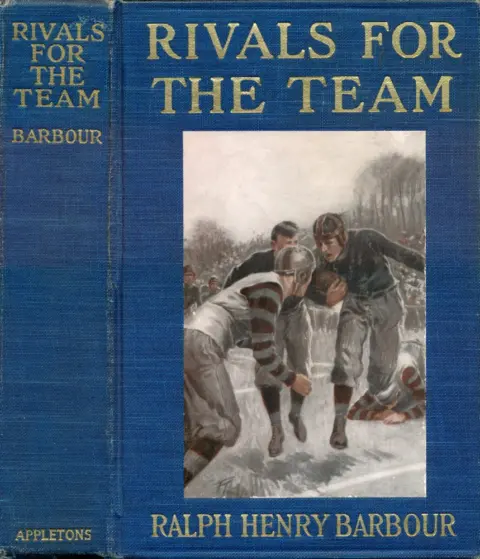
"Rivals for the Team: A Story of School Life and Football" by Ralph Henry Barbour is a novel written in the early 20th century. This engaging tale revolves around the lives of boys at a prep school as they navigate the challenges of friendship, competition, and, of course, football. The main characters introduced in the opening portions include Ted Trafford, Bert Winslow, and Nick Blake, who form a trio of friends dealing with the trials of school life while preparing for an upcoming football season. The opening of the narrative sets the scene during the pre-season at Grafton School, where the boys are experiencing the heat of late summer and the anticipation of the school term. Conversations between Ted, Bert, and Nick reveal their camaraderie, playful banter, and excitement for the forthcoming football practices. This section establishes the boys' distinct personalities as they discuss their rooms, practice schedules, and upcoming challenges, including the integration of new classmates like Hugh Ordway, who brings a touch of English decorum into their American school life. As they transition from summer relaxation to the structured life of a boarding school, the foundation is laid for both the competitive spirit of football and the deeper themes of friendship and teamwork that will unfold throughout the story.
Introduction adapted from the source catalogue; source summaries may be automatically generated.
Free to read · English · 72,431 words · No account needed
MAKE TIME FOR A GOOD BOOK
On by default. Untick to stop anonymous reading totals. Each page counts after 10 seconds in view. How this works.
Anonymous counting is on unless you have switched it off.
“What,” demanded Bert, as he closed the door behind him, “what is this――this”――unconsciously he adopted Hugh’s phrase of the other evening――“this piffling poppycock?”
Hugh, standing at the window, one knee on the cushion, turned and smiled conciliatingly. “Mother telegraphed to faculty. She doesn’t want me to play. She――she’s afraid I’d get hurt, don’t you know. Of course, it’s bally nonsense, but there you are, what?”
Bert advanced into the room and shied his cap to the table. Then he plunged his hands in his pockets and observed sweetly:
“Must have been an awful surprise to you!”
Hugh colored. “Well, there it is, eh?”
“Most breaks your heart, doesn’t it?” continued Bert with suspicious
sympathy.
“Oh, well, now, old chap, of course a fellow’s disappointed, and all that, but――――”
Then Bert let loose. I’m not going to try to say what he did, partly because it was all dreadfully incoherent and partly because he used expressions and called names that barely escaped being in shocking bad taste. One of the nicest things he called Hugh was a “dunder-headed ass”! And Hugh took it all quite good-naturedly and very calmly, even seating himself as though in order to listen more attentively. And when, at last, Bert petered out for lack of breath or language, Hugh only grinned at him!
“You can’t prove anything you’ve said,” he remarked finally, just when Bert showed a disposition to go on again. “And, anyway――――”
“I don’t have to prove it; I know it!” bellowed the other. “I’m not a complete fool!” He glared at Hugh a space longer and then subsided in the Morris chair. “What――what did you do it for, Hugh?” he asked almost pathetically.
Hugh blustered weakly. “I haven’t said I’d done anything, have I? That’s your story. If you don’t believe me when I tell you that――that――――”
“Well, go on,” said Bert sarcastically.
But Hugh didn’t. “Anyway, it’s done and that’s all there is to it. What’s the good of cutting up rough?”
“Hugh, you’re an ass.”
Hugh smiled and shrugged his shoulders. “I say, you know, you’ve told me that before a number of times.”
“And I tell it to you again, you――you chump! If this ever gets out Bonner will scalp you and the school will chase you from here to the Junction!”
“Why should it get out, as you say? And――and what is there to get out,
anyway?”
“There’s this. You wrote home and got your mother to send that telegram, and if that isn’t――――”
Your reading position is saved on this browser. Take it to another device with a library code. Reading pages adapt to text, rather than matching a printed edition.
Ralph Henry Barbour
Ralph Henry Barbour

Ralph Henry Barbour

Ralph Henry Barbour
BEHIND THE BOOK
This eBook is for the use of anyone anywhere in the United States and most other parts of the world at no cost and with almost no restrictions whatsoever. You may copy it, give it away or re-use it under the terms of the Project Gutenberg License included with this eBook or online at www.gutenberg.org. If you are not located in the United States, you will have to check the laws of the country where you are located before using this eBook. Read the source licence.
The original source file, including credits and licence, is retained by this library. Request an original-format copy at no charge. Please include the book title and Project Gutenberg identifier #67805.
KEEP YOUR CURIOSITY GOING
Coulson Kernahan

Maurice Baring
Frances Wright
Cécile Tormay

Frederic Jesup Stimson

W. H. P. (William Henry Pope) Jarvis