
The lost dirigible
Ralph Henry Barbour
THE CLASSIC COLLECTION · 1916
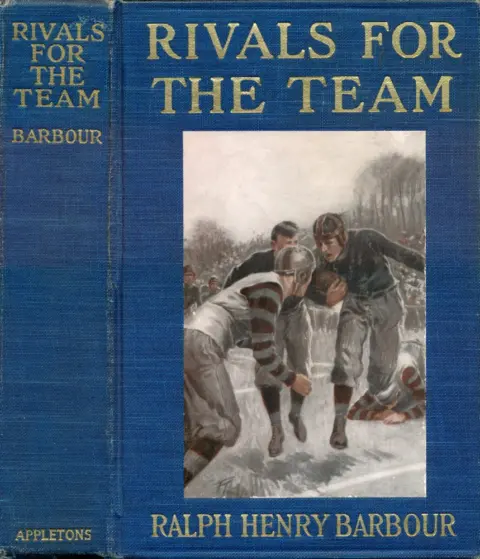
"Rivals for the Team: A Story of School Life and Football" by Ralph Henry Barbour is a novel written in the early 20th century. This engaging tale revolves around the lives of boys at a prep school as they navigate the challenges of friendship, competition, and, of course, football. The main characters introduced in the opening portions include Ted Trafford, Bert Winslow, and Nick Blake, who form a trio of friends dealing with the trials of school life while preparing for an upcoming football season. The opening of the narrative sets the scene during the pre-season at Grafton School, where the boys are experiencing the heat of late summer and the anticipation of the school term. Conversations between Ted, Bert, and Nick reveal their camaraderie, playful banter, and excitement for the forthcoming football practices. This section establishes the boys' distinct personalities as they discuss their rooms, practice schedules, and upcoming challenges, including the integration of new classmates like Hugh Ordway, who brings a touch of English decorum into their American school life. As they transition from summer relaxation to the structured life of a boarding school, the foundation is laid for both the competitive spirit of football and the deeper themes of friendship and teamwork that will unfold throughout the story.
Introduction adapted from the source catalogue; source summaries may be automatically generated.
Free to read · English · 72,431 words · No account needed
MAKE TIME FOR A GOOD BOOK
On by default. Untick to stop anonymous reading totals. Each page counts after 10 seconds in view. How this works.
Anonymous counting is on unless you have switched it off.
The quartette passed the end of the gridiron, on which the unfortunate first team members were still toiling monotonously, crossed the practice field and finally reached the boathouse. Fortunately for their undertaking, there was no one inside nor about the landing, and Bowen led the way around the corner of the old building to where a piece of fairly level sward sloped to the river almost in the shadow of the bridge.
“Now go to it, you idiots,” he said indifferently, “if you have to. But if I sing out, beat it! For I don’t intend to get yanked up before Charlie, even if you do.”
Longley tossed his cap to the ground and impatiently tore off coat and waistcoat, and Hugh, a bit more calmly, similarly divested himself. Then his opponent, scowling ferociously, advanced across the turf, and Hugh squared to meet him.
“Shake hands, gentlemen,” said Bowen facetiously, and Peet giggled.
“Oh, cut out the comedy stuff,” growled Longley. “Now then, you Little Lord Fauntleroy, where’ll you have it?”
Some twenty minutes later, Bert, laboriously trying to get out of his coat-sweater without hurting the damaged rib, heard the study door open and close quietly.
“That you, Hugh?” he asked.
“Yes,” was the quiet reply. But Hugh didn’t appear at the doorway. Instead he crossed to his own bedroom and Bert heard him pouring water into the bowl.
“What are you so select for?” Bert sang out. “Aren’t you speaking to your friends today?”
There was no audible reply from 29a, and having got rid of the sweater at the cost of a few twinges, Bert sauntered across the study to Hugh’s doorway. Then:
“For――the――love――of――Mike!” whispered Bert awedly. “Where’d you get it?”
Hugh, looking up from his task of applying a wet sponge to a disfigured countenance, smiled painfully.
“Longley,” he answered.
“Longley! Do you mean that Brew Longley battered you up like that? What was the row? Great Scott, Hugh, you’re an awful mess! What did you do to him?”
“Not much, I’m afraid,” replied Hugh dejectedly. “I got in a few, but he was too clever for me.” He turned to the mirror over the dresser and viewed his reflection judicially, the wet sponge trickling water on the rug. “He’s a ripping good fighter, Bert,” he added with what sounded like unwilling admiration.
Bert, hands in pockets, gazed fascinatedly at his room-mate’s countenance. He whistled tunelessly and under his breath. Hugh went back to the basin.
“I fancy I flattened his nose for him, anyway,” he said more cheerfully.
Your reading position is saved on this browser. Take it to another device with a library code. Reading pages adapt to text, rather than matching a printed edition.
Ralph Henry Barbour
Ralph Henry Barbour

Ralph Henry Barbour

Ralph Henry Barbour
BEHIND THE BOOK
This eBook is for the use of anyone anywhere in the United States and most other parts of the world at no cost and with almost no restrictions whatsoever. You may copy it, give it away or re-use it under the terms of the Project Gutenberg License included with this eBook or online at www.gutenberg.org. If you are not located in the United States, you will have to check the laws of the country where you are located before using this eBook. Read the source licence.
The original source file, including credits and licence, is retained by this library. Request an original-format copy at no charge. Please include the book title and Project Gutenberg identifier #67805.
KEEP YOUR CURIOSITY GOING
Coulson Kernahan

Maurice Baring
Frances Wright
Cécile Tormay

Frederic Jesup Stimson

W. H. P. (William Henry Pope) Jarvis