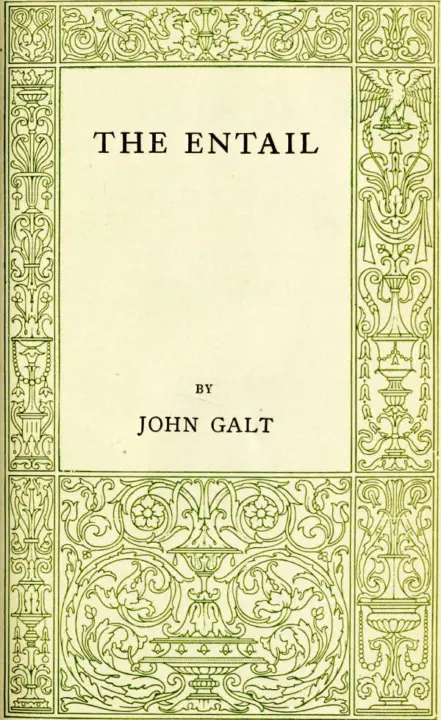
The Entail; or, The Lairds of Grippy
John Galt
THE CLASSIC COLLECTION · 1823
"Ringan Gilhaize, or The Covenanters" by John Galt is a historical novel written in the early 19th century. The story is set during the tumultuous period of the Scottish Reformation, focusing on the struggles for religious liberty and the conflict between the Covenanters and the ruling authorities. The main character is Ringan Gilhaize, who embodies the zealous spirit of the Covenanters, illustrating the tension between faith and oppression. The opening of the novel establishes a reflective tone as the narrator recounts the historical background and personal experiences of Ringan's grandfather during the Reformation. It highlights his family's past and their involvement in the early struggles against the Catholic Church. The narrative flows into his grandfather's youth, outlining the events that led him to join the fight for religious freedom alongside the Protestant reformers. An early conflict arises when the family's rebellious spirit is ignited by witnessing the hypocrisy of the church and the martyrdom of reformers, setting the stage for the broader conflicts that will emerge as a central theme in the story.
Introduction adapted from the source catalogue; source summaries may be automatically generated.
Free to read · English · 164,427 words · No account needed
MAKE TIME FOR A GOOD BOOK
On by default. Untick to stop anonymous reading totals. Each page counts after 10 seconds in view. How this works.
Anonymous counting is on unless you have switched it off.
On the arrival of Dun, he was on the instant admitted to her presence; for she was at the time in the tapestried chamber, surrounded by her priests and ladies, and many officers, all consulting her according to their fears. The sight, said my grandfather, for he also went into the presence, was a proof to him that the cause of the papacy was in the dead-thraws, the judgments of all present being so evidently in a state of discomfiture and desertion.
Dun going forward with the wonted reverences, the Queen said to him
abruptly,--
"Well, Erskine, what is this?"
Whereupon he represented to her, in a sedate manner, that the Reformed ministers were not treated as they had been encouraged to hope; nevertheless, to show their submission to those in temporal authority over them, they were coming, in obedience to the citation, to stand trial.
"But their retinue--when have delinquents come to trial so attended?"
she exclaimed eagerly.
"The people, please your Highness," said Dun, with a steadfastness of manner that struck every one with respect for him, "the people hold the same opinions and believe the same doctrines as their preachers, and they feel that the offence, if it be offence, of which the ministers are accused, lies equally against them, and therefore they have resolved to make their case a common cause."
"And do they mean to daunt us from doing justice against seditious schismatics?" cried her Highness somewhat in anger.
"They mean," replied Dun, "to let your Highness see whether it be possible to bring so many to judgment. Their sentiment, with one voice, is, Cursed be they that seek the effusion of blood, or war, or dissension. Let us possess the evangile, and none within Scotland shall be more obedient subjects. In sooth, madam, they hold themselves as guilty of the crime charged as their ministers are, and they will suffer with them."
"Suffer! Call you rebellion suffering?" exclaimed the Queen.
"They have not yet rebelled," said Dun, calmly; "they come to remonstrate with your Highness first; for, as Christians, they are loth to draw the sword. They have no arms with them, to the end that no one may dare to accuse them of any treason."
"It is a perilous thing when subjects," said the Queen, much troubled, "declare themselves so openly against the authority of their rulers."
"It is a bold thing for rulers," replied Dun, "to meddle with the consciences of their subjects."
"How!" exclaimed the Queen, startled and indignant.
Your reading position is saved on this browser. Take it to another device with a library code. Reading pages adapt to text, rather than matching a printed edition.
John Galt
John Galt
John Galt
John Galt
BEHIND THE BOOK
This eBook is for the use of anyone anywhere in the United States and most other parts of the world at no cost and with almost no restrictions whatsoever. You may copy it, give it away or re-use it under the terms of the Project Gutenberg License included with this eBook or online at www.gutenberg.org. If you are not located in the United States, you will have to check the laws of the country where you are located before using this eBook. Read the source licence.
The original source file, including credits and licence, is retained by this library. Request an original-format copy at no charge. Please include the book title and Project Gutenberg identifier #30749.
KEEP YOUR CURIOSITY GOING
Cécile Tormay

Moritz Busch
Coulson Kernahan
John L. Ransom

Maurice Baring
Frances Wright