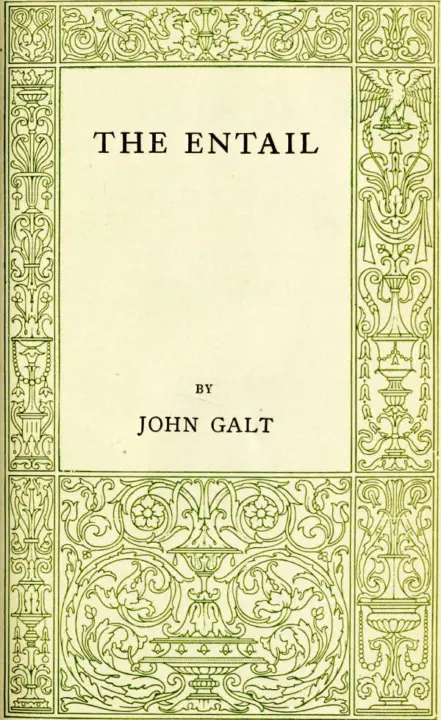
The Entail; or, The Lairds of Grippy
John Galt
THE CLASSIC COLLECTION · 1823
"Ringan Gilhaize, or The Covenanters" by John Galt is a historical novel written in the early 19th century. The story is set during the tumultuous period of the Scottish Reformation, focusing on the struggles for religious liberty and the conflict between the Covenanters and the ruling authorities. The main character is Ringan Gilhaize, who embodies the zealous spirit of the Covenanters, illustrating the tension between faith and oppression. The opening of the novel establishes a reflective tone as the narrator recounts the historical background and personal experiences of Ringan's grandfather during the Reformation. It highlights his family's past and their involvement in the early struggles against the Catholic Church. The narrative flows into his grandfather's youth, outlining the events that led him to join the fight for religious freedom alongside the Protestant reformers. An early conflict arises when the family's rebellious spirit is ignited by witnessing the hypocrisy of the church and the martyrdom of reformers, setting the stage for the broader conflicts that will emerge as a central theme in the story.
Introduction adapted from the source catalogue; source summaries may be automatically generated.
Free to read · English · 164,427 words · No account needed
MAKE TIME FOR A GOOD BOOK
On by default. Untick to stop anonymous reading totals. Each page counts after 10 seconds in view. How this works.
Anonymous counting is on unless you have switched it off.
My grandfather, after this and some farther discourse, retired to the hall, and took breakfast with the household, where he was much edified with the douce deportment of all present, so unlike that of the lewd and graceless varlets who rioted in the houses of the other nobles. Verily, he used to say, the evidences of a reforming spirit were brightly seen there; and, to rule every one into a chaste sobriety of conversation, a pious clerk sate at the head of the board, and said grace before and after the meal, making it manifest how much all things about the Lord James Stuart were done in order.
Having taken breakfast, and reposed himself some time, for his long ride had made him very weary, he rose, and, changing his apparel, went to the Greyfriars church, where the clergy were assembling, and elbowing himself gently into the heart of the people waiting around for admission, he got in with the crowd when the doors were opened.
The matter that morning to be considered concerned the means to be taken, within the local jurisdictions of those there met, to enforce the process of the summons which had been issued against the reformed preachers to appear at Stirling.
But while they were busily conversing and contriving how best to aid and further that iniquitous aggression of perfidious tyranny, there came in one of the brethren of the monastery, with a frightened look, and cried aloud, that John Knox was come, and had been all night in the town. At the news the spectators, as if moved by one spirit, gave a triumphant shout,--the clergy were thunderstruck,--some started from their seats, unconscious of what they did,--others threw themselves back where they sat,--and all appeared as if a judgment had been pronounced upon them. In the same moment the church began to skail,--the session was adjourned,--and the people ran in all directions. The cry rose everywhere, "John Knox is come!" All the town came rushing into the streets,--the old and the young, the lordly and the lowly, were seen mingling and marvelling together,--all tasks of duty, and servitude, and pleasure, were forsaken,--the sick-beds of the dying were deserted,--the priests abandoned their altars and masses, and stood pale and trembling at the doors of their churches,--mothers set down their infants on the floors, and ran to inquire what had come to pass,--funerals were suspended, and the impious and the guilty stood aghast, as if some dreadful apocalypse had been made;--travellers, with the bridles in their hands, lingering in profane discourse with their hosts, suddenly mounted, and speeded into the country with the tidings. At every cottage door and wayside bield, the inmates stood in clusters, silent and wondering, as horseman came following horseman, crying, "John Knox is come!" Barks that had departed, when they heard the news, bore up to tell others that they saw afar at sea. The shepherds were called in from the hills;--the warders on the castle, when, at the sound of many quickened feet approaching, they challenged the comers, were answered, "John Knox is come!" Studious men were roused from the spells of their books;--nuns, at their windows, looked out fearful and inquiring,--and priests and friars were seen standing by themselves, shunned like lepers. The whole land was stirred as with the inspiration of some new element, and the hearts of the persecutors were withered.
Your reading position is saved on this browser. Take it to another device with a library code. Reading pages adapt to text, rather than matching a printed edition.
John Galt
John Galt
John Galt
John Galt
BEHIND THE BOOK
This eBook is for the use of anyone anywhere in the United States and most other parts of the world at no cost and with almost no restrictions whatsoever. You may copy it, give it away or re-use it under the terms of the Project Gutenberg License included with this eBook or online at www.gutenberg.org. If you are not located in the United States, you will have to check the laws of the country where you are located before using this eBook. Read the source licence.
The original source file, including credits and licence, is retained by this library. Request an original-format copy at no charge. Please include the book title and Project Gutenberg identifier #30749.
KEEP YOUR CURIOSITY GOING
Cécile Tormay

Moritz Busch
Coulson Kernahan
John L. Ransom

Maurice Baring
Frances Wright