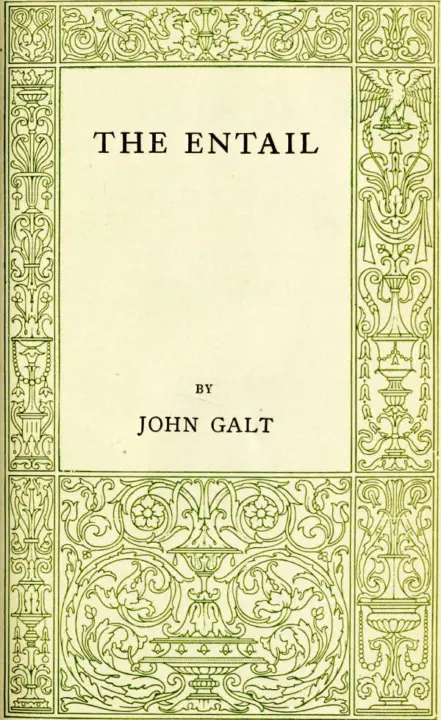
The Entail; or, The Lairds of Grippy
John Galt
THE CLASSIC COLLECTION · 1823
"Ringan Gilhaize, or The Covenanters" by John Galt is a historical novel written in the early 19th century. The story is set during the tumultuous period of the Scottish Reformation, focusing on the struggles for religious liberty and the conflict between the Covenanters and the ruling authorities. The main character is Ringan Gilhaize, who embodies the zealous spirit of the Covenanters, illustrating the tension between faith and oppression. The opening of the novel establishes a reflective tone as the narrator recounts the historical background and personal experiences of Ringan's grandfather during the Reformation. It highlights his family's past and their involvement in the early struggles against the Catholic Church. The narrative flows into his grandfather's youth, outlining the events that led him to join the fight for religious freedom alongside the Protestant reformers. An early conflict arises when the family's rebellious spirit is ignited by witnessing the hypocrisy of the church and the martyrdom of reformers, setting the stage for the broader conflicts that will emerge as a central theme in the story.
Introduction adapted from the source catalogue; source summaries may be automatically generated.
Free to read · English · 164,427 words · No account needed
MAKE TIME FOR A GOOD BOOK
On by default. Untick to stop anonymous reading totals. Each page counts after 10 seconds in view. How this works.
Anonymous counting is on unless you have switched it off.
"I ne'er contended," said I, "that any sin was permitted by the law of God--far less murder, which is expressly forbidden in the Ten Commands."
"Then ye acknowledge the murder of the Archbishop to have been murder?"
"That's between those that did it and God."
"Hooly, hooly, friend!" cried Murray; "that, Ringan, winna do; was it or
was it not murder?"
"Can I tell, who was not there?"
"Then to satisfy your conscience on that score, Ringan, I would ask you, if a gang of ruffians slay a defenceless man, do or do they not commit murder?"
"I can easily answer that."
Lord Kelburne again bent eagerly forward, and rested his cheek again on his hand, placing his elbow on the table, while I continued,--
"A gang of ruffians coming in wantonness, or for plunder, upon a defenceless man, and putting him to death, there can be no doubt is murder; but it has not yet been called murder to kill an enemy in battle; and therefore, if the captain of a host go to war without arms, and thereby be defenceless, it cannot be said that those of the adverse party, who may happen to slay him, do any murder."
"Do you mean to justify the manner of the death of the Archbishop?" exclaimed the advocate, starting back and spreading out his arms in wonderment.
"'Deed no, sir," replied I, a little nettled at the construction he would put upon what I said; "but I will say, even here, what Sir Davie Lindsay o' the Mount said on the similar event o' Cardinal Beaton's death,--
'As for this Cardinal, I grant
He was the man we might well want;
God will forgive it soon:
But of a truth, the sooth to say,
Although the loon be well away,
The fact was foully done.'"
There was a rustle of gratification among all in the court as I said the rhyme, and Lord Kelburne smiled; but Murray, somewhat out of humour, said,--
"I fancy, my Lord, we must consider this as an admission that the killing of the Archbishop was murder."
"I fear," said his Lordship, "that neither of the two questions have been so directly put as to justify me to pronounce any decision, though I am willing to put the most favourable construction on what has passed." And then his Lordship, looking to me, added,--
"Do you consider the late rebellion, being contrary to the King's
authority, rebellion?"
"Contrary to the King's right authority," replied I, "it was not rebellion; but contrary to an authority beyond the right taken by him, despite the law of God, it was rebellion."
Your reading position is saved on this browser. Take it to another device with a library code. Reading pages adapt to text, rather than matching a printed edition.
John Galt
John Galt
John Galt
John Galt
BEHIND THE BOOK
This eBook is for the use of anyone anywhere in the United States and most other parts of the world at no cost and with almost no restrictions whatsoever. You may copy it, give it away or re-use it under the terms of the Project Gutenberg License included with this eBook or online at www.gutenberg.org. If you are not located in the United States, you will have to check the laws of the country where you are located before using this eBook. Read the source licence.
The original source file, including credits and licence, is retained by this library. Request an original-format copy at no charge. Please include the book title and Project Gutenberg identifier #30749.
KEEP YOUR CURIOSITY GOING
Cécile Tormay

Moritz Busch
Coulson Kernahan
John L. Ransom

Maurice Baring
Frances Wright