Ironheart
William MacLeod Raine
THE CLASSIC COLLECTION · 1909
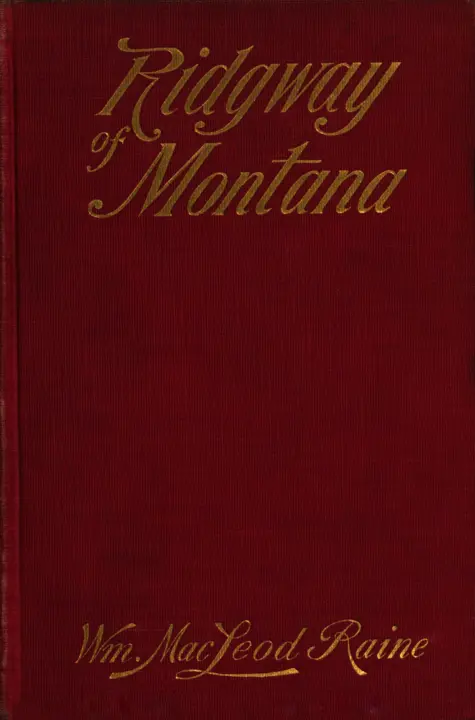
"Ridgway of Montana: A story of to-day, in which the hero is also the villain" by William Macleod Raine is a fictional novel written during the early 20th century. The narrative centers on Waring Ridgway, a complex character depicted as both a brilliant businessman and a ruthless opponent, set against the backdrop of the burgeoning but gritty mining industry in Montana. The story explores themes of ambition, morality, and the personal relationships that intertwine with business rivalries, particularly focusing on Ridgway's interactions with the beautiful Virginia Balfour. The beginning of the novel introduces us to Waring Ridgway and Virginia Balfour as they engage in a witty and candid conversation about their relationship, revealing her conflicted feelings towards him. Virginia acknowledges that marriage to Ridgway would come with greater opportunities, although it wouldn't be for love. This sets up a rich exploration of their dynamic, with Ridgway characterized as a strong, confident figure who is adept at maneuvering through the cutthroat business landscape, raising questions about morality and ethics in both business and love. As the story progresses, we see the tension between Ridgway's ambition and the consequences of his actions, hinting at internal conflicts that will likely be further explored throughout the narrative.
Introduction adapted from the source catalogue; source summaries may be automatically generated.
Free to read · English · 63,750 words · No account needed
MAKE TIME FOR A GOOD BOOK
On by default. Untick to stop anonymous reading totals. Each page counts after 10 seconds in view. How this works.
Anonymous counting is on unless you have switched it off.
To this jaunty retort Eaton had found no answer when Smythe opened the door to announce the arrival of the Honorable Thomas B. Pelton, very anxious for an immediate interview with Mr. Ridgway.
“Show him in,” nodded the president, adding in an aside: “You better
stay, Steve.”
Pelton was a rotund oracular individual in silk hat and a Prince Albert coat of broadcloth. He regarded himself solemnly as a statesman because he had served two inconspicuous terms in the House at Washington. He was fond of proclaiming himself a Southern gentleman, part of which statement was unnecessary and part untrue. Like many from his section, he had a decided penchant for politics.
“Have you seen the infamous libel in that scurrilous sheet of the gutters the Herald?” he demanded immediately of Ridgway.
“Which libel? They don’t usually stop at one, colonel.”
“The one, seh, which slanders my honorable name; which has the scoundrelly audacity to charge me with introducing the mining extension bill for venal reasons, seh.”
“Oh! Yes, I’ve seen that. Rather an unfortunate story to come out just
now.”
“I shall force a retraction, seh, or I shall demand the satisfaction
due a Southern gentleman.
“Yes, I would, colonel,” replied Ridgway, secretly amused at the vain threats of this bag of wind which had been punctured.
“It’s a vile calumny, an audacious and villainous lie.”
“What part of it? I’ve just glanced over it, but the part I read seems to be true. That’s the trouble with it. If it were a lie you could explode it.”
“I shall deny it over my signature.”
“Of course. The trouble will be to get people to believe your denial with Quinton’s affidavit staring them in the face. It seems they have got hold of a letter, too, that you wrote. Deny it, of course, then lie low and give the public time to forget it.”
“Do you mean that I should withdraw from the senatorial race?”
“That’s entirely as you please, colonel, but I’m afraid you’ll find your support will slip away from you.”
“Do you mean that YOU won’t support me, seh?”
Ridgway locked his hands behind his head and leaned back in his chair. “We’ve got to face facts, colonel. In the light of this exposure you can’t be elected.”
“But I tell you, by Gad, seh, that I mean to deny it.”
“Certainly. I should in your place,” agreed the mine-owner coolly. “The question is, how many people are going to believe you?”
Your reading position is saved on this browser. Take it to another device with a library code. Reading pages adapt to text, rather than matching a printed edition.
William MacLeod Raine
William MacLeod Raine
William MacLeod Raine
William MacLeod Raine
BEHIND THE BOOK
This eBook is for the use of anyone anywhere in the United States and most other parts of the world at no cost and with almost no restrictions whatsoever. You may copy it, give it away or re-use it under the terms of the Project Gutenberg License included with this eBook or online at www.gutenberg.org. If you are not located in the United States, you will have to check the laws of the country where you are located before using this eBook. Read the source licence.
The original source file, including credits and licence, is retained by this library. Request an original-format copy at no charge. Please include the book title and Project Gutenberg identifier #2285.
KEEP YOUR CURIOSITY GOING
Coulson Kernahan

Maurice Baring
Frances Wright
Cécile Tormay

Frederic Jesup Stimson

W. H. P. (William Henry Pope) Jarvis