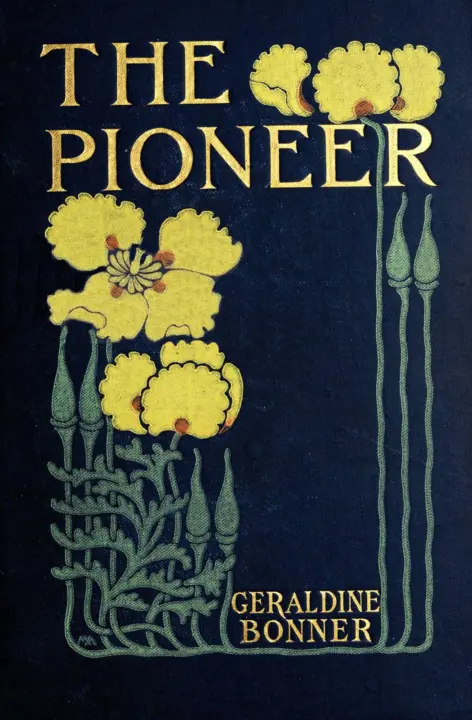
The pioneer
Geraldine Bonner

THE CLASSIC COLLECTION · 1906
"Rich Men’s Children" by Geraldine Bonner is a novel written in the early 20th century. The story revolves around the lives of wealthy characters navigating personal and social dilemmas against the backdrop of California’s mining history. The central figures introduced include Bill Cannon, a prosperous miner known as the Bonanza King, and his daughter Rose, who are depicted against a dramatic landscape marked by isolation and intrigue. The opening portion sets the stage for the journey of Bill Cannon and his daughter, Rose, as they travel through the cold California foothills to reach the mining camp of Rocky Bar. The atmosphere is charged with a mix of adventure and the stark realities of pioneer life. The narrative captures their arrival in Rocky Bar, where they attract attention due to their status and the mystique surrounding Bill Cannon’s past. As they settle in for a meal at the local inn, hints of personal complexities and underlying tensions in their lives begin to emerge. This first chapter introduces not only the physical journey but also foreshadows a deeper exploration of themes related to family, societal expectations, and the impact of wealth on relationships.
Introduction adapted from the source catalogue; source summaries may be automatically generated.
Free to read · English · 116,251 words · No account needed
MAKE TIME FOR A GOOD BOOK
On by default. Untick to stop anonymous reading totals. Each page counts after 10 seconds in view. How this works.
Anonymous counting is on unless you have switched it off.
He looked up and Dominick was suddenly aware that his face was charged with the tensest, the most vital interest. Thrust forward, it showed a hungriness of anticipation that was almost passionate. The young man was not only surprised at the expression but at the question.
“I haven’t an idea,” he said. “I wasn’t home to dinner last night, and didn’t get in till late. Why do you want to know?”
“For many reasons, or for one, perhaps--for one exceedingly important
reason.”
He paused, his eyes again turned slantingly on the stick and gloves, his lips tight-pressed, one against the other.
“How did you know any woman came in here last night at that hour? Did you come up to call?” asked Dominick.
“No--no--” the other spoke with quick impatience evidently from the surface of his mind, “no, it was--at first, anyway--purely accidental. I saw the woman--and--and--afterward I saw her enter here. Mr. Ryan,” he said suddenly, looking at his vis-à-vis with piercing directness and speaking with an intensity of urgency that was almost a command, “can you give me half an hour of your time and your full attention? I want to speak to you of a matter, that to me, at least, is of great--the greatest--importance. You can help me; at least you can, I hope, throw some light on what is a dark subject. Have I your permission to talk freely to you, freely and at length?”
Dominick, who was beginning to feel as if he were in a play, and was exceedingly surprised and intrigued, nodded, remarking,
“Why, certainly, go on. If I can be of any help to you or explain anything for you, nothing would give me greater pleasure. Let me hear what it is.”
The actor dropped his glance to the floor for what seemed an anxiously-considering moment, then he raised his head and, looking directly at his host, said,
“You may remember that, while at Antelope, I once spoke to you of having been married--of having, in fact, been unfortunate enough to lose my wife.”
Dominick remembered, but it seemed imperfectly, for he said in a doubtful tone, which had more than a suggestion of questioning,
“She--er--she died?”
“No,” said the other, “she did not die. I lost her in a way that I think was more painful than death. She left me, voluntarily, of her own free will.”
“Oh, of course,” said the young man hastily. “I remember perfectly, one day by the sitting-room fire. I remember it all as clearly as possible now.”
Your reading position is saved on this browser. Take it to another device with a library code. Reading pages adapt to text, rather than matching a printed edition.
Geraldine Bonner
Geraldine Bonner
Geraldine Bonner
Geraldine Bonner
BEHIND THE BOOK
This eBook is for the use of anyone anywhere in the United States and most other parts of the world at no cost and with almost no restrictions whatsoever. You may copy it, give it away or re-use it under the terms of the Project Gutenberg License included with this eBook or online at www.gutenberg.org. If you are not located in the United States, you will have to check the laws of the country where you are located before using this eBook. Read the source licence.
The original source file, including credits and licence, is retained by this library. Request an original-format copy at no charge. Please include the book title and Project Gutenberg identifier #67454.
KEEP YOUR CURIOSITY GOING
Coulson Kernahan

Maurice Baring
Frances Wright
Cécile Tormay

Frederic Jesup Stimson

W. H. P. (William Henry Pope) Jarvis