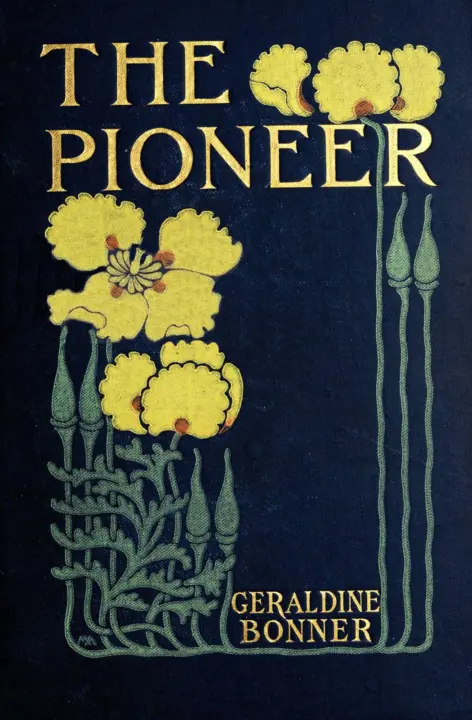
The pioneer
Geraldine Bonner

THE CLASSIC COLLECTION · 1906
"Rich Men’s Children" by Geraldine Bonner is a novel written in the early 20th century. The story revolves around the lives of wealthy characters navigating personal and social dilemmas against the backdrop of California’s mining history. The central figures introduced include Bill Cannon, a prosperous miner known as the Bonanza King, and his daughter Rose, who are depicted against a dramatic landscape marked by isolation and intrigue. The opening portion sets the stage for the journey of Bill Cannon and his daughter, Rose, as they travel through the cold California foothills to reach the mining camp of Rocky Bar. The atmosphere is charged with a mix of adventure and the stark realities of pioneer life. The narrative captures their arrival in Rocky Bar, where they attract attention due to their status and the mystique surrounding Bill Cannon’s past. As they settle in for a meal at the local inn, hints of personal complexities and underlying tensions in their lives begin to emerge. This first chapter introduces not only the physical journey but also foreshadows a deeper exploration of themes related to family, societal expectations, and the impact of wealth on relationships.
Introduction adapted from the source catalogue; source summaries may be automatically generated.
Free to read · English · 116,251 words · No account needed
MAKE TIME FOR A GOOD BOOK
On by default. Untick to stop anonymous reading totals. Each page counts after 10 seconds in view. How this works.
Anonymous counting is on unless you have switched it off.
The old woman moved across the room to the corner where she had been standing when he entered. She did not turn, and he continued:
“You’re asking people to this ball that you hardly know. Everybody in San Francisco’s going. What harm has Berny done that you should leave her out this way?”
“I don’t want women with that kind of record in my house. I don’t ask decent people here to meet that sort,” said his mother over her shoulder.
He gave a suppressed exclamation, the meaning of which it was difficult
to read, then said,
“Are you never going to forget the past, mother?”
She wheeled round toward him almost shouting,
“No--no--no! Never! Never! Make your mind up to that.”
They looked at each other across the open space, the angry defiance in their faces not hiding the love and appeal that spoke in their eyes. The mother longed to take her son in her arms; the son longed to lay his head on her shoulder and forget the wretchedness and humiliations of the last two years. But they were held apart, not only by the specter of the absent woman, but on the one side by a fierce, unbendable pride, and on the other by an unforgettable sense of obligation and duty.
“Oh, mother!” he exclaimed, half-turning away with a movement of
despair.
His mother looked at him from under her lowered brows, her under lip thrust out, her face unrelenting.
“Come here whenever you like,” she said, “as often as you want. It’s your home, Dominick, mine and yours. But it’s not your wife’s. Understand that.”
She turned away and again moved slowly toward the corner, her rich skirts trailing fanwise over the parquet. He stood, sick at heart, looking at the tip of his cane as it rested on the floor.
“Dominick,” said his sister’s voice beside him, “go; that’s the only thing to do. You see it’s no use.” She made a backward jerk of her head toward their mother, and then, struck by the misery of the eyes he lifted to her face, said tenderly, “I’m so sorry. You know I’d have sent it if I could. But it’s no use. It’s just the same old fight over again and nothing gained. Tell your wife it’s hopeless. Make her give it up.”
He turned slowly, his head hanging.
“All right,” he said, “I’ll tell her. Good-night, mother.”
“Good-night, Dominick,” came the answer.
“Good-night, Cornie,” he said in a muffled voice and left the room.
Your reading position is saved on this browser. Take it to another device with a library code. Reading pages adapt to text, rather than matching a printed edition.
Geraldine Bonner
Geraldine Bonner
Geraldine Bonner

Geraldine Bonner
BEHIND THE BOOK
This eBook is for the use of anyone anywhere in the United States and most other parts of the world at no cost and with almost no restrictions whatsoever. You may copy it, give it away or re-use it under the terms of the Project Gutenberg License included with this eBook or online at www.gutenberg.org. If you are not located in the United States, you will have to check the laws of the country where you are located before using this eBook. Read the source licence.
The original source file, including credits and licence, is retained by this library. Request an original-format copy at no charge. Please include the book title and Project Gutenberg identifier #67454.
KEEP YOUR CURIOSITY GOING
Coulson Kernahan

Maurice Baring
Frances Wright
Cécile Tormay

Frederic Jesup Stimson

W. H. P. (William Henry Pope) Jarvis