
The Truth About an Author
Arnold Bennett
THE CLASSIC COLLECTION · 1923
"Riceyman Steps: A Novel" by Arnold Bennett is a fiction work written in the early 20th century. The narrative appears to focus on the life of Henry Earlforward, a bookseller navigating the complexities of loneliness and burgeoning affection, particularly towards Elsie, his charwoman. The setting of Clerkenwell serves as a backdrop, offering a vivid picture of urban life, where the stories of the characters unfold amidst the rich history of the area. The opening of the novel introduces Henry Earlforward as he embarks on a routine afternoon climb up Riceyman Steps, where he is contemplative yet distracted by thoughts of Elsie, a widow and his employee. As he observes the bustling King's Cross Road, his mind drifts to sharing tales of the area's history with her, hinting at a growing emotional connection. The scene is set further with the introduction of a second-hand bookshop, establishing Earlforward's character as a thoughtful, somewhat eccentric bookseller. His interactions with various patrons, including Dr. Raste, and insights into his solitary life reveal his inner struggles and aspirations, foreshadowing a deeper exploration of relationships and community within the narrative.
Introduction adapted from the source catalogue; source summaries may be automatically generated.
Free to read · English · 94,903 words · No account needed
MAKE TIME FOR A GOOD BOOK
On by default. Untick to stop anonymous reading totals. Each page counts after 10 seconds in view. How this works.
Anonymous counting is on unless you have switched it off.
She went on towards the stairs.
"We surely shan't want the stove to-day," he stopped her. "We haven't needed it yet. It's going to be a beautiful day."
She had had the fire laid in the stove more than a week ago, perceiving, with her insight into human nature, that a fire laid is already half lighted.
"That's all very well for you--for you to talk like that," she laughed, hiding her disquiet with devilish duplicity under a display of affectionate banter. "You're going out, but I have to keep shop."
He was dashed.
"Well, you'll see later on. I won't light it now, at any rate. You'll see later on. Of course you must use your own judgment, my dear," he added, courteously, judicial, splendidly fair.
"Elsie," said Violet, peeping into the bathroom on her way upstairs. "Do you really need that geyser full on all the time?" She spoke with nervous exasperation.
"Well, 'm----"
"I don't know what your master will say when he sees the gas-bill that's come in this very moment. I really don't. I daren't show it him." She warningly produced the impeachment.
"Well, 'm, I must make the water hot."
"Yes, I know. But please do be as careful as you can."
"Well, 'm, I've nearly finished." And Elsie dramatically turned off the
gas-tap of the geyser.
The gloomy bathroom was like a tropic, and the heat very damp. Linen hung sodden and heavy along the line. The panes of the open window were obscured by steam. The walls trickled with condensed steam. And Elsie's face and arms were like bedewed beetroot. But to Violet the excessive warmth was very pleasant.
"You didn't have any tea this morning," said she, for she had noticed that nobody had been into the kitchen before herself.
"No, 'm. It's no use. If I'm to get through with my work Monday mornings I can't waste my time getting my tea. And that's all about it, 'm."
Elsie, her brow puckered, seemed to be actually accusing her mistress of trying to tempt her from the path of virtue. The contract between employers and employed in that house had long since passed, so far as the employed was concerned, far beyond the plane of the commercial. The employers gave £20 a year; the employed gave all her existence, faculties, energy; and gave them with passion, without reserve open or secret, without reason, sublimely.
"It's her affair," muttered Violet as she mounted to the kitchen to finish preparing breakfast. "It's her affair. If she chooses to work two hours on a Monday morning on an empty stomach, I can't help it." And there followed a shamed little thought: "It saves the gas."
Your reading position is saved on this browser. Take it to another device with a library code. Reading pages adapt to text, rather than matching a printed edition.
Arnold Bennett

Arnold Bennett
Arnold Bennett
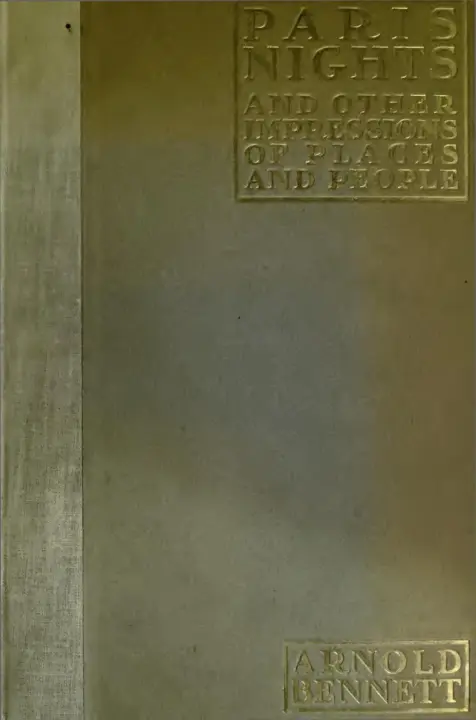
Arnold Bennett
BEHIND THE BOOK
This eBook is for the use of anyone anywhere in the United States and most other parts of the world at no cost and with almost no restrictions whatsoever. You may copy it, give it away or re-use it under the terms of the Project Gutenberg License included with this eBook or online at www.gutenberg.org. If you are not located in the United States, you will have to check the laws of the country where you are located before using this eBook. Read the source licence.
The original source file, including credits and licence, is retained by this library. Request an original-format copy at no charge. Please include the book title and Project Gutenberg identifier #58666.
KEEP YOUR CURIOSITY GOING
Coulson Kernahan

Maurice Baring
Frances Wright
Cécile Tormay

Frederic Jesup Stimson

W. H. P. (William Henry Pope) Jarvis