THE CLASSIC COLLECTION✦An outlaw’s diary: the CommuneCLASSIC FREE BOOKS
An outlaw’s diary: the Commune
Cécile Tormay
THE CLASSIC COLLECTION · 1913
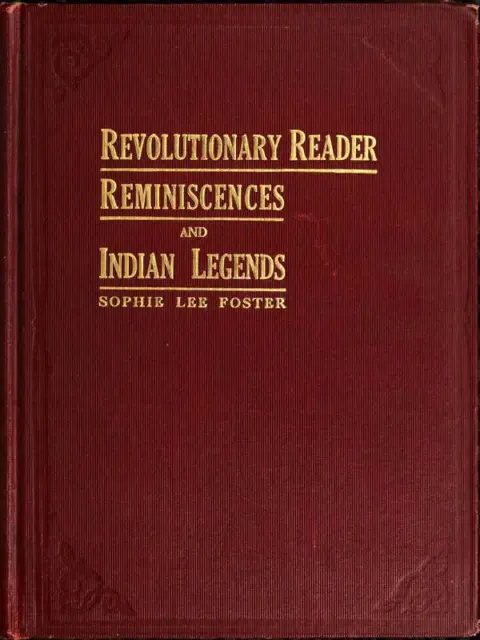
"Revolutionary Reader: Reminiscences and Indian Legends" by Sophie Lee Foster is a historical compilation written in the early 20th century. This work serves as a collection of stories and accounts from the Revolutionary period in American history, emphasizing notable figures and events, particularly in Georgia. With contributions from various authors, it delves into themes of patriotism, women's roles, Indian legends, and the struggles for independence, aiming to educate and inspire a new generation about the American Revolution. The opening of this collection introduces the reader to the author's ambitious mission to foster a deeper understanding of revolutionary history through engaging narratives. It lays the groundwork for a variety of pieces featuring significant events such as Washington's inauguration, battles like Lexington and Concord, and biographical sketches of pivotal figures like James Oglethorpe and Patrick Henry. The dedication to the Daughters of the American Revolution highlights the book's intent to preserve and share this important heritage, while the preface explains its role as a supplementary reader for educational purposes.
Introduction adapted from the source catalogue; source summaries may be automatically generated.
Free to read · English · 115,669 words · No account needed
MAKE TIME FOR A GOOD BOOK
On by default. Untick to stop anonymous reading totals. Each page counts after 10 seconds in view. How this works.
Anonymous counting is on unless you have switched it off.
"While the communities of the sea coast were yet in a fever heat from the uprising against the stamp act, the first explorers were toiling painfully to Kentucky, and the first settlers were building their palisaded hamlets on the banks of the Wautauga. The year that saw the first Continental Congress saw also the short grim tragedy of Lord Dunmore's war. The battles of the Revolution were fought while Boone and his comrades were laying the foundation of their Commonwealth. Hitherto the two chains of events had been only remotely connected, but in 1776, the year of the Declaration of Independence, the struggle between the king and his rebellious subjects shook the whole land and the men of the western border were drawn headlong into the full current of the Revolutionary war. From that moment our politics became national, and the fate of each portion of our country was thenceforth in some sort dependent upon the welfare of every other. Each section had its own work to do; the east won independence while the west began to conquer the continent, yet the deeds of each were of vital consequence to the other. The Continentals gave the west its freedom, and took in return, for themselves and their children, a share of the land that had been conquered and held by the scanty bands of tall backwoodsmen."
Kentucky had been settled chiefly through Daniel Boone's instrumentality in the year that saw the first fighting of the Revolution, and had been added to Virginia by the strenuous endeavors of Major George Rogers Clark of Albermarle, Virginia, whose far seeing and ambitious soul prompted him to use it as a base from which to conquer the vast region northwest of the Ohio. "The country beyond the Ohio was not like Kentucky, a tenantless and debatable hunting ground. It was the seat of powerful and warlike Indian confederacies, and of cluster of ancient French hamlets which had been founded generations before Kentucky pioneers were born. It also contained forts that were garrisoned and held by the soldiers of the British king." It is true that Virginia claimed this territory under the original grant in her charter, but it was almost an unknown and foreign land, and could only be held by force. Clark's scheming brain and bold heart had long been planning its conquest. He looked about to see from whence came the cause of the Indian atrocities on the whole American frontier, and like Washington he saw that those Indian movements were impelled by some outside force. He discovered that the British forts of Detroit, Kaskaskia and St. Vincent were the centers from which the Indians obtained their ammunition and arms to devastate the country. He resolved to take these forts. "He knew that it would be impossible to raise a force to capture these forts from the scanty garrisoned forts and villages of Kentucky, though he knew of a few picked men peculiarly suited to his purpose, but fully realized that he would have to go to Virginia for the body of his forces. Accordingly, he decided to lay the case before Patrick Henry, the governor of Virginia. Henry's ardent soul quickly caught the flame from Clark's fiery enthusiasm, but the peril of sending an expedition to such a wild and distant country was so great, and Virginia's forces so exhausted that he could do little beyond lending Clark the weight of his name and influence. Finally though, Henry authorized him to raise seven companies, each of fifty men, who were to act as militia, and to be paid as such. He also advanced him a sum of twelve hundred pounds and gave him an order on the authorities at Pittsburg for boats, supplies and ammunition; while three of the most prominent gentlemen of Virginia, Thomas Jefferson, George Mason and George Wythe, agreed, in writing, to do their part to induce the legislature to grant to each of the adventurers three hundred acres of the conquered land, if they were successful. Clark was given the commission of colonel with the instruction to raise his men from the frontier counties west of the Blue Ridge, so as not to weaken the sea coast region in their struggle against the British." To this instruction he did not strictly adhere. There was a company of soldiers from Bedford County, Virginia, under his command, a list of whose names are on our county records. Two of these are connections of the mother of Mrs. R. B. Clayton, the regent of the Peaks of Otter Chapter of Virginia Daughters, which facts enhance our pride and interest in the capture of the western forts by Colonel Clark, which perhaps, prevented a vast and beautiful region of our country from being a part of a then foreign and hostile empire.
Your reading position is saved on this browser. Take it to another device with a library code. Reading pages adapt to text, rather than matching a printed edition.
BEHIND THE BOOK
This eBook is for the use of anyone anywhere in the United States and most other parts of the world at no cost and with almost no restrictions whatsoever. You may copy it, give it away or re-use it under the terms of the Project Gutenberg License included with this eBook or online at www.gutenberg.org. If you are not located in the United States, you will have to check the laws of the country where you are located before using this eBook. Read the source licence.
The original source file, including credits and licence, is retained by this library. Request an original-format copy at no charge. Please include the book title and Project Gutenberg identifier #46400.
KEEP YOUR CURIOSITY GOING
Cécile Tormay

Moritz Busch
John L. Ransom

Maurice Baring
Frances Wright
Cécile Tormay