THE CLASSIC COLLECTION✦Plays and controversiesCLASSIC FREE BOOKS
Plays and controversies
W. B. (William Butler) Yeats
THE CLASSIC COLLECTION · 1916
"Reveries over Childhood and Youth" by W. B. Yeats is a reflective memoir written in the early 20th century. The work delves into Yeats's childhood and youth, exploring his formative experiences, memories, and the emotional world that shaped him. This autobiographical account offers insights into significant relationships, particularly with his grandparents, and how these dynamics influenced his understanding of life and art. The opening of the memoir sets the tone for Yeats's exploration of his early memories, which are presented as fragmented and emotional recollections rather than a linear narrative. He reflects on moments of joy and sorrow, detailing vivid memories such as observing childhood scenes through windows, playing with relatives, and the profound impact of his grandfather's stoic presence. Yeats describes both the beauty and the pain of childhood, capturing his feelings of awe towards nature and his complex emotions surrounding love, loss, and innocence. As he weaves these memories together, he hints at the profound influence this period had on his later artistic expressions and philosophical musings.
Introduction adapted from the source catalogue; source summaries may be automatically generated.
Free to read · English · 31,987 words · No account needed
MAKE TIME FOR A GOOD BOOK
On by default. Untick to stop anonymous reading totals. Each page counts after 10 seconds in view. How this works.
Anonymous counting is on unless you have switched it off.
The only lessons I had ever learned were those my father taught me, for he terrified me by descriptions of my moral degradation and he humiliated me by my likeness to disagreeable people; but presently I was sent to school at Hammersmith. It was a Gothic building of yellow brick: a large hall full of desks, some small class-rooms and a separate house for boarders, all built perhaps in 1840 or 1850. I thought it an ancient building and that it had belonged to the founder of the school, Lord Godolphin, who was romantic to me because there was a novel about him. I never read the novel, but I thought only romantic people were put in books. On one side, there was a piano factory of yellow brick, upon two sides half finished rows of little shops and villas all yellow brick, and on the fourth side, outside the wall of our playing field, a brickfield of cinders and piles of half-burned yellow bricks. All the names and faces of my school-fellows have faded from me except one name without a face and the face and name of one friend, mainly no doubt because it was all so long ago, but partly because I only seem to remember things that have mixed themselves up with scenes that have some quality to bring them again and again before the memory. For some days, as I walked homeward along the Hammersmith Road, I told myself that whatever I most cared for had been taken away. I had found a small, green-covered book given to my father by a Dublin man of science; it gave an account of the strange sea creatures the man of science had discovered among the rocks at Howth or dredged out of Dublin Bay. It had long been my favourite book; and when I read it I believed that I was growing very wise, but now I should have no time for it nor for my own thoughts. Every moment would be taken up learning or saying lessons or walking between school and home four times a day, for I came home in the middle of the day for dinner. But presently I forgot my trouble, absorbed in two things I had never known, companionship and enmity. After my first day's lesson, a circle of boys had got around me in a playing field and asked me questions, "who's your father?" "what does he do?" "how much money has he?" Presently a boy said something insulting. I had never struck anybody or been struck, and now all in a minute, without any intention upon my side, but as if I had been a doll moved by a string, I was hitting at the boys within reach and being hit. After that I was called names for being Irish, and had many fights and never, for years, got the better of any one of them; for I was delicate and had no muscles. Sometimes, however, I found means of retaliation, even of aggression. There was a boy with a big stride, much feared by little boys, and finding him alone in the playing field, I went up to him and said, "rise upon Sugaun and sink upon Gad." "What does that mean?" he said. "Rise upon hay-leg and sink upon straw," I answered and told him that in Ireland the sergeant tied straw and hay to the ankles of a stupid recruit to show him the difference between his legs. My ears were boxed, and when I complained to my friends, they said I had brought it upon myself; and that I deserved all I got. I probably dared myself to other feats of a like sort, for I did not think English people intelligent or well-behaved unless they were artists. Everyone I knew well in Sligo despised Nationalists and Catholics, but all disliked England with a prejudice that had come down perhaps from the days of the Irish Parliament. I knew stories to the discredit of England, and took them all seriously. My mother had met some English woman who did not like Dublin because the legs of the men were too straight, and at Sligo, as everybody knew, an Englishman had once said to a car-driver, "if you people were not so lazy, you would pull down the mountain and spread it out over the sand and that would give you acres of good fields." At Sligo there is a wide river mouth and at ebb tide most of it is dry sand, but all Sligo knew that in some way I cannot remember it was the spreading of the tide over the sand that left the narrow channel fit for shipping. At any rate the carman had gone chuckling all over Sligo with his tale. People would tell it to prove that Englishmen were always grumbling. "They grumble about their dinners and everything--there was an Englishman who wanted to pull down Knock-na-Rea" and so on. My mother had shown them to me kissing at railway stations, and taught me to feel disgust at their lack of reserve, and my father told how my grandfather, William Yeats, who had died before I was born, when he came home to his Rectory in County Down from an English visit, spoke of some man he had met on a coach road who "Englishman-like" told him all his affairs. My father explained that an Englishman generally believed that his private affairs did him credit, while an Irishman, being poor and probably in debt, had no such confidence. I, however, did not believe in this explanation. My Sligo nurses, who had in all likelihood the Irish Catholic political hatred, had never spoken well of any Englishman.
Your reading position is saved on this browser. Take it to another device with a library code. Reading pages adapt to text, rather than matching a printed edition.
W. B. (William Butler) Yeats
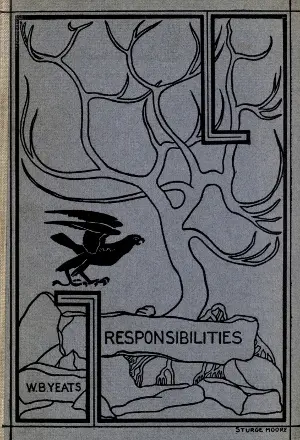
W. B. (William Butler) Yeats
W. B. (William Butler) Yeats
W. B. (William Butler) Yeats
BEHIND THE BOOK
This eBook is for the use of anyone anywhere in the United States and most other parts of the world at no cost and with almost no restrictions whatsoever. You may copy it, give it away or re-use it under the terms of the Project Gutenberg License included with this eBook or online at www.gutenberg.org. If you are not located in the United States, you will have to check the laws of the country where you are located before using this eBook. Read the source licence.
The original source file, including credits and licence, is retained by this library. Request an original-format copy at no charge. Please include the book title and Project Gutenberg identifier #33348.
KEEP YOUR CURIOSITY GOING
John L. Ransom

Herman W. Mudgett

Harriet Monroe
Daniel Dulany Addison
Charles Lanman

Harold Rosher