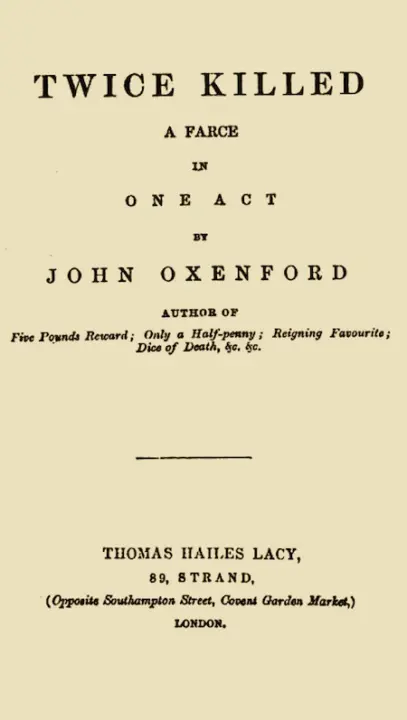
Twice Killed: A Farce in One Act
John Oxenford
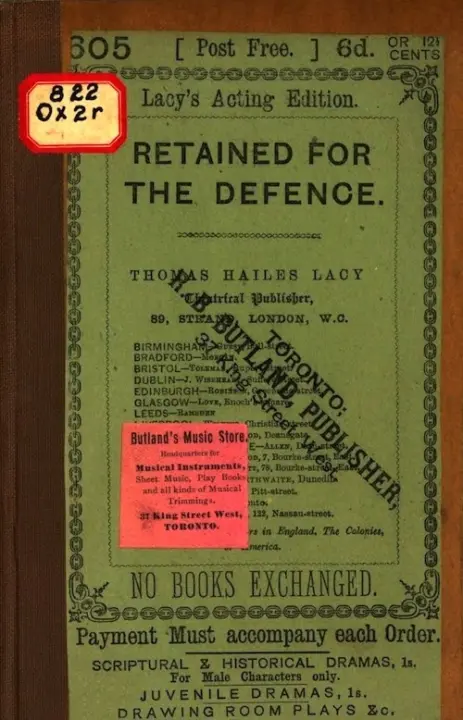
THE CLASSIC COLLECTION · 1859
"Retained for the Defence: A Farce, in One Act" by John Oxenford is a comedic play written in the mid-19th century, likely during the Victorian era. This work is a farce, a genre characterized by exaggerated and improbable situations, and focuses on the comedic entanglements in a social setting. The narrative revolves around themes of mistaken identity and the absurdity of social distinctions, showcasing how appearances can be deceiving. The plot unfolds at an evening party hosted by Mr. De Windsor, who has just returned from watching a court case where a man named Pawkins was acquitted of theft, having been wrongfully accused. Eager to stand by the “innocent” Pawkins, De Windsor invites him to his party, leading to a series of humorous misunderstandings. The character of Whitewash, a barrister who defended Pawkins, finds himself tangled in a web of deception and comedy as De Windsor insists on marrying his daughter to him, believing he’s a noble defender of virtue. As the story unfolds, Pawkins inadvertently becomes the center of attention, while various characters' true intentions are hilariously revealed, ultimately culminating in a farcical resolution that highlights the ridiculousness of the societal situation.
Introduction adapted from the source catalogue; source summaries may be automatically generated.
Free to read · English · 6,875 words · No account needed
MAKE TIME FOR A GOOD BOOK
On by default. Untick to stop anonymous reading totals. Each page counts after 10 seconds in view. How this works.
Anonymous counting is on unless you have switched it off.
PAWKINS. (wringing his hand) Thank you; but draw it a little mild.
DE W. (L.) Mr. Pawkins, you are one of the men I like.
PAWKINS. Same to you, sir. You are Mr. De--de--fancy soap line, sir?
DE W. De Windsor.
PAWKINS. Well then, sir, two minutes ago I told the young 'oman she was a credit to you, and now I don't mind telling you you're a credit to the young 'oman.
DE W. (aside) Somewhat coarse; but frank and genial.
PAWKINS. You've sent me a sort o' note, sir, as the saying is, asking me to come here; but it strikes me there's some mistake.
DE W. Not in the least, Mr. Pawkins, not in the least. Take a seat.
PAWKINS. (sits, R. after putting down umbrella, R.) That's all right then. At all events I've brought the tongs in my pocket.
DE W. The tongs?--rather a singular proceeding!--and the shovel?
PAWKINS. No; get out with you--I mean the curling irons.
DE W. (coldly) I--I begin to comprehend; Mr. Pawkins, you are a
hair-dresser.
PAWKINS. No; that's where you put your foot in it. I ain't a regular hair-dresser for a nobby concern like this. I cuts a little in the common way, but I am chiefly in the easy shaving line.
DE W. I understand, you keep a hair-cutting saloon frequented by
gentlemen only.
PAWKINS. I calls it a shop, sir, but if you calls it a s'loon it's werry kind on you, and I'm much obliged, and if you calls my customers gen'leman, they ought to be werry much obliged to you too.
DE W. (aside) Ha! I wish he had been a little higher in the social scale--but no matter. His wrongs have been extraordinary, society owes him an extraordinary reparation. Mr. Pawkins, I trust Mrs. Pawkins and the children are quite well?
PAWKINS. Mrs. Pawkins and the children--ha, ha, ha! Them's as well as
can be expected.
DE W. I see--a recent increase to the family.
PAWKINS. Recent gammon! Why there ain't no Mrs. Pawkins--there ain't
even a young un.
DE W. Bless me! (aside) I'm sure Whitewash talked about small
children.
WHITEWASH runs in C. from L.
WHITE. Mr. De Windsor, sir--(aside) Egad! the rascal's in full confab. Sir----(pushes himself between PAWKINS and DE WINDSOR, C.)
PAWKINS. (R.) Why, I'm blest if here ain't my professional gen'leman!
DE W. (L.) Ah, sir, Mr. Whitewash is your true friend.
PAWKINS. No mistake about that! No, Mr. Whitewash, I'm a poor man, but if there's any way of shewing my gratitude----
Your reading position is saved on this browser. Take it to another device with a library code. Reading pages adapt to text, rather than matching a printed edition.
John Oxenford
BEHIND THE BOOK
This eBook is for the use of anyone anywhere in the United States and most other parts of the world at no cost and with almost no restrictions whatsoever. You may copy it, give it away or re-use it under the terms of the Project Gutenberg License included with this eBook or online at www.gutenberg.org. If you are not located in the United States, you will have to check the laws of the country where you are located before using this eBook. Read the source licence.
The original source file, including credits and licence, is retained by this library. Request an original-format copy at no charge. Please include the book title and Project Gutenberg identifier #49296.
KEEP YOUR CURIOSITY GOING
Maurice Baring
W. B. (William Butler) Yeats
Edward Martyn

John Brougham & Charlotte Brontë
Marguerite Merington
Leonid Andreyev