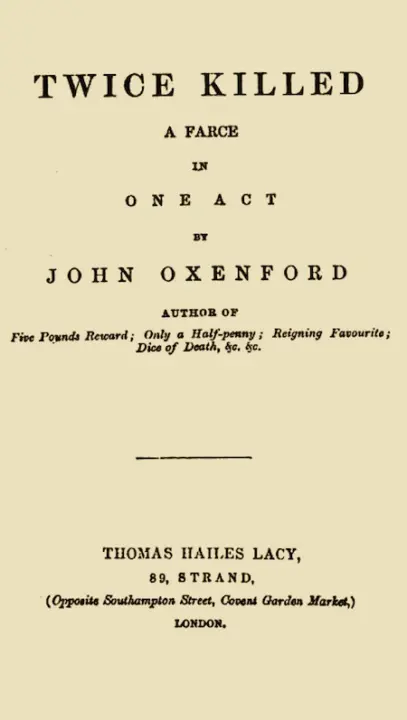
Twice Killed: A Farce in One Act
John Oxenford
THE CLASSIC COLLECTION · 1859
"Retained for the Defence: A Farce, in One Act" by John Oxenford is a comedic play written in the mid-19th century, likely during the Victorian era. This work is a farce, a genre characterized by exaggerated and improbable situations, and focuses on the comedic entanglements in a social setting. The narrative revolves around themes of mistaken identity and the absurdity of social distinctions, showcasing how appearances can be deceiving. The plot unfolds at an evening party hosted by Mr. De Windsor, who has just returned from watching a court case where a man named Pawkins was acquitted of theft, having been wrongfully accused. Eager to stand by the “innocent” Pawkins, De Windsor invites him to his party, leading to a series of humorous misunderstandings. The character of Whitewash, a barrister who defended Pawkins, finds himself tangled in a web of deception and comedy as De Windsor insists on marrying his daughter to him, believing he’s a noble defender of virtue. As the story unfolds, Pawkins inadvertently becomes the center of attention, while various characters' true intentions are hilariously revealed, ultimately culminating in a farcical resolution that highlights the ridiculousness of the societal situation.
Introduction adapted from the source catalogue; source summaries may be automatically generated.
Free to read · English · 6,875 words · No account needed
MAKE TIME FOR A GOOD BOOK
On by default. Untick to stop anonymous reading totals. Each page counts after 10 seconds in view. How this works.
Anonymous counting is on unless you have switched it off.
THWAITES. And I'll listen if you talk for an hour. If I take up the newspaper, is it to read about politics? No! About plays?--No, I should rather think not! About pictures? bother, no! I look to see if Mr. Whitewash has been saying something for some poor devil in the Central Criminal Court. That's my intellectual treat!
WHITE. (flattered) Indeed! ha! ha! Really, my dear Miss de Windsor we should do wrong to check this diffusion of intelligence among the masses.
Enter DE WINDSOR, C. from L. C.
DE W. He is here--is he--the dear boy. I must shake him by the hand. (rushes forward, R. C. and grasps THWAITES by the hand) Eh! ha! ha! You're not Whitewash! Ridiculous! I'm always making myself ridiculous; I've too much heart. You feel what I mean, Whitewash. (shakes his hand violently) You feel what I mean.
WHITE. (L. C.) Most acutely! (wringing his hand)
DE W. I'm so glad you are here before the others. Leave the room, Thwaites. (THWAITES lingers, moving at back to C.) I can now disburden my heart. As I said, I'm all heart. (THWAITES advances, C.) Leave the room, Thwaites! (THWAITES goes up, and moves chair from R. to C.) This moment is the most important--Zounds! Thwaites, will you leave the room?
THWAITES. (aside, going up, C.) That's the man of money. Give me the
man of mind!
Exit, C., off, L.
DE W. (coming to C.) Now look, I hesitate no longer; I shilly-shally no longer; I follow the dictates of my heart, and my heart tells me to--Come here, Whitewash--come here, Aggy. (joins their hands) Whitewash, consider yourself as my son-in-law.
AGATHA. Really, this is very sudden, 'pa.
DE W. Of course it is; I'm always sudden, I'm a creature of impulse. But do you dislike the arrangement?
AGATHA. I did not say that, 'pa.
DE W. Didn't say that, 'pa! Then why don't you speak out? Wear your mind in your face, as I do, or as my young friend here, with whom I want to speak a few words in private. So, go and see how they are getting on with the coffee.
WHITE. (R.) And don't forget, that you are engaged to me for the first set, and the Polka, and the Lancers.
DE W. Of course, she won't forget. Run along child.
Exit, AGATHA, C., off, L.
Now, I can give vent to my feelings; Whitewash, you've done it. I was long making up my mind, but now, you've done it. You are one of the men I like. (shakes his hand violently--they sit)
WHITE. My dear sir, I'm most happy. (wringing his hand)
Your reading position is saved on this browser. Take it to another device with a library code. Reading pages adapt to text, rather than matching a printed edition.
John Oxenford
BEHIND THE BOOK
This eBook is for the use of anyone anywhere in the United States and most other parts of the world at no cost and with almost no restrictions whatsoever. You may copy it, give it away or re-use it under the terms of the Project Gutenberg License included with this eBook or online at www.gutenberg.org. If you are not located in the United States, you will have to check the laws of the country where you are located before using this eBook. Read the source licence.
The original source file, including credits and licence, is retained by this library. Request an original-format copy at no charge. Please include the book title and Project Gutenberg identifier #49296.
KEEP YOUR CURIOSITY GOING
Maurice Baring
W. B. (William Butler) Yeats
Edward Martyn

John Brougham & Charlotte Brontë
Marguerite Merington
Leonid Andreyev