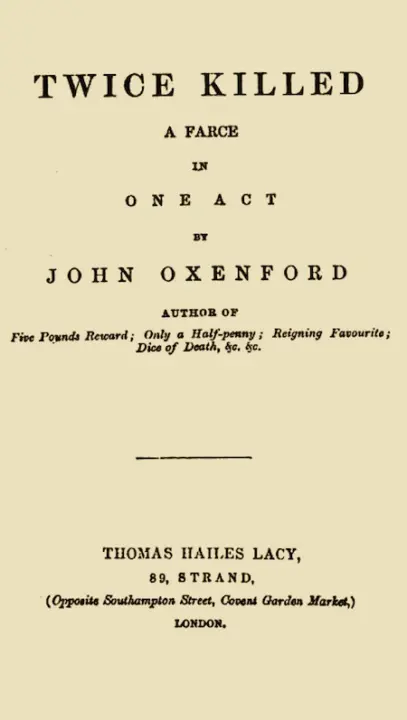
Twice Killed: A Farce in One Act
John Oxenford
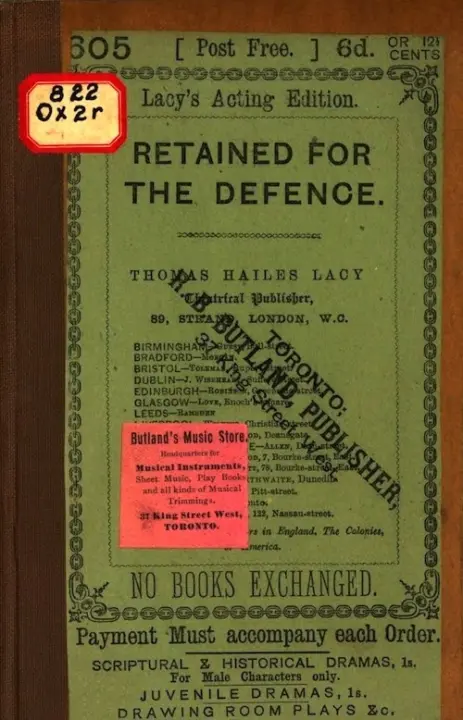
THE CLASSIC COLLECTION · 1859
"Retained for the Defence: A Farce, in One Act" by John Oxenford is a comedic play written in the mid-19th century, likely during the Victorian era. This work is a farce, a genre characterized by exaggerated and improbable situations, and focuses on the comedic entanglements in a social setting. The narrative revolves around themes of mistaken identity and the absurdity of social distinctions, showcasing how appearances can be deceiving. The plot unfolds at an evening party hosted by Mr. De Windsor, who has just returned from watching a court case where a man named Pawkins was acquitted of theft, having been wrongfully accused. Eager to stand by the “innocent” Pawkins, De Windsor invites him to his party, leading to a series of humorous misunderstandings. The character of Whitewash, a barrister who defended Pawkins, finds himself tangled in a web of deception and comedy as De Windsor insists on marrying his daughter to him, believing he’s a noble defender of virtue. As the story unfolds, Pawkins inadvertently becomes the center of attention, while various characters' true intentions are hilariously revealed, ultimately culminating in a farcical resolution that highlights the ridiculousness of the societal situation.
Introduction adapted from the source catalogue; source summaries may be automatically generated.
Free to read · English · 6,875 words · No account needed
MAKE TIME FOR A GOOD BOOK
On by default. Untick to stop anonymous reading totals. Each page counts after 10 seconds in view. How this works.
Anonymous counting is on unless you have switched it off.
WHITE. Ha! the case is desperate, and a desperate effort must be made.
AGATHA and several GUESTS enter from L. C., and form an AUDIENCE, R.
Listen, all parties present.
DE W. (R. C.) Well, talk away, and make the best of it.
WHITE. Look at the face of this worthy man. Pawkins, get into the dock! (places him on chair, L., and turns another chair round to lean on, &c.) Examine every lineament.
PAWKINS. (on chair, L.) Come, come, you do make one look such a
fool!
WHITE. (L. C.) Believe me, this excellent man is one of those rare natures that are seldom to be found. Ask the independent electors of Marylebone, whom they would place in the van.
PAWKINS. I've been in the wan!
WHITE. Whom they would place in the van as the staunchest champion of their interests. They will answer Pawkins! Ask the poor----(takes tongs from his own pocket)
PAWKINS. Them's my tongs!
WHITE. (throws them on table) Ask the poor--the suffering poor--whom they regard as their kindest benefactor. They will answer--Pawkins. (aside to him) Cry!
PAWKINS. I can't! I say, ain't you pitching it raither too strong!
WHITE. They say we were found in a cupboard at three o'clock in the morning. Well, we admit the trivial fact, we were in the cupboard.
PAWKINS. No, no, no!
WHITE. Though we have every high virtue, we are still but human; we have hearts not altogether unsusceptible to female beauty. (FERGUSON comes forward, R., in great agitation) Do you now persist in asking why we were in the cupboard? Well, then, we were there for the sake of one of the fair sex.
FERGUS. But, sir, there is a husband----
PAWKINS. Now he's done it!
WHITE. A husband! Do you call that a husband? As Mr. Justice Blesswell remarked in the great divorce case of Martyr v. Bangwife--such a wretch is not worthy the name of a husband. A man who indulges in large potations--comes home at little hours--and is limited in his notions of crinoline! (bangs chair during speech, then turns it and sits)
PAWKINS. He'll smash that ere chair!
FERGUS. But, sir, I'm the husband----
WHITE. (rises and goes to PAWKINS) That's awkward!
PAWKINS. Yes; it is awkward!
WHITE. But we won't flinch! Mr. De Windsor, I must say your society is not the most select. (pulls chair from under PAWKINS)
FERGUS. (crossing to L., and collaring PAWKINS) And now, you
villain--you destwoyer of my domestic peace--what have you to say for
yourself?
Your reading position is saved on this browser. Take it to another device with a library code. Reading pages adapt to text, rather than matching a printed edition.
John Oxenford
BEHIND THE BOOK
This eBook is for the use of anyone anywhere in the United States and most other parts of the world at no cost and with almost no restrictions whatsoever. You may copy it, give it away or re-use it under the terms of the Project Gutenberg License included with this eBook or online at www.gutenberg.org. If you are not located in the United States, you will have to check the laws of the country where you are located before using this eBook. Read the source licence.
The original source file, including credits and licence, is retained by this library. Request an original-format copy at no charge. Please include the book title and Project Gutenberg identifier #49296.
KEEP YOUR CURIOSITY GOING
Maurice Baring
W. B. (William Butler) Yeats
Edward Martyn

John Brougham & Charlotte Brontë
Marguerite Merington
Leonid Andreyev