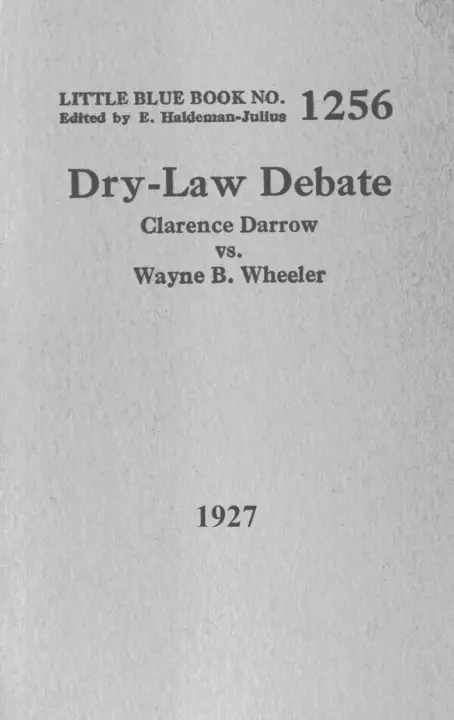
Dry-law debate
Clarence Darrow & Wayne Bidwell Wheeler
THE CLASSIC COLLECTION · 1902
"Resist not evil" by Clarence Darrow is a political-philosophical treatise written in the early 20th century. It contends that states, armies, and courts are instruments of force, that punishment fails to reform or deter, and that non-resistance and humane solidarity offer the only rational path to social health. The opening of the treatise acknowledges Tolstoy’s influence and sets out a case for non-resistance by tracing the state’s origins to conquest and its modern continuity through armies, police, courts, and prisons. It argues that militarism burdens and brutalizes society, patriotism indoctrinates obedience, and standing armies chiefly exist to control domestic workers rather than repel foreign foes. Civil government is presented as militarism in disguise, enforcing property and class rule; punishment is portrayed as vengeance masquerading as justice, with shifting definitions of crime and arbitrary, harmful penalties. Early chapters attack deterrence—highlighting the brutalizing effect of public executions and the futility of prisons—and reframe crime as a social disease rooted in poverty, environment, and heredity, noting rises in “crime” in winter, hard times, and overcrowded old countries. They conclude that just judgment is impossible, proportional punishment cannot be measured, and state penalties multiply suffering by injuring families and communities, whereas food, opportunity, and kindness would address causes.
Introduction adapted from the source catalogue; source summaries may be automatically generated.
Free to read · English · 28,198 words · No account needed
MAKE TIME FOR A GOOD BOOK
On by default. Untick to stop anonymous reading totals. Each page counts after 10 seconds in view. How this works.
Anonymous counting is on unless you have switched it off.
The abolition of public hangings may speak something for the sensitiveness, or at least, the squeamishness of the state. But it is evident that all of this is a terrible admission of guilt upon the part of those who uphold this crime. It is possible that one might believe at least in the sincerity of those who argue that punishment prevents crime, if these terrible scenes of violence were carried out in open day before the multitude, and fully understood and discussed in all their harrowing, shocking details of cruelty and blood. If the sight of punishment terrorizes men from the commission of crime then, of course, punishment should be as open as the day. In so far as the state is successful in keeping secret the execution of its victim, in this far does it abandon every claim of prevention and rests its case for punishment on vengeance and cruelty alone. The rulers of this generation, who are ashamed of their deeds, may be wiser and more sensitive than those of the last, but our ancestors, although less refined, were much more logical and infinitely more honest than are we.
The whole question of punishment is not only proven but fully admitted by our rulers in their dealings with the death penalty. It is now everywhere admitted that the brutalizing effects of public executions are beyond dispute. It was only after the completest evidence that the believers in the beneficence of punishment and violence abandoned public executions, for to abandon these was to utterly abandon the principle on which all punishment is based.
It would, of course, be impossible to prove the exact result of a public execution. Somewhere in a quiet rural community, growing out of sudden passion or some unexplained and temporary aberration, a man takes the life of his fellow man. To the shock incident to this fatal act is added a long public trial in the courts where every detail is distorted and magnified and passed from tongue to tongue until even the lisping babe is thoroughly familiar with every circumstance of the case with all its harrowing details iterated and reiterated again and again. There grows up in the public mind a bitter hatred against the unfortunate victim whose antecedents, life and motives they can in no way understand or judge. It is really believed that no one has the right to look upon this person with any feeling save that of hatred, and the least word of pity or sign of sympathy for the outcast is set down as sickly sentimentalism and the mark of mental and spiritual disease. Weeks and months, sometimes even years, elapse in the slow and unending process of the courts. The whole tragedy has been well nigh forgot, at least it no longer has any vital effect upon the community. Finally it is announced that on a certain day a public hanging will take place. Once more every detail of the tragedy is recalled to the public mind; once more each man conjures up a monster in the place of the hunted, weak, doomed victim whose act no one either fathoms or seeks to understand. A sightly spot is chosen perhaps upon the village green. For several days men are kept busy erecting a strange and ominous machine; the old men and women, the middle aged, the boys and girls, the little children, even the toddling babes, filled with curiosity watch the work and discuss every detail of the weird and fatal trap. At length the day arrives for the majesty of the law to vindicate itself. From every point of the compass comes a great throng of both sexes, all conditions and ages, each to witness the most startling event of their lives; children are there, babes in arms, and even the unborn. A rope is tied around a beam, a noose is formed of the other end, a trembling, helpless, frantic, friendless victim is led up the steps, placed on a trap, his hands and feet are bound, a black cap is pulled down to hide his face, the noose is securely fastened around his neck below his ears. The crowd watches breathless with suspense, the signal is given, the trap opens, the man falls through space, he is caught in mid-air by the rope tightening about his neck, and strangling him to death. His body heaves, his legs and arms move with violent convulsions, he swings a few minutes in mid-air before the crowd, a ghastly human pendulum moving back and forth, the mortal body of a man created in the image of God whom the state has led out and killed to show the glory and majesty of law!
Your reading position is saved on this browser. Take it to another device with a library code. Reading pages adapt to text, rather than matching a printed edition.
Clarence Darrow & Wayne Bidwell Wheeler
Clarence Darrow
Clarence Darrow
Clarence Darrow
BEHIND THE BOOK
This eBook is for the use of anyone anywhere in the United States and most other parts of the world at no cost and with almost no restrictions whatsoever. You may copy it, give it away or re-use it under the terms of the Project Gutenberg License included with this eBook or online at www.gutenberg.org. If you are not located in the United States, you will have to check the laws of the country where you are located before using this eBook. Read the source licence.
The original source file, including credits and licence, is retained by this library. Request an original-format copy at no charge. Please include the book title and Project Gutenberg identifier #76531.
KEEP YOUR CURIOSITY GOING

David Patterson (Spirit) Hatch
Coulson Kernahan

Ralph Waldo Emerson
Frances Wright

Edwin Abbott Abbott

Joseph Droz