THE CLASSIC COLLECTION✦Obiter Dicta: Second SeriesCLASSIC FREE BOOKS
Obiter Dicta: Second Series
Augustine Birrell
THE CLASSIC COLLECTION · 1892
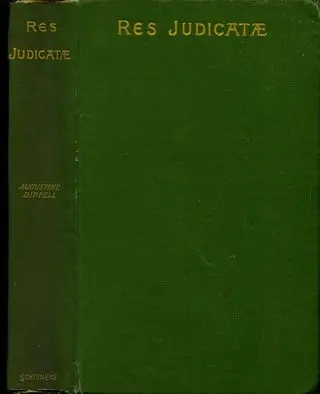
"Res Judicatæ: Papers and Essays" by Augustine Birrell is a collection of essays written in the late 19th century. The work showcases Birrell's reflections and lectures on various literary figures, including Samuel Richardson and Edward Gibbon, among others. Through these essays, the author offers insights into the lives, works, and influences of these key literary figures, providing a blend of biographical narrative and critical analysis. At the start of the book, Birrell introduces Samuel Richardson with a consideration of the challenges in describing mankind, emphasizing the division between those who appreciate Richardson's novels and those who do not. He critiques the cultural disdain faced by Richardson, notably how his character as a respectable printer has led to ridicule despite the emotional depth and realism in his novels, particularly "Pamela" and "Clarissa." Birrell elaborates on Richardson's nonconformity to literary traditions of his time, discussing how his life and works reflect a different approach to storytelling, focusing on sentiment and morality.
Introduction adapted from the source catalogue; source summaries may be automatically generated.
Free to read · English · 58,473 words · No account needed
MAKE TIME FOR A GOOD BOOK
On by default. Untick to stop anonymous reading totals. Each page counts after 10 seconds in view. How this works.
Anonymous counting is on unless you have switched it off.
I must be permitted to observe that lawyers have been great Richardsonians. The Rev. Mr. Loftus, writing to our author from Ireland, says: 'I will tell you a story about your sweet girl Pamela. Our late lord chancellor,[4] who was a man more remarkable for the goodness of his heart than even for the abilities of his head, which were of the most exalted kind, was so struck with her history that he sat up reading it the whole night, although it was then the middle of term, and declared to his family he could not find it in his heart to quit his book, nor imagined it to be so late by many hours.'
The eminent Sergeant Hill, though averse to literature, used to set Clarissa's will before his pupils, and bid them determine how many of its uses and trusts could be supported in court. I am sorry to have to add that in the learned sergeant's opinion, poor Clarissa, in addition to all her other misfortunes, died intestate.
All this commotion and excitement and Clarissa-worship meant that something was brewing, and that good Mr. Richardson, with his fat, round face flushed with the fire, had his ladle in the pan and was busy stirring it about. What is called the correspondence of Samuel Richardson, which was edited by that admirable woman, Mrs. Barbauld, and published in six volumes in 1804, is mostly made up, not of letters from, but to, the author of Clarissa. All the more effectually on that account does it let us into the manufactory of his mind. The letters a man receives are perhaps more significant of his real character than those he writes. People did not write to Mr. Richardson about themselves or about their business, or about literature, unless it were to say they did not like Tom Jones, or about politics, or other sports, but they wrote to him about himself and his ideas, his good woman, Clarissa, his good man, Sir Charles, and the true relation between the sexes. They are immense fun, these letters, but they ought also to be taken seriously; Mr. Richardson took them as seriously as he always took himself. There was, perhaps, only one subject Richardson regarded as of equal importance with himself, and that was the position of woman. This is why he hated Fielding, the triumphant, orthodox Fielding, to whom man was a rollicking sinner, and woman a loving slave. He pondered on this subject, until the anger within him imparts to his style a virility and piquancy not usually belonging to it. The satire in the following extract from a letter he wrote to the good lady who shed a pint of tears over Clarissa, is pungent: 'Man is an animal that must bustle in the world, go abroad, converse, fight battles, encounter other dangers of seas, winds, and I know not what, in order to protect, provide for, maintain in ease and plenty, women. Bravery, anger, fierceness are made familiar to them. They buffet and are buffeted by the world; are impatient and uncontrollable; they talk of honour, run their heads against stone walls to make good their pretensions to it, and often quarrel with one another and fight duels upon any other silly thing that happens to raise their choler--their shadows if you please; while women are meek, passive, good creatures, who used to stay at home, set their maids at work, and formerly themselves, get their houses in order to receive, comfort, oblige, give joy to their fierce, fighting, bustling, active protectors, providers, maintainers, divert him with pretty pug's tricks, tell him soft tales of love, and of who and who's together, what has been done in his absence, bring to him little master, so like his own dear papa, and little pretty miss, a soft, sweet, smiling soul, with her sampler in her hand, so like what her meek mamma was at her years.'
Your reading position is saved on this browser. Take it to another device with a library code. Reading pages adapt to text, rather than matching a printed edition.
Augustine Birrell
Augustine Birrell
Augustine Birrell
Augustine Birrell
BEHIND THE BOOK
This eBook is for the use of anyone anywhere in the United States and most other parts of the world at no cost and with almost no restrictions whatsoever. You may copy it, give it away or re-use it under the terms of the Project Gutenberg License included with this eBook or online at www.gutenberg.org. If you are not located in the United States, you will have to check the laws of the country where you are located before using this eBook. Read the source licence.
The original source file, including credits and licence, is retained by this library. Request an original-format copy at no charge. Please include the book title and Project Gutenberg identifier #37159.
KEEP YOUR CURIOSITY GOING

David Patterson (Spirit) Hatch

David Patterson (Spirit) Hatch

David Patterson (Spirit) Hatch
Cécile Tormay

Moritz Busch
John L. Ransom