THE CLASSIC COLLECTION✦Obiter Dicta: Second SeriesCLASSIC FREE BOOKS
Obiter Dicta: Second Series
Augustine Birrell
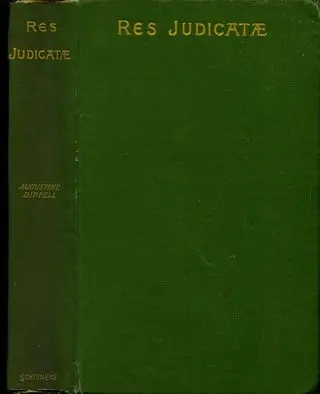
THE CLASSIC COLLECTION · 1892
"Res Judicatæ: Papers and Essays" by Augustine Birrell is a collection of essays written in the late 19th century. The work showcases Birrell's reflections and lectures on various literary figures, including Samuel Richardson and Edward Gibbon, among others. Through these essays, the author offers insights into the lives, works, and influences of these key literary figures, providing a blend of biographical narrative and critical analysis. At the start of the book, Birrell introduces Samuel Richardson with a consideration of the challenges in describing mankind, emphasizing the division between those who appreciate Richardson's novels and those who do not. He critiques the cultural disdain faced by Richardson, notably how his character as a respectable printer has led to ridicule despite the emotional depth and realism in his novels, particularly "Pamela" and "Clarissa." Birrell elaborates on Richardson's nonconformity to literary traditions of his time, discussing how his life and works reflect a different approach to storytelling, focusing on sentiment and morality.
Introduction adapted from the source catalogue; source summaries may be automatically generated.
Free to read · English · 58,473 words · No account needed
MAKE TIME FOR A GOOD BOOK
On by default. Untick to stop anonymous reading totals. Each page counts after 10 seconds in view. How this works.
Anonymous counting is on unless you have switched it off.
'Bring none of these; but let me be
While all around in silence lies,
Moved to the window near, and see
Once more before my dying eyes,
'Bathed in the sacred dews of morn
The wide aerial landscape spread--
The world which was ere I was born,
The world which lasts when I am dead.
'Which never was the friend of one,
Nor promised love it could not give,
But lit for all its generous sun
And lived itself and made us live.
'Then let me gaze--till I become
In soul, with what I gaze on, wed!
To feel the universe my home;
To have before my mind--instead
'Of the sick room, the mortal strife,
The turmoil for a little breath--
The pure eternal course of life,
Not human combatings with death!
'Thus feeling, gazing, let me grow
Composed, refresh'd, ennobled, clear--
Then willing let my spirit go
To work or wait, elsewhere or here!'
To turn from Arnold's poetry to his theological writings--if so grim a name can be given to these productions--from Rugby Chapel to Literature and Dogma, from Obermann to God and the Bible, from Empedocles on Etna to St. Paul and Protestantism, is to descend from the lofty table-lands,
'From the dragon-warder'd fountains
Where the springs of knowledge are,
From the watchers on the mountains
And the bright and morning star,'
to the dusty highroad. It cannot, I think, be asserted that either the plan or the style of these books was in keeping with their subjects. It was characteristic of Mr. Arnold, and like his practical turn of mind, to begin Literature and Dogma in the Cornhill Magazine. A book rarely shakes off the first draft--Literature and Dogma never did. It is full of repetitions and wearisome recapitulations, well enough in a magazine where each issue is sure to be read by many who will never see another number, but which disfigure a book. The style is likewise too jaunty. Bantering the Trinity is not yet a recognised English pastime. Bishop-baiting is, but this notwithstanding, most readers of Literature and Dogma grew tired of the Bishop of Gloucester and Bristol and of his alleged desire to do something for the honour of the Godhead, long before Mr. Arnold showed any signs of weariness. But making all these abatements, and fully admitting that Literature and Dogma is not likely to prove permanently interesting to the English reader, it must be pronounced a most valuable and useful book, and one to which the professional critics and philosophers never did justice. The object of Literature and Dogma was no less than the restoration of the use of the Bible to the sceptical laity. It was a noble object, and it was in a great measure, as thousands of quiet people could testify, attained. It was not a philosophical treatise. In its own way it was the same kind of thing as many of Cardinal Newman's writings. It started with an assumption, namely, that it is impossible to believe in the miracles recorded in the Old and New Testaments. There is no laborious attempt to distinguish between one miracle and another, or to lighten the burden of faith in any particular. Nor is any serious attempt made to disprove miracles. Mr. Arnold did not write for those who find no difficulty in believing in the first chapter of St. Luke's gospel, or the sixteenth chapter of St. Mark's, but for those who simply cannot believe a word of either the one chapter or the other. Mr. Arnold knew well that this inability to believe is apt to generate in the mind of the unbeliever an almost physical repulsion to open books which are full of supernatural events. Mr. Arnold knew this and lamented it. His own love of the Bible was genuine and intense. He could read even Jeremiah and Habakkuk. As he loved Homer with one side of him, so he loved the Bible with the other. He saw how men were crippled and maimed through growing up in ignorance of it, and living all the days of their lives outside its influence. He longed to restore it to them, to satisfy them that its place in the mind of man--that its educational and moral power was not due to the miracles it records nor to the dogmas that Catholics have developed or Calvanists extracted from its pages, but to its literary excellence and to the glow and enthusiasm it has shed over conduct, self-sacrifice, humanity, and holy living. It was at all events a worthy object and a most courageous task. It exposed him to a heavy cross-fire. The Orthodox fell upon his book and abused it, unrestrainedly abused it for its familiar handling of their sacred books. They almost grudged Mr. Arnold his great acquaintance with the Bible, just as an Englishman might be annoyed at finding Moltke acquainted with all the roads from Dover to London. This feeling was natural, and on the whole I think it creditable to the orthodox party that a book so needlessly pain-giving as Literature and Dogma did not goad them into any personal abuse of its author. But they could not away with the book. Nor did the philosophical sceptic like it much better. The philosophical sceptic is too apt to hate the Bible, even as the devil was reported to hate holy water. Its spirit condemns him. Its devout, heart-stirring, noble language creates an atmosphere which is deadly for pragmatic egotism. To make men once more careful students of the Bible was to deal a blow at materialism, and consequently was not easily forgiven. 'Why can't you leave the Bible alone?' they grumbled--'What have we to do with it?' But Pharisees and Sadducees do not exhaust mankind, and Mr. Arnold's contributions to the religious controversies of his time were very far from the barren things that are most contributions, and indeed most controversies on such subjects. I believe I am right when I say that he induced a very large number of persons to take up again and make a daily study of the books both of the Old and the New Testament.
Your reading position is saved on this browser. Take it to another device with a library code. Reading pages adapt to text, rather than matching a printed edition.
Augustine Birrell
Augustine Birrell
Augustine Birrell
Augustine Birrell
BEHIND THE BOOK
This eBook is for the use of anyone anywhere in the United States and most other parts of the world at no cost and with almost no restrictions whatsoever. You may copy it, give it away or re-use it under the terms of the Project Gutenberg License included with this eBook or online at www.gutenberg.org. If you are not located in the United States, you will have to check the laws of the country where you are located before using this eBook. Read the source licence.
The original source file, including credits and licence, is retained by this library. Request an original-format copy at no charge. Please include the book title and Project Gutenberg identifier #37159.
KEEP YOUR CURIOSITY GOING

David Patterson (Spirit) Hatch

David Patterson (Spirit) Hatch

David Patterson (Spirit) Hatch
Cécile Tormay

Moritz Busch
John L. Ransom