THE CLASSIC COLLECTION✦Obiter Dicta: Second SeriesCLASSIC FREE BOOKS
Obiter Dicta: Second Series
Augustine Birrell
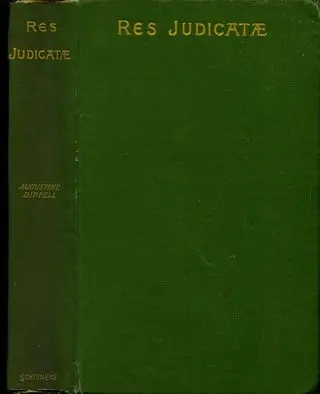
THE CLASSIC COLLECTION · 1892
"Res Judicatæ: Papers and Essays" by Augustine Birrell is a collection of essays written in the late 19th century. The work showcases Birrell's reflections and lectures on various literary figures, including Samuel Richardson and Edward Gibbon, among others. Through these essays, the author offers insights into the lives, works, and influences of these key literary figures, providing a blend of biographical narrative and critical analysis. At the start of the book, Birrell introduces Samuel Richardson with a consideration of the challenges in describing mankind, emphasizing the division between those who appreciate Richardson's novels and those who do not. He critiques the cultural disdain faced by Richardson, notably how his character as a respectable printer has led to ridicule despite the emotional depth and realism in his novels, particularly "Pamela" and "Clarissa." Birrell elaborates on Richardson's nonconformity to literary traditions of his time, discussing how his life and works reflect a different approach to storytelling, focusing on sentiment and morality.
Introduction adapted from the source catalogue; source summaries may be automatically generated.
Free to read · English · 58,473 words · No account needed
MAKE TIME FOR A GOOD BOOK
On by default. Untick to stop anonymous reading totals. Each page counts after 10 seconds in view. How this works.
Anonymous counting is on unless you have switched it off.
He always asserted himself to be a good Liberal. So in truth he was. A better Liberal than many a one whose claim to that title it would be thought absurd to dispute. He did not indeed care very much about some of the articles of the Liberal creed as now professed. He had taken a great dislike to the Deceased Wife's Sister Bill. He wished the Church and the State to continue to recognise each other. He had not that jealousy of State interference in England which used to be (it is so no longer) a note of political Liberalism. He sympathised with Italian national aspirations because he thought it wrong to expect a country with such a past as Italy to cast in her lot with Austria. He did not sympathise with Irish national aspirations because he thought Ireland ought to be willing to admit that she was relatively to England an inferior and less interesting country, and therefore one which had no moral claim for national institutions. He may have been right or wrong on these points without affecting his claim to be considered a Liberal. Liberalism is not a creed, but a frame of mind. Mr. Arnold's frame of mind was Liberal. No living man is more deeply permeated with the grand doctrine of Equality than was he. He wished to see his countrymen and countrywomen all equal: Jack as good as his master, and Jack's master as good as Jack; and neither taking claptrap. He had a hearty un-English dislike of anomalies and absurdities. He fully appreciated the French Revolution and was consequently a Democrat. He was not a democrat from irresistible impulse, or from love of mischief, or from hatred of priests, or like the average British workman from a not unnatural desire to get something on account of his share of the family inheritance--but all roads lead to Rome, and Mr. Arnold was a democrat from a sober and partly sorrowful conviction that no other form of government was possible. He was an Educationalist, and Education is the true Leveller. His almost passionate cry for better middle-class education arose from his annoyance at the exclusion of large numbers of this great class from the best education the country afforded. It was a ticklish job telling this great, wealthy, middle class--which according to the newspapers had made England what she is and what everybody else wishes to be--that it was, from an educational point of view, beneath contempt. 'I hear with surprise,' said Sir Thomas Bazley at Manchester, 'that the education of our great middle class requires improvement.' But Mr. Arnold had courage. Indeed he carried one kind of courage to an heroic pitch. I mean the courage of repeating yourself over and over again. It is a sound forensic maxim: Tell a judge twice whatever you want him to hear. Tell a special jury thrice, and a common jury half-a-dozen times the view of a case you wish them to entertain. Mr. Arnold treated the middle class as a common jury and hammered away at them remorselessly and with the most unblushing iteration. They groaned under him, they snorted, and they sniffed--but they listened, and, what was more to the purpose, their children listened, and with filial frankness told their heavy sires that Mr. Arnold was quite right, and that their lives were dull, and hideous, and arid, even as he described them as being. Mr. Arnold's work as a School Inspector gave him great opportunities of going about amongst all classes of the people. Though not exactly apostolic in manner or method, he had something to say both to and of everybody. The aristocracy were polite and had ways he admired, but they were impotent of ideas and had a dangerous tendency to become studiously frivolous. Consequently the Future did not belong to them. Get ideas and study gravity, was the substance of his discourse to the Barbarians, as, with that trick of his of miscalling God's creatures, he had the effrontery to dub our adorable nobility. But it was the middle class upon whom fell the full weight of his discourse. His sermons to them would fill a volume. Their great need was culture, which he declared to be a study of perfection, the sentiment for beauty and sweetness, the sentiment against hideousness and rawness. The middle class, he protested, needed to know all the best things that have been said and done in the world since it began, and to be thereby lifted out of their holes and corners, private academies and chapels in side streets, above their tenth-rate books and miserable preferences, into the main stream of national existence. The lower orders he judged to be a mere rabble, and thought it was as yet impossible to predict whether or not they would hereafter display any aptitude for Ideas, or passion for Perfection. But in the meantime he bade them learn to cohere, and to read and write, and above all he conjured them not to imitate the middle classes.
Your reading position is saved on this browser. Take it to another device with a library code. Reading pages adapt to text, rather than matching a printed edition.
Augustine Birrell
Augustine Birrell
Augustine Birrell
Augustine Birrell
BEHIND THE BOOK
This eBook is for the use of anyone anywhere in the United States and most other parts of the world at no cost and with almost no restrictions whatsoever. You may copy it, give it away or re-use it under the terms of the Project Gutenberg License included with this eBook or online at www.gutenberg.org. If you are not located in the United States, you will have to check the laws of the country where you are located before using this eBook. Read the source licence.
The original source file, including credits and licence, is retained by this library. Request an original-format copy at no charge. Please include the book title and Project Gutenberg identifier #37159.
KEEP YOUR CURIOSITY GOING

David Patterson (Spirit) Hatch

David Patterson (Spirit) Hatch

David Patterson (Spirit) Hatch
Cécile Tormay

Moritz Busch
John L. Ransom