THE CLASSIC COLLECTION✦Obiter Dicta: Second SeriesCLASSIC FREE BOOKS
Obiter Dicta: Second Series
Augustine Birrell
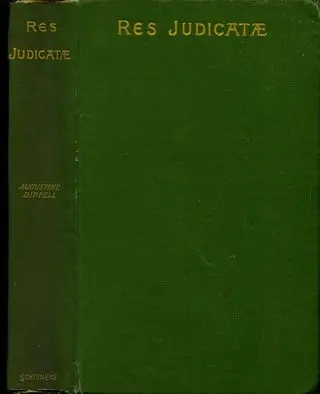
THE CLASSIC COLLECTION · 1892
"Res Judicatæ: Papers and Essays" by Augustine Birrell is a collection of essays written in the late 19th century. The work showcases Birrell's reflections and lectures on various literary figures, including Samuel Richardson and Edward Gibbon, among others. Through these essays, the author offers insights into the lives, works, and influences of these key literary figures, providing a blend of biographical narrative and critical analysis. At the start of the book, Birrell introduces Samuel Richardson with a consideration of the challenges in describing mankind, emphasizing the division between those who appreciate Richardson's novels and those who do not. He critiques the cultural disdain faced by Richardson, notably how his character as a respectable printer has led to ridicule despite the emotional depth and realism in his novels, particularly "Pamela" and "Clarissa." Birrell elaborates on Richardson's nonconformity to literary traditions of his time, discussing how his life and works reflect a different approach to storytelling, focusing on sentiment and morality.
Introduction adapted from the source catalogue; source summaries may be automatically generated.
Free to read · English · 58,473 words · No account needed
MAKE TIME FOR A GOOD BOOK
On by default. Untick to stop anonymous reading totals. Each page counts after 10 seconds in view. How this works.
Anonymous counting is on unless you have switched it off.
The position, therefore, of Richardson in our literature is that of a great Nonconformist. He was not manufactured according to any established process. If I may employ a metaphor borrowed from his own most honourable craft, he was set up in a new kind of type. He was born in 1689 in a Derbyshire village, the name of which, for some undiscovered reason, he would never tell. The son of poor parents--his father was a joiner--he had never any but a village school education, nor did he in later life worry much about learning, or seek, as so many printers have done, to acquire foreign tongues. At fourteen years of age he was bound apprentice to a printer in Aldersgate Street, and for seven years toiled after a fashion which would certainly nowadays be forbidden by Act of Parliament, were there the least likelihood of anybody either demanding or performing drudgery so severe. When out of his apprenticeship, he worked for eight years as a compositor, reader, and overseer, and then, marrying his late master's daughter, set up for himself, and slowly but steadily grew prosperous and respected. His first wife dying, he married again, the daughter of a bookseller of Bath. At the age of fifty he published his first novel, Pamela. John Bunyan's life was not more unlike an Archbishop of Canterbury's than was Richardson's unlike the life of an ordinary English novelist of his period.
This simile to Nonconformity also holds good a little when we seek to ascertain the ambit of Richardson's popularity. To do this we must take wide views. We must not confine our attention to what may be called the high and dry school of literary orthodoxy. There, no doubt, Richardson has his admirers, just as Spurgeon's sermons have been seen peeping out from under a heap of archidiaconal, and even episcopal Charges, although the seat of Spurgeon's popularity is not in bishops' palaces, but in shop parlours. I do not mean by this that Richardson is now a popular novelist, for the fact, I suppose, is otherwise; but I mean that to take the measure of his popularity, you must look over the wide world and not merely at the clans and the cliques, the noble army of writers, and the ever lessening body of readers who together constitute what are called literary circles. Of Richardson's great fame on the Continent, it will be time enough to speak in a few minutes; for the moment I will stop at home. Mr. Leslie Stephen, who has been called to be editor of our first really great Dictionary of National Biography, and has in that capacity to sit like a coroner's jury upon every dead author, and to decide whether his exploits are to be squeezed into one miserable paragraph, or may be allowed proudly to expand over a page--he, I say, pronounces Pamela to be neither moral nor amusing. Poor Pamela, who through two mortal volumes thinks of nothing but her virtue, and how to get married according to law! to be thus dismissed by her most recent, most distinguished editor! But, I repeat, we must take wide views. We must not be content with the verdict of the university; we must seek that of the kitchen: nor is the distance ever great between these institutions. Two months ago a cook in a family of my acquaintance, one Saturday evening, when like old Caspar 'her work was done,' suddenly bethought herself of Pamela, a book she had not read since girlhood. Rest was impossible--get it forthwith she must. The housemaid proffered her The Heir of Redclyffe, and the kitchen-maid, a somewhat oppressed damsel, timidly produced Gates Ajar. The cook was not to be trifled with after any such feeble fashion. The spell of Pamela was upon her, and out she sallied, arrayed in her majesty, to gratify her soul's desire. Had she been a victim of what is called 'Higher Education of Women,' and therefore in the habit of frequenting orthodox bookshops, she would doubtless have found the quest at so late an hour as hopeless as that of the Holy Grail; but she was not that sort of person, and the shop she had in her mind, and whither she straightway bent her steps, was a small stationer's where are vended Family Heralds and Ballads and Pamelas; for the latter, in cheap sixpenny guise--and I hope complete, but for this I cannot vouch--is a book which is constantly reprinted for sale amongst the poor. The cook, having secured her prize, returned to her home in triumph, where a dinner worthy of the name was not to be had until Pamela's virtue was rewarded, which, as you doubtless remember, it only was when her master brings her a license and presses for a day. She desires it may be on a Thursday, and gives her reasons. He rallies her agreeably on that head. The Thursday following is fixed upon. She reflects seriously on the near prospect of her important change of condition, and is diffident of her own worthiness, and prays for humility that her new condition may not be a snare to her, and makes up her mind how to behave herself to the servants, she herself having been one.
Your reading position is saved on this browser. Take it to another device with a library code. Reading pages adapt to text, rather than matching a printed edition.
Augustine Birrell
Augustine Birrell
Augustine Birrell
Augustine Birrell
BEHIND THE BOOK
This eBook is for the use of anyone anywhere in the United States and most other parts of the world at no cost and with almost no restrictions whatsoever. You may copy it, give it away or re-use it under the terms of the Project Gutenberg License included with this eBook or online at www.gutenberg.org. If you are not located in the United States, you will have to check the laws of the country where you are located before using this eBook. Read the source licence.
The original source file, including credits and licence, is retained by this library. Request an original-format copy at no charge. Please include the book title and Project Gutenberg identifier #37159.
KEEP YOUR CURIOSITY GOING

David Patterson (Spirit) Hatch

David Patterson (Spirit) Hatch

David Patterson (Spirit) Hatch
Cécile Tormay

Moritz Busch
John L. Ransom