THE CLASSIC COLLECTION✦Obiter Dicta: Second SeriesCLASSIC FREE BOOKS
Obiter Dicta: Second Series
Augustine Birrell
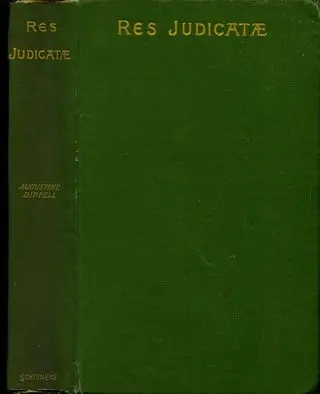
THE CLASSIC COLLECTION · 1892
"Res Judicatæ: Papers and Essays" by Augustine Birrell is a collection of essays written in the late 19th century. The work showcases Birrell's reflections and lectures on various literary figures, including Samuel Richardson and Edward Gibbon, among others. Through these essays, the author offers insights into the lives, works, and influences of these key literary figures, providing a blend of biographical narrative and critical analysis. At the start of the book, Birrell introduces Samuel Richardson with a consideration of the challenges in describing mankind, emphasizing the division between those who appreciate Richardson's novels and those who do not. He critiques the cultural disdain faced by Richardson, notably how his character as a respectable printer has led to ridicule despite the emotional depth and realism in his novels, particularly "Pamela" and "Clarissa." Birrell elaborates on Richardson's nonconformity to literary traditions of his time, discussing how his life and works reflect a different approach to storytelling, focusing on sentiment and morality.
Introduction adapted from the source catalogue; source summaries may be automatically generated.
Free to read · English · 58,473 words · No account needed
MAKE TIME FOR A GOOD BOOK
On by default. Untick to stop anonymous reading totals. Each page counts after 10 seconds in view. How this works.
Anonymous counting is on unless you have switched it off.
In this view historians have pretty generally acquiesced. Camden speaks of Tunstall of Durham dying at Lambeth 'in free custody'--a happy phrase which may be recommended to those of Her Majesty's subjects in Ireland who find themselves in prison under a statute of Edward III., not for doing anything, but for refusing to say they will not do it again. Even that most erudite and delightful of English Catholics, Charles Butler, who is one of the pleasantest memories of Lincoln's Inn, made but little of the sufferings of these bishops, whilst some Protestant writers have thought it quite amazing they were not all burnt as heretics. 'There were no retaliatory burnings,' says Canon Perry regretfully. But this surely is carrying Anglican assurance to an extraordinary pitch. What were they to be burnt for? You are burnt for heresy. That is right enough. No one would complain of that. But who in the year 1559 would have been bold enough to declare that the Archbishop of York was a heretic for refusing an oath prescribed by an Act of the Queen of the same year? Why, even now, after three centuries and a quarter of possession, I suppose Lord Selborne would hesitate before burning the Archbishop of Westminster as a heretic. Hanging is a different matter. It is very easy to get hung--but to be burnt requires a combination of circumstances not always forthcoming. Canon Perry should have remembered this.
These deposed bishops were neither burnt nor hung. The aged Tunstall of Durham, who had played a very shabby part in Henry's time, died, where he was bound to die, in his bed, very shortly after his deposition; so also did the Bishops of Lichfield and Coventry, St. David's, Carlisle, and Winchester. Dr. Scott of Chester, after four years in the Fleet prison, managed to escape to Belgium, where he died in 1565. Dr. Pate of Worcester, who was a Council of Trent man, spent three years in the Tower, and then contrived to slip away unobserved. Dr. Poole of Peterborough was never in prison at all, but was allowed to live in retirement in the neighbourhood of London till his death in 1568. Bishop Bonner was kept a close prisoner in the Marshalsea till his death in 1569. He was not popular in London. As he had burnt about one hundred and twenty persons, this need not surprise us. Bishop Bourne of Bath and Wells was lodged in the Tower from June, 1560, to the autumn of 1563, when the plague breaking out, he was quartered on the new Bishop of Lincoln, who had to provide him with bed and board till May, 1566, after which date the ex-bishop was allowed to be at large till his death in 1569. The Bishop of Exeter was kept in the Tower for three years. What subsequently became of him is not known. He is supposed to have lived in the country. Bishop Thirlby of Ely, after three years in the Tower, lived for eleven years with Archbishop Parker, uncomfortably enough, without confession or mass. Then he died. It is not to be supposed that Parker ever told his prisoner that they both belonged to the same Church. Dr. Heath, the Archbishop of York, survived his deprivation twenty years, three only of which were spent in prison. He was a man of more mark than most of his brethren, and had defended the Papal supremacy with power and dignity in his place in Parliament. The Queen, who had a liking for him, was very anxious to secure his presence at some of the new offices, but he would never go, summing up his objections thus:--'Whatever is contrary to the Catholic faith is heresy, whatever is contrary to Unity is schism.' On getting out of the Tower, Dr. Heath, who had a private estate, lived upon it till his death. Dr. Watson of Lincoln was the most learned and the worst treated of the deposed bishops. He was in the Tower and the Marshalsea, with short intervals, from 1559 to 1577, when he was handed over to the custody of the Bishop of Winchester, who passed him on, after eighteen months, to his brother of Rochester, from whose charge he was removed to join other prisoners in Wisbeach Castle, where very queer things happened. Watson died at Wisbeach in 1584. There was now but one bishop left, the by no means heroic Goldwell of St. Asaph's, who in June, 1559, proceeded in disguise to the sea-coast, and crossed over to the Continent without being recognised. He continued to live abroad for the rest of his days, which ended on the 3rd of April, 1585. With him the ancient hierarchy ceased to exist. That, at least, is the assertion of the reverend authors of the book referred to. There are those who maintain the contrary.
Your reading position is saved on this browser. Take it to another device with a library code. Reading pages adapt to text, rather than matching a printed edition.
Augustine Birrell
Augustine Birrell
Augustine Birrell
Augustine Birrell
BEHIND THE BOOK
This eBook is for the use of anyone anywhere in the United States and most other parts of the world at no cost and with almost no restrictions whatsoever. You may copy it, give it away or re-use it under the terms of the Project Gutenberg License included with this eBook or online at www.gutenberg.org. If you are not located in the United States, you will have to check the laws of the country where you are located before using this eBook. Read the source licence.
The original source file, including credits and licence, is retained by this library. Request an original-format copy at no charge. Please include the book title and Project Gutenberg identifier #37159.
KEEP YOUR CURIOSITY GOING

David Patterson (Spirit) Hatch

David Patterson (Spirit) Hatch

David Patterson (Spirit) Hatch
Cécile Tormay

Moritz Busch
John L. Ransom