THE CLASSIC COLLECTION✦Obiter Dicta: Second SeriesCLASSIC FREE BOOKS
Obiter Dicta: Second Series
Augustine Birrell
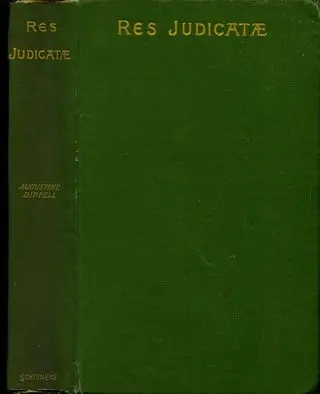
THE CLASSIC COLLECTION · 1892
"Res Judicatæ: Papers and Essays" by Augustine Birrell is a collection of essays written in the late 19th century. The work showcases Birrell's reflections and lectures on various literary figures, including Samuel Richardson and Edward Gibbon, among others. Through these essays, the author offers insights into the lives, works, and influences of these key literary figures, providing a blend of biographical narrative and critical analysis. At the start of the book, Birrell introduces Samuel Richardson with a consideration of the challenges in describing mankind, emphasizing the division between those who appreciate Richardson's novels and those who do not. He critiques the cultural disdain faced by Richardson, notably how his character as a respectable printer has led to ridicule despite the emotional depth and realism in his novels, particularly "Pamela" and "Clarissa." Birrell elaborates on Richardson's nonconformity to literary traditions of his time, discussing how his life and works reflect a different approach to storytelling, focusing on sentiment and morality.
Introduction adapted from the source catalogue; source summaries may be automatically generated.
Free to read · English · 58,473 words · No account needed
MAKE TIME FOR A GOOD BOOK
On by default. Untick to stop anonymous reading totals. Each page counts after 10 seconds in view. How this works.
Anonymous counting is on unless you have switched it off.
Our great lawyers on the bench have always treated literature in the abstract with the utmost respect. They have in many cases felt that they too, but for the grace of God, might have been authors. Like Charles Lamb's solemn Quaker, 'they had been wits in their youth.' Lord Mansfield never forgot that, according to Mr. Pope, he was a lost Ovid. Before ideas in their divine essence the judges have bowed down. 'A literary composition,' it has been said by them, 'so long as it lies dormant in the author's mind, is absolutely in his own possession.' Even Mr. Horatio Sparkins, of whose brilliant table-talk this observation reminds us, could not more willingly have recognised an obvious truth.
But they have gone much further than this. Not only is the repose of the dormant idea left undisturbed, but the manuscript to which it, on ceasing to be dormant, has been communicated, is hedged round with divinity. It would be most unfair to the delicacy of the legal mind to attribute this to the fact, no doubt notorious, that whilst it is easy (after, say, three years in a pleader's chambers) to draw an indictment against a man for stealing paper, it is not easy to do so if he has only stolen the ideas and used his own paper. There are some quibbling observations in the second book of Justinian's Institutes, and a few remarks of Lord Coke's which might lead the thoughtless to suppose that in their protection of an author's manuscripts the courts were thinking more of the paper than of the words put upon it; but that this is not so clearly appears from our law as it is administered in the Bankruptcy branch of the High Court.
Suppose a popular novelist were to become a bankrupt--a supposition which, owing to the immense sums these gentlemen are now known to make, is robbed of all painfulness by its impossibility--and his effects were found to consist of the three following items: first, his wearing apparel; second, a copy of Whitaker's Almanack for the current year; and third, the manuscript of a complete and hitherto unpublished novel, worth in the Row, let us say, one thousand pounds. These are the days of cash payments, so we must not state the author's debts at more than fifteen hundred pounds. It would have been difficult for him to owe more without incurring the charge of imprudence. Now, how will the law deal with the effects of this bankrupt? Ever averse to exposing anyone to criminal proceedings, it will return to him his clothing, provided its cash value does not exceed twenty pounds, which, as authors have left off wearing bloom-coloured garments even as they have left off writing Vicars of Wakefield, it is not likely to do. This humane rule disposes of item number one. As to Whitaker's Almanack, it would probably be found necessary to take the opinion of the court; since, if it be a tool of the author's trade, it will not vest in the official receiver and be divisible amongst the creditors, but, like the first item, will remain the property of the bankrupt--but otherwise, if not such a tool. On a point like this the court would probably wish to hear the evidence of an expert--of some man like Mr. George Augustus Sala, who knows the literary life to the backbone. This point disposed of, or standing over for argument, there remains the manuscript novel, which, as we have said, would, if sold in the Row, produce a sum not only sufficient to pay the costs of the argument about the Almanack and of all parties properly appearing in the bankruptcy, but also, if judiciously handled, a small dividend to the creditors. But here our law steps in with its chivalrous, almost religious respect for ideas, and declares that the manuscript shall not be taken from the bankrupt and published without his consent. In ordinary cases everything a bankrupt has, save the clothes for his back and the tools of his trade, is ruthlessly torn from him. Be it in possession, reversion, or remainder, it all goes. His incomes for life, his reversionary hopes, are knocked down to the speculator. In vulgar phrase, he is 'cleaned out.' But the manuscripts of the bankrupt author, albeit they may be worth thousands, are not recognised as property; they are not yet dedicated to the public. The precious papers, despite all their writer's misfortunes, remain his--his to croon and to dream over, his to alter and re-transcribe, his to withhold, ay, his to destroy, if he should deem them, either in calm judgment, or in a despairing hour, unhappy in their expression or unworthy of his name.
Your reading position is saved on this browser. Take it to another device with a library code. Reading pages adapt to text, rather than matching a printed edition.
Augustine Birrell
Augustine Birrell
Augustine Birrell
Augustine Birrell
BEHIND THE BOOK
This eBook is for the use of anyone anywhere in the United States and most other parts of the world at no cost and with almost no restrictions whatsoever. You may copy it, give it away or re-use it under the terms of the Project Gutenberg License included with this eBook or online at www.gutenberg.org. If you are not located in the United States, you will have to check the laws of the country where you are located before using this eBook. Read the source licence.
The original source file, including credits and licence, is retained by this library. Request an original-format copy at no charge. Please include the book title and Project Gutenberg identifier #37159.
KEEP YOUR CURIOSITY GOING

David Patterson (Spirit) Hatch

David Patterson (Spirit) Hatch

David Patterson (Spirit) Hatch
Cécile Tormay

Moritz Busch
John L. Ransom