THE CLASSIC COLLECTION✦An outlaw’s diary: the CommuneCLASSIC FREE BOOKS
An outlaw’s diary: the Commune
Cécile Tormay
THE CLASSIC COLLECTION · 1842
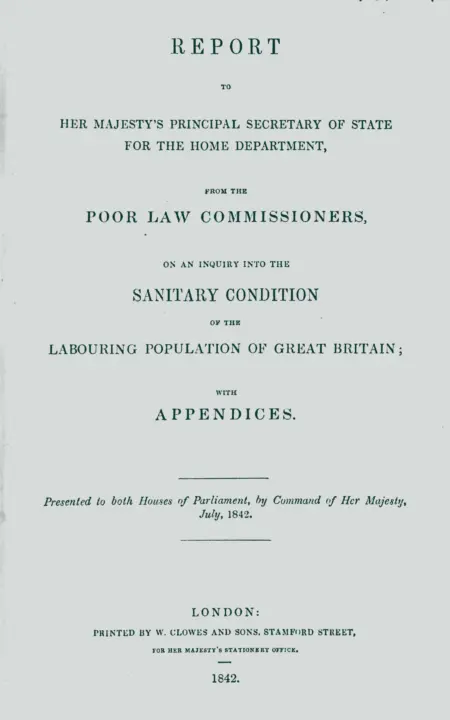
"Report to Her Majesty's Principal Secretary of State For the Home Department" by Edwin Chadwick is a scientific publication written in the early 19th century. This report addresses the sanitary conditions of the laboring population in Great Britain, focusing on the causes of disease and the potential improvements that could be made in their living conditions. It highlights the relationship between poverty, living conditions, and public health, aiming to provide evidence to support legislative reforms for the benefit of the working classes. At the start of the report, Edwin Chadwick outlines the context of a series of inquiries undertaken by the Poor Law Commissioners at the behest of Lord John Russell in 1839. These inquiries were prompted by the alarming prevalence of diseases among the laboring classes, particularly in urban areas. The text details the systematic approach taken to gather data from various unions, medical professionals, and local authorities regarding the living conditions and health impacts on the laboring population. The tone is formal, presenting preliminary statistics and testimonies about the dismal state of housing, hygiene, and public health, setting the stage for a thorough examination of the societal factors contributing to health disparities in Britain.
Introduction adapted from the source catalogue; source summaries may be automatically generated.
Free to read · English · 254,670 words · No account needed
MAKE TIME FOR A GOOD BOOK
On by default. Untick to stop anonymous reading totals. Each page counts after 10 seconds in view. How this works.
Anonymous counting is on unless you have switched it off.
You are aware that one inconvenience of the existing mode of street cleansing, independently of the great expense, is the length of time during which the wet refuse remains to the public annoyance on the surface, until removed by the slow process of sweeping and cartage?—Yes; and the men would appear to delay for the purpose of the dirt being removed, by being washed by rain into the sewers.
Do you conceive that all the business of street cleansing and house draining might be consolidated advantageously to the public?—Yes, clearly so, and with great economy.
In the evidence of Mr. Oldfield, an experienced builder in the wealthy districts of the metropolis, will be found exemplifications of the mischiefs resulting from the defective modes of opening sub-drains or communications, even from houses of the first class, into the main drains.[7] The state of sewerage and drainage in the larger towns, as described in the medical reports, in its effects of frequent disease and death,—is much worse in the provincial towns. But every step in improvement is an advance in reduction of existing burdens; drainage, per se, will be found to be a reduction of an existing charge for the expenses of sickness and mortality; science, applied to the improvement of drainage, not only gives it efficiency, but reduces greatly the expense.
The streets in the larger towns commonly display, from the want of science in their construction, similar waste, and equally admit of an improved and scientific arrangement, which will conduce to economy and to improved public health.
The bad condition of the streets in many of the towns is very generally ascribable to pavement being commonly regarded as requisite solely for cart or carriage conveyance, and not as a means of cleanliness. The pavement has therefore been usually confined to the chief streets in which the carriage traffic is considerable. Some of the principal streets even in the metropolis almost justify the description of being “streams of mud and filth in winter,” and “seas of dust” in summer. But attention has of late been directed to the cleansing of the road as a means of removing damp and dirt or dust, which are each found to be injurious. So far as various experiments have yet proceeded in the metropolis, they are stated to be highly favourable to the use of wood as a substance for paving the streets, though perhaps in forms different from those at present in use, with improvements which further experience will suggest. Wood, when pinned together and laid on a firm substratum, appears to be less retentive of wet than most forms of stone pavement, and to possess very considerable advantages over the Macadamised roads for crowded thoroughfares. If it be brought into general use it will have an advantage in removing the granite dust, which medical authorities believe to be much more prejudicial to health, in exciting or aggravating lung diseases, than the public have been aware of. Where there is much dust in the working of close quarries, the effects of it are almost as destructive to the lungs of the operatives as the knife-grinding to the operatives of Sheffield who do not guard against the steel-dust. “It is scarcely conceivable,” Dr. Arnott states, “that the immense quantities of granite-dust pounded by one or two hundred thousand pairs of wheels working on Macadamised streets, should not greatly injure the public health. In houses bordering such streets or roads, it is found that, notwithstanding the practice of watering, the furniture is often covered with dust even more than once in the day, so that writing on it with the finger becomes legible, and the lungs and air-tubes of the inhabitants, with a moist lining to detain the dust, are constantly pumping the same atmosphere. The passengers by a stage-coach in dry weather, when the wind is moving with them so as to keep them enveloped in the cloud of dust raised by the horses’ feet and the wheels of the coach, have their clothes soon saturated to whiteness with the dust, and their lungs of course are charged in a corresponding degree. A gentleman who rode only 20 miles in this way, had afterwards to cough and expectorate for 10 days to clear his chest again.” The imperfection of road cleansing in paved streets at the same time deteriorates the salubrity of the towns, the value of the refuse for production, and the streets themselves. The farmers find that the refuse of the streets, of which horse-dung and other excrementitious substances form so important a part, is valuable in proportion as it is “fresh.” On a proposition to sweep the streets of a town district oftener, it was stated by some farmers that they would, in that case, give more for the refuse. It is with this description of refuse, as stated with respect to the night-soil, in proportion as it is allowed to remain in the streets to dry, it loses the gas which gives it value; and the gas which is lost frequently gives to streets the offensive smell perceptible to strangers who have not been familiarised to it, and makes a deleterious addition to the compounds by which the health of the town population is injured. The complete and rapid cleansing of the roads has also its effects on the draught. It is proved experimentally that, “calling the draught on a broken-stone road 5, that on the same road covered with dust is 8, and that on the same road wet and muddy is 10.”[8] A road should be cleansed “from time to time, so as never to have half an inch of mud upon it. This is particularly necessary to be attended to where the materials are weak, for if the surface is not kept clean, so as to admit of its becoming dry in the intervals between showers of rain, it will be rapidly worn away.” With the even surface obtainable from the use of wood as a pavement, it is stated that the streets which are now kept wet and dirty whilst the process of cleansing is slowly carried on by the hand, may be rapidly and cheaply swept by sweeping-machines drawn by horses. With the advantage of such a system of sewerage as that described by Mr. Roe, the surface refuse, which continues exposed during a whole week, may be removed every morning before the hours of traffic from all the principal thoroughfares. In the main streets of the towns of considerable traffic, a smooth and firm surface for the carriage-way would ensure the advantages of a railroad, in addition to those to the public health from cleanliness. The experience on several portions of smooth road shows that single horses with lighter and less expensive vehicles would suffice where two horses are now required on the common roads; where strong stone pavements are required to resist the shock of heavy vehicles, and heavy vehicles propelled with double power to resist the battering of strong pavements, and the grinding and wear and tear of heavy and dirty roads.
Your reading position is saved on this browser. Take it to another device with a library code. Reading pages adapt to text, rather than matching a printed edition.
BEHIND THE BOOK
This eBook is for the use of anyone anywhere in the United States and most other parts of the world at no cost and with almost no restrictions whatsoever. You may copy it, give it away or re-use it under the terms of the Project Gutenberg License included with this eBook or online at www.gutenberg.org. If you are not located in the United States, you will have to check the laws of the country where you are located before using this eBook. Read the source licence.
The original source file, including credits and licence, is retained by this library. Request an original-format copy at no charge. Please include the book title and Project Gutenberg identifier #65090.
KEEP YOUR CURIOSITY GOING
Cécile Tormay

Moritz Busch
John L. Ransom
Frances Wright
Cécile Tormay

Mabel Potter Daggett