THE CLASSIC COLLECTION✦An outlaw’s diary: the CommuneCLASSIC FREE BOOKS
An outlaw’s diary: the Commune
Cécile Tormay
THE CLASSIC COLLECTION · 1842
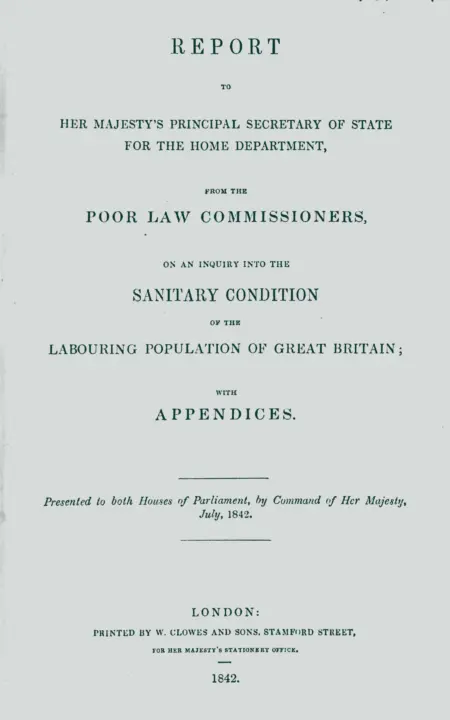
"Report to Her Majesty's Principal Secretary of State For the Home Department" by Edwin Chadwick is a scientific publication written in the early 19th century. This report addresses the sanitary conditions of the laboring population in Great Britain, focusing on the causes of disease and the potential improvements that could be made in their living conditions. It highlights the relationship between poverty, living conditions, and public health, aiming to provide evidence to support legislative reforms for the benefit of the working classes. At the start of the report, Edwin Chadwick outlines the context of a series of inquiries undertaken by the Poor Law Commissioners at the behest of Lord John Russell in 1839. These inquiries were prompted by the alarming prevalence of diseases among the laboring classes, particularly in urban areas. The text details the systematic approach taken to gather data from various unions, medical professionals, and local authorities regarding the living conditions and health impacts on the laboring population. The tone is formal, presenting preliminary statistics and testimonies about the dismal state of housing, hygiene, and public health, setting the stage for a thorough examination of the societal factors contributing to health disparities in Britain.
Introduction adapted from the source catalogue; source summaries may be automatically generated.
Free to read · English · 254,670 words · No account needed
MAKE TIME FOR A GOOD BOOK
On by default. Untick to stop anonymous reading totals. Each page counts after 10 seconds in view. How this works.
Anonymous counting is on unless you have switched it off.
“Or shall on the said bridge, or in any street or place within the distance aforesaid (all the legislation was restricted to “fifty yards”) from either end thereof, hoop, fire, cleanse, wash, or scald any cask or tub; or hew, saw, or cut any stone, wood or timber; or bore any timber; or make or repair, or wash or clean any coach, chaise, waggon, sledge or other carriage, or the wheel, body, springs, or other part of any coach, chaise, waggon, sledge, or other carriage (except such as may want immediate repair from any sudden accident on the spot, and which cannot be conveniently removed for that purpose); or wet, slack, or mix any lime; or wet, mix or make any mortar; or shoe, bleed, or farry any horse or other beast, unless in case of sudden accident; or clean, dress, drive, or turn loose any horse, or other beast, or cattle; or show or expose any stallion or stonehorse; or show or expose, or exercise or expose to sale any horse or other beast; or kill or slaughter, or scald, singe, dress or cut up any animal, either wholly or in part; or cause or permit any blood to run from any slaughter-house, butcher’s-shop or shamble into any of the streets or places within the distance aforesaid from the said bridge; or shall sell or assist in selling by auction or public sale, any cattle, goods, wares, merchandize, or thing or things whatsoever; or hang up or expose to sale, or cause or permit to be hanged up, placed or exposed to sale, any goods, wares, or merchandize whatever, or any fruit, vegetables, or garden-stuff, butchers’ meat, or other matter or thing upon the said bridge; or in, or upon, or so as to project over or upon the footway or carriage-way of the said streets or places within the distance aforesaid, or beyond the line, or on the outside of the window or windows of the house, shop, or place at which the same shall be so hanged up, placed, or exposed to sale, or so as to obstruct or incommode the passage of any person or carriage: or leave open after sunset the door or window of any cellar, or other underground room or apartment, without having placed or left a sufficient light therein to warn and prevent persons passing in the streets and public places within the distance aforesaid from the said bridge, from falling into such cellars or other underground rooms or apartments; or bait, or cause to be baited any bull or other animal; or throw at any cock or fowl in the manner called cock-throwing, or set up any fowl to be thrown at in such manner; or play at foot-ball, or at any other game on the said bridge, or within such distance as aforesaid, to the annoyance of any inhabitant or inhabitants, or passenger or passengers,” * * * * “or wilfully permit or suffer any horse, or other beast or cattle which such person may be riding or driving, or leading, to go thereon; or shall tie or fasten any horse or other cattle to any house, wall, fence, post, tree, or other thing whatsoever, across any of the highways, footways, or foot-pavements of the said bridge, or within the distance aforesaid.”
Your reading position is saved on this browser. Take it to another device with a library code. Reading pages adapt to text, rather than matching a printed edition.
BEHIND THE BOOK
This eBook is for the use of anyone anywhere in the United States and most other parts of the world at no cost and with almost no restrictions whatsoever. You may copy it, give it away or re-use it under the terms of the Project Gutenberg License included with this eBook or online at www.gutenberg.org. If you are not located in the United States, you will have to check the laws of the country where you are located before using this eBook. Read the source licence.
The original source file, including credits and licence, is retained by this library. Request an original-format copy at no charge. Please include the book title and Project Gutenberg identifier #65090.
KEEP YOUR CURIOSITY GOING
Cécile Tormay

Moritz Busch
John L. Ransom
Frances Wright
Cécile Tormay

Mabel Potter Daggett