THE CLASSIC COLLECTION✦An outlaw’s diary: the CommuneCLASSIC FREE BOOKS
An outlaw’s diary: the Commune
Cécile Tormay
THE CLASSIC COLLECTION · 1842
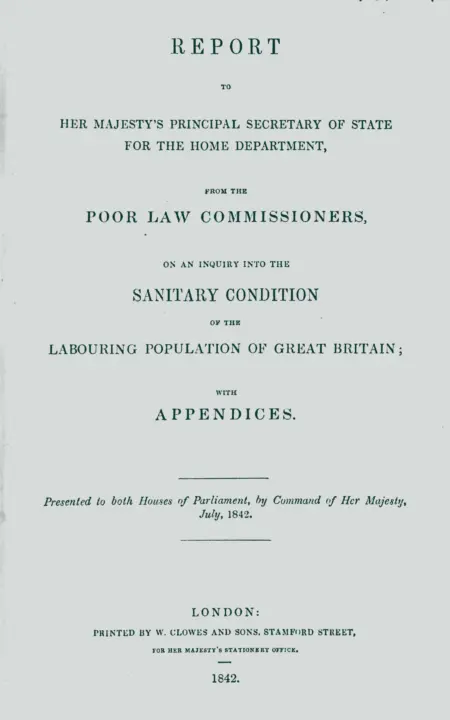
"Report to Her Majesty's Principal Secretary of State For the Home Department" by Edwin Chadwick is a scientific publication written in the early 19th century. This report addresses the sanitary conditions of the laboring population in Great Britain, focusing on the causes of disease and the potential improvements that could be made in their living conditions. It highlights the relationship between poverty, living conditions, and public health, aiming to provide evidence to support legislative reforms for the benefit of the working classes. At the start of the report, Edwin Chadwick outlines the context of a series of inquiries undertaken by the Poor Law Commissioners at the behest of Lord John Russell in 1839. These inquiries were prompted by the alarming prevalence of diseases among the laboring classes, particularly in urban areas. The text details the systematic approach taken to gather data from various unions, medical professionals, and local authorities regarding the living conditions and health impacts on the laboring population. The tone is formal, presenting preliminary statistics and testimonies about the dismal state of housing, hygiene, and public health, setting the stage for a thorough examination of the societal factors contributing to health disparities in Britain.
Introduction adapted from the source catalogue; source summaries may be automatically generated.
Free to read · English · 254,670 words · No account needed
MAKE TIME FOR A GOOD BOOK
On by default. Untick to stop anonymous reading totals. Each page counts after 10 seconds in view. How this works.
Anonymous counting is on unless you have switched it off.
Fourcroy, after repeating in his translation of Ramazzini all the passages from this author, adds, in a note, several observations to prove the dangers of tobacco; such as, that a lady died from a cancer in the nose in consequence of taking too much snuff; another from a polypus in the œsophagus, which prevented her swallowing; another from frightful convulsions produced by sleeping in a room in which tobacco had been rasped. Fourcroy states, however, that there are some privileged persons who become accustomed to the action of tobacco, and experience no inconvenience from it.
Cadet-Gassicourt, in a memoir addressed to the prefect of police on the maladies incident to the trades carried on in Paris, says that the workmen occupied in the preparation of tobacco are subject to vomitings, colics, and acute and chronic affections of the chest; that they have often vertigo, bloody fluxes, and are addicted to drink.
Tourtelle, in his Elémens d’Hygiène, affirms that it is very dangerous to sleep in warehouses of tobacco; and he quotes a case, mentioned by Buchoz, of a young girl of five, who died in a short time from dreadful vomitings, occasioned by this sole cause.
Percy, in the article Chapeau, in the Dictionnaire des Sciences Médicales, mentions, that some soldiers, exercising in the Champ-de-Mars in very warm weather, were overcome by syncope, which he attributes to some tobacco that these men had put in their caps.
In a new edition of Ramazzini and Fourcroy, by Patissier, we find the opinions of these authors without observation or comment. The editor is content to add, that those who have to do with tobacco are, in general, wasted, discoloured, yellow, and asthmatical.
Finally, Merat, in the article Tabac, in the Dictionnaire des Sciences Médicales, says, that men engaged in the preparation of this substance are wasted, discoloured, yellow, asthmatic, subject to colic, diarrhœa, the bloody flux, but, above all, to vertigo, cephalalgia, muscular tremor, to true narcotism, and to diseases, more or less acute, of the chest. “All these assertions,” he continues, “are the fruit of my observations in the hospitals of Paris. Tobacco causes not only evils without number, but even death to those who prepare it. It deranges the memory of all who inhale it, and renders it less clear and entire; it weakens the tissues, especially the nervous tissues; it causes trembling of the limbs; diminishes strength; it produces emaciation, and even consumption, particularly among females; and sometimes begets entire imbecility.”
Your reading position is saved on this browser. Take it to another device with a library code. Reading pages adapt to text, rather than matching a printed edition.
BEHIND THE BOOK
This eBook is for the use of anyone anywhere in the United States and most other parts of the world at no cost and with almost no restrictions whatsoever. You may copy it, give it away or re-use it under the terms of the Project Gutenberg License included with this eBook or online at www.gutenberg.org. If you are not located in the United States, you will have to check the laws of the country where you are located before using this eBook. Read the source licence.
The original source file, including credits and licence, is retained by this library. Request an original-format copy at no charge. Please include the book title and Project Gutenberg identifier #65090.
KEEP YOUR CURIOSITY GOING
Cécile Tormay

Moritz Busch
John L. Ransom
Frances Wright
Cécile Tormay

Mabel Potter Daggett