THE CLASSIC COLLECTION✦An outlaw’s diary: the CommuneCLASSIC FREE BOOKS
An outlaw’s diary: the Commune
Cécile Tormay
THE CLASSIC COLLECTION · 1842
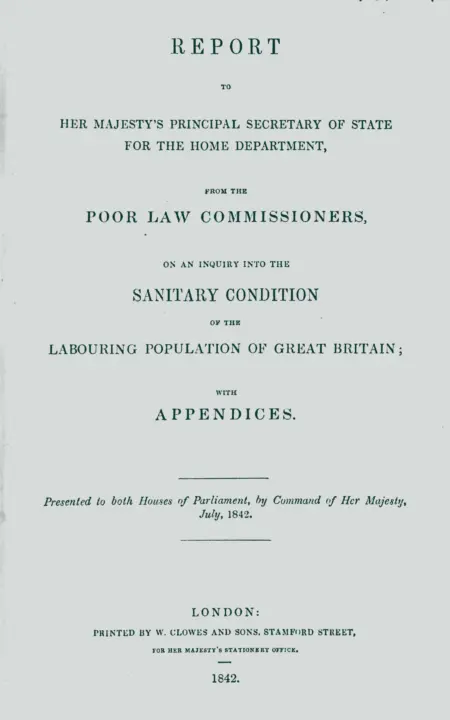
"Report to Her Majesty's Principal Secretary of State For the Home Department" by Edwin Chadwick is a scientific publication written in the early 19th century. This report addresses the sanitary conditions of the laboring population in Great Britain, focusing on the causes of disease and the potential improvements that could be made in their living conditions. It highlights the relationship between poverty, living conditions, and public health, aiming to provide evidence to support legislative reforms for the benefit of the working classes. At the start of the report, Edwin Chadwick outlines the context of a series of inquiries undertaken by the Poor Law Commissioners at the behest of Lord John Russell in 1839. These inquiries were prompted by the alarming prevalence of diseases among the laboring classes, particularly in urban areas. The text details the systematic approach taken to gather data from various unions, medical professionals, and local authorities regarding the living conditions and health impacts on the laboring population. The tone is formal, presenting preliminary statistics and testimonies about the dismal state of housing, hygiene, and public health, setting the stage for a thorough examination of the societal factors contributing to health disparities in Britain.
Introduction adapted from the source catalogue; source summaries may be automatically generated.
Free to read · English · 254,670 words · No account needed
MAKE TIME FOR A GOOD BOOK
On by default. Untick to stop anonymous reading totals. Each page counts after 10 seconds in view. How this works.
Anonymous counting is on unless you have switched it off.
It may further be submitted for consideration that, by the beneficial progress made in the habits of temperance in some districts, the disuse of spirituous or fermented liquors may enable the proprietors of houses of a higher order of resort than those in question to convert them into coffee-houses or victualling-houses, and at the same time dispense with the expense of the licence, and avoid also the responsibilities for the protection of the public which the law has attached to licensed houses of resort for travellers.
From the reports received from the more populous towns, it would appear that there are few houses which are let for the accommodation of large numbers of regular lodgers which might not be benefited by the inspection of a medical officer. I believe it would be more beneficial to the public to extend than to narrow the definition of the places which should be subjected to regulations as lodging-houses; and that a discretion as to the description of house which shall be included might be safely confided to the magistrates who have local charge of the public peace and the public economy of the towns.
The report received from Mr. Charles R. Baird, on the state of the law applicable to the sanitary regulation of Glasgow, and the condition of the labouring classes, as affected by the incompleteness or absence of such regulations, affords evidence of the practical effect of measures such as those recommended. Powers for the execution of such measures have been already obtained and put into operation by the magistrates and authorities of that city.
“The lodging-houses,” said Dr. Cowan, “are the media through which the newly-arrived immigrants find their way to the fever hospital; and it is remarkable how many of the inmates of that hospital, coming from lodging-houses, have not been six months in the city.” He might have added, these lodging-houses are the great foci of poverty, vice, and crime, as well as of disease. These houses are generally of a very wretched description, in low, unwholesome situations, exceedingly dirty and ill-ventilated, and are frequently crowded to excess, it being no uncommon thing to find 8, 10, and 12 persons in one small apartment, as 9 feet by 8, or 11 by 8. Some of them also have no beds whatever in them, the inmates lying on the bare floor, or with a few shavings below them, with their clothes on. A more particular description of them will be got in Captain Miller’s Papers on Crime in the City Proper, Mr. Rutherglen’s (one of the magistrates) on Calton, and Mr. Richardson on the Barony of Gorbals. It would appear from these published documents, and from what I have been able to learn otherwise, that the lodging-houses in the City Proper are decidedly of the worst description; but I am aware that the authorities are adopting means to have them in better order in future. In the burgh of Anderston they have for some time been under the surveillance of the police; and a record is kept of all lodging-houses for the accommodation of casual visitors in Gorbals (by which it appears that there were lately 92—50 kept by males, and 42 by females; only 25 of them entertain the lowest class of poor), so that they may be properly regulated. It is only in Calton, however, that they are attended to with that strict care which is requisite, and fortunately the last Police Act for that burgh gives ample powers for that purpose. It provides, by section 20, That no keeper of lodging-houses of an inferior description, for the accommodation of mendicant strangers and others, shall receive lodgers without the house having been inspected and approved of by the superintendent of police, and the superintendent is authorized to fix the number of lodgers who may be accommodated, and to order a ticket containing the number of lodgers for which each house is registered; and any rules or instructions of the commissioners of police regarding health, cleanliness, and ventilation, to be placed in a conspicuous part of each room in which lodgers are received. It also provides that the keepers of such lodgings offending against these regulations shall be liable in penalties. Section 21 enacts, That in the event of any person in such houses becoming ill of fever or other disease, the keepers shall be bound to give intimation thereof to the superintendent of police or inspector, so that the disease may be inquired into and treated, and the magistrates are authorized to order such persons to be removed. And section 22 further enacts, That on any contagious or infectious disease occurring in any such lodging-houses, or in any house or apartment in any house, or apartment in any common tenement, &c., where there is reasonable apprehension of such diseases spreading, the magistrates may cause the remaining lodgers to be removed, and measures to be taken for the disinfecting and cleaning of the houses and apartments, and for the washing and purifying of the persons and clothes of the inhabitants.
Your reading position is saved on this browser. Take it to another device with a library code. Reading pages adapt to text, rather than matching a printed edition.
BEHIND THE BOOK
This eBook is for the use of anyone anywhere in the United States and most other parts of the world at no cost and with almost no restrictions whatsoever. You may copy it, give it away or re-use it under the terms of the Project Gutenberg License included with this eBook or online at www.gutenberg.org. If you are not located in the United States, you will have to check the laws of the country where you are located before using this eBook. Read the source licence.
The original source file, including credits and licence, is retained by this library. Request an original-format copy at no charge. Please include the book title and Project Gutenberg identifier #65090.
KEEP YOUR CURIOSITY GOING
Cécile Tormay

Moritz Busch
John L. Ransom
Frances Wright
Cécile Tormay

Mabel Potter Daggett