THE CLASSIC COLLECTION✦An outlaw’s diary: the CommuneCLASSIC FREE BOOKS
An outlaw’s diary: the Commune
Cécile Tormay
THE CLASSIC COLLECTION · 1842
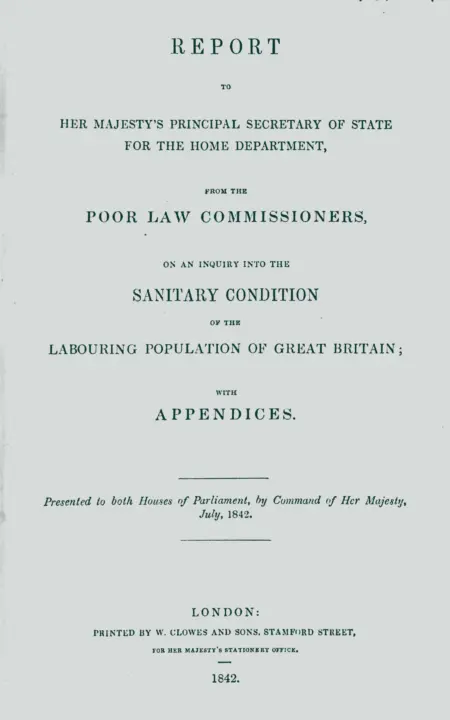
"Report to Her Majesty's Principal Secretary of State For the Home Department" by Edwin Chadwick is a scientific publication written in the early 19th century. This report addresses the sanitary conditions of the laboring population in Great Britain, focusing on the causes of disease and the potential improvements that could be made in their living conditions. It highlights the relationship between poverty, living conditions, and public health, aiming to provide evidence to support legislative reforms for the benefit of the working classes. At the start of the report, Edwin Chadwick outlines the context of a series of inquiries undertaken by the Poor Law Commissioners at the behest of Lord John Russell in 1839. These inquiries were prompted by the alarming prevalence of diseases among the laboring classes, particularly in urban areas. The text details the systematic approach taken to gather data from various unions, medical professionals, and local authorities regarding the living conditions and health impacts on the laboring population. The tone is formal, presenting preliminary statistics and testimonies about the dismal state of housing, hygiene, and public health, setting the stage for a thorough examination of the societal factors contributing to health disparities in Britain.
Introduction adapted from the source catalogue; source summaries may be automatically generated.
Free to read · English · 254,670 words · No account needed
MAKE TIME FOR A GOOD BOOK
On by default. Untick to stop anonymous reading totals. Each page counts after 10 seconds in view. How this works.
Anonymous counting is on unless you have switched it off.
“The situation of this district where the diseases herein mentioned prevail, is a perfect flat called the South Marsh, in the main road between Bristol and Bridgewater. There are numerous dykes or ditches for the purpose of drainage. The cottages of the poor are mostly of a bad description, frequently mud wall, and often situated close to the dykes, where the water for the most part is in a state of stagnation. Oftentimes not more than one room for the whole family; sometimes two; one above the other; with the really poor, the latter is seldom to be met with, (unless it should happen now and then in a parish where a poor-house was built a short time before the formation of the Union). A pigsty where the inmates are capable of keeping a pig is frequently attached to the dwelling, and in the heat of summer produces a stench quite intolerable; the want of space however prevents it being otherwise. The regular poor-house (those mentioned above being detached cottages) in most of the parishes in this district are of a much worse description, several large families existing under the same roof, occupying only one room each family, and having but one entrance door to the dwelling; here filth and poverty go hand-in-hand without any restriction and under no control. The accumulation of filth being attributable to the want of proper receptacles for refuse, and the indolent and filthy disposition of the inhabitants, in no instance have such places been provided. The floors are seldom or never scrubbed; and the parish authorities pay so little attention to these houses, that the walls never get white-limed from one end of the year to the other. The windows are kept air-tight by the stuffing of some old garments, and every article for use is kept in the same room. The necessary is close to the building, where all have access, and producing a most intolerable nuisance. In a locality naturally engendering malaria, the diseases with which the poor are for the most part afflicted are, fevers such as are stated in this report and which sometimes run into a low typhoid state. The neighbourhood in general is considered in as good a state of drainage as it will admit of. The occurrence of disease among the poor population is for the most part at spring and autumn, at those times agues and fevers prevail. Small-pox and scarlet fever are met with at all seasons of the year, but prevail as epidemics, the former in spring and summer, and the latter about autumn or the beginning of winter. I attribute the prevalence of diseases of an epidemic character, which exists so much more among the poor than among the rich, to be, from the want of better accommodation as residence, (their dwelling instead of being built of solid materials are complete shells of mud on a spot of waste land the most swampy in the parish, this is to be met with almost everywhere in rural districts,) to the want of better clothing, being better fed, more attention paid to the cleanliness of their dwellings, and less congregated together. The health of persons even where a large family is, and where superior cottage accommodation is afforded to them, is much better generally than others less advantageously situated. The influence over their habits will also be very beneficial, they will be less likely to run to a beer-house with their last penny, the comforts of a home after the toils of the day keeps them by their own fireside; they become better contented, less liable to disease, make better husbands, better fathers, better neighbours, and with each other better friends. There is a subject which I wish particularly to press on the attention of the Commissioners; the presence throughout the country, and to be found in every parish, of low lodging-houses, where persons of the lowest grade of society, beggars, thieves, and such like, take up a temporary abode in passing from one part of the kingdom to another, bringing with them the seeds of infectious diseases and oftentimes the actual disease itself into a neighbourhood previously in a comparative state of health. I have observed, where persons are living in a locality habitually affected with malaria, that when becoming convalescent from any other disease, are often attacked with ague, more particularly among the poorer classes.
Your reading position is saved on this browser. Take it to another device with a library code. Reading pages adapt to text, rather than matching a printed edition.
BEHIND THE BOOK
This eBook is for the use of anyone anywhere in the United States and most other parts of the world at no cost and with almost no restrictions whatsoever. You may copy it, give it away or re-use it under the terms of the Project Gutenberg License included with this eBook or online at www.gutenberg.org. If you are not located in the United States, you will have to check the laws of the country where you are located before using this eBook. Read the source licence.
The original source file, including credits and licence, is retained by this library. Request an original-format copy at no charge. Please include the book title and Project Gutenberg identifier #65090.
KEEP YOUR CURIOSITY GOING
Cécile Tormay

Moritz Busch
John L. Ransom
Frances Wright
Cécile Tormay

Mabel Potter Daggett