THE CLASSIC COLLECTION✦An outlaw’s diary: the CommuneCLASSIC FREE BOOKS
An outlaw’s diary: the Commune
Cécile Tormay
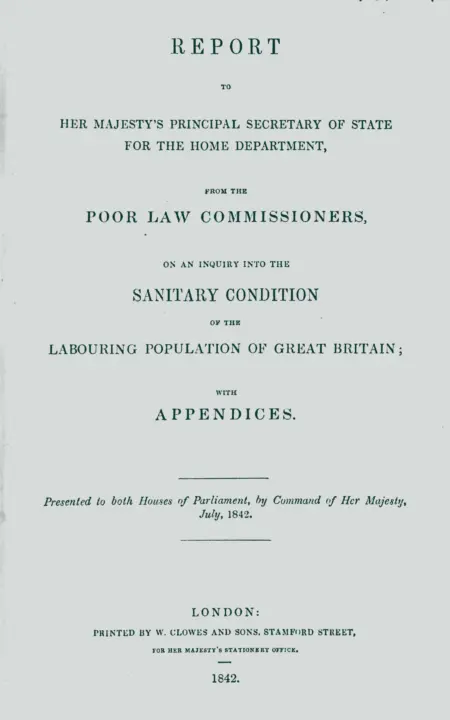
THE CLASSIC COLLECTION · 1842
"Report to Her Majesty's Principal Secretary of State For the Home Department" by Edwin Chadwick is a scientific publication written in the early 19th century. This report addresses the sanitary conditions of the laboring population in Great Britain, focusing on the causes of disease and the potential improvements that could be made in their living conditions. It highlights the relationship between poverty, living conditions, and public health, aiming to provide evidence to support legislative reforms for the benefit of the working classes. At the start of the report, Edwin Chadwick outlines the context of a series of inquiries undertaken by the Poor Law Commissioners at the behest of Lord John Russell in 1839. These inquiries were prompted by the alarming prevalence of diseases among the laboring classes, particularly in urban areas. The text details the systematic approach taken to gather data from various unions, medical professionals, and local authorities regarding the living conditions and health impacts on the laboring population. The tone is formal, presenting preliminary statistics and testimonies about the dismal state of housing, hygiene, and public health, setting the stage for a thorough examination of the societal factors contributing to health disparities in Britain.
Introduction adapted from the source catalogue; source summaries may be automatically generated.
Free to read · English · 254,670 words · No account needed
MAKE TIME FOR A GOOD BOOK
On by default. Untick to stop anonymous reading totals. Each page counts after 10 seconds in view. How this works.
Anonymous counting is on unless you have switched it off.
The Reverend Whitwell Elwin observes upon this subject that—
“Those who think that labourers will work for themselves a reform in their habitations very much underrate the effects of habit. A person accustomed to fresh air, and all the comforts of civilized life, goes into a miserable room, dirty, bare, and, above all, sickening from the smell. Judging from his own sensations, he conceives that nothing but the most abject poverty could have produced this state of things, and he can imagine nothing necessary to a cure but a way for escape. A very simple experiment will correct these erroneous impressions. Let him remain a short time in the room, and the perception of closeness will so entirely vanish that he will almost fancy that the atmosphere has been purified since his entrance. There are few who are not familiar with this fact; and if such are the effects of an hour in blunting our refined sensations, and rendering them insensible to noxious exhalations, what must be the influence of years on the coarser perceptions of the working-man?
“All who know the lower classes will testify that the last want felt by the dirty is cleanliness, that their last expenditure is on the comforts of their home. Two winters ago I found a painter whose bed was without blankets, whose room was without furniture, who was destitute even of the ordinary utensils of civilized life, whose floor was covered with worse filth than that of the streets—I found this man at dinner with a roast loin of pork stuffed with onions, a Yorkshire pudding, a large jug of ale, cheese, and a salad. I will undertake to say that half the gentlemen in Bath did not sit down on that Sunday to so good a dinner.”
A number of communications simply assign “intemperance” as the cause of fever, and of the prevalent mortality. Of most of these communications, which it were unnecessary to recite, it may be observed, that when intemperance is mentioned as the cause of disease, as being the immediate antecedent, on carrying investigation a little further back, discomfort is found to be the immediate antecedent to the intemperance; and where the external causes of positive discomfort do not prevail in the towns, the workpeople are generally found to have few or no rival pleasures to wean them from habits of intemperance, and to have come from districts subject to the discomforts likely to engender them. In one of the returns from Scotland it is observed that with the people, whether for a fever, a cold, or consumption, or a pleurisy, whiskey is the universal antidote. The popular belief that fermented liquor or ardent spirits are proper antidotes to the effects of damp or cold has been universal, and has not wanted even medical sanction. Out-door allowances of beer have been prescribed by some medical officers in marshy and undrained districts as the proper preservatives against ague or rheumatism. The Board will now be in a position to urge the importance of facilitating drainage as a means for the protection of the population by the prevention of disease and the inducement to pernicious habits, as well as a source of profitable industry. It is now beginning to be observed in several dangerous occupations that temperance is the best means of withstanding the effects of the noxious agencies which they have to encounter. Amongst the painters, for example, the men who are temperate and cleanly suffer little from the occupation, but if any one of them become intemperate, the noxious causes take effect with a certainty and rapidity proportioned to the relaxed domestic habits. The Inquiry presents many instances of the beneficial effects of the changes of the popular habit of having recourse to fermented liquors or to spirits as necessary protective stimulants. In several of the mining districts, for example, it is an extensive practice to provide for the accommodation of the miners out of the hot mines a room in which they may drink beer as a preservative against the effects of the change to the cold and damp air to which they are about to expose themselves. Dr. Barham, in his Report to the Commissioners appointed to inquire into the Employment of Young Persons in Mines and Manufactories, notices an admirable example within the province of voluntary exertion, and the beneficial effects produced by it at the Dolcoath copper and tin mine, Camborne, Cornwall. There the proprietors, besides establishing other easy and economical preventive arrangements, provide a warm room for the miners to change their dresses and take hot meat-soup, which is cheaper, probably, than beer. “And the men” (says a witness) “say they never feel cold when they take it. We conceive that there have been much fewer cases of consumption on the club since this practice has been adopted.”
Your reading position is saved on this browser. Take it to another device with a library code. Reading pages adapt to text, rather than matching a printed edition.
BEHIND THE BOOK
This eBook is for the use of anyone anywhere in the United States and most other parts of the world at no cost and with almost no restrictions whatsoever. You may copy it, give it away or re-use it under the terms of the Project Gutenberg License included with this eBook or online at www.gutenberg.org. If you are not located in the United States, you will have to check the laws of the country where you are located before using this eBook. Read the source licence.
The original source file, including credits and licence, is retained by this library. Request an original-format copy at no charge. Please include the book title and Project Gutenberg identifier #65090.
KEEP YOUR CURIOSITY GOING
Cécile Tormay

Moritz Busch
John L. Ransom
Frances Wright
Cécile Tormay

Mabel Potter Daggett