THE CLASSIC COLLECTION✦An outlaw’s diary: the CommuneCLASSIC FREE BOOKS
An outlaw’s diary: the Commune
Cécile Tormay
THE CLASSIC COLLECTION · 1842
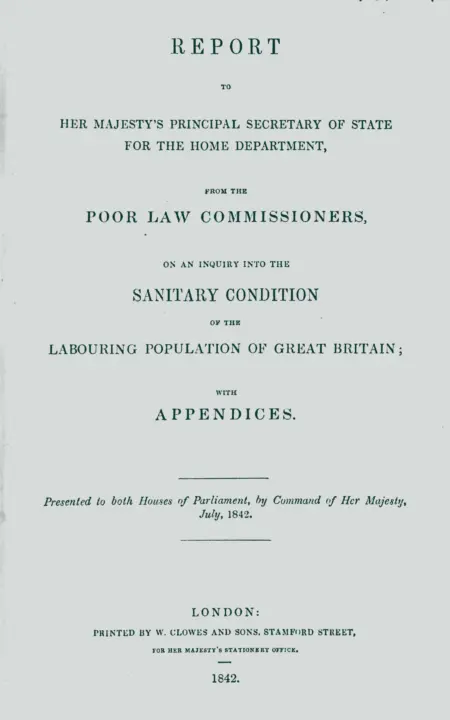
"Report to Her Majesty's Principal Secretary of State For the Home Department" by Edwin Chadwick is a scientific publication written in the early 19th century. This report addresses the sanitary conditions of the laboring population in Great Britain, focusing on the causes of disease and the potential improvements that could be made in their living conditions. It highlights the relationship between poverty, living conditions, and public health, aiming to provide evidence to support legislative reforms for the benefit of the working classes. At the start of the report, Edwin Chadwick outlines the context of a series of inquiries undertaken by the Poor Law Commissioners at the behest of Lord John Russell in 1839. These inquiries were prompted by the alarming prevalence of diseases among the laboring classes, particularly in urban areas. The text details the systematic approach taken to gather data from various unions, medical professionals, and local authorities regarding the living conditions and health impacts on the laboring population. The tone is formal, presenting preliminary statistics and testimonies about the dismal state of housing, hygiene, and public health, setting the stage for a thorough examination of the societal factors contributing to health disparities in Britain.
Introduction adapted from the source catalogue; source summaries may be automatically generated.
Free to read · English · 254,670 words · No account needed
MAKE TIME FOR A GOOD BOOK
On by default. Untick to stop anonymous reading totals. Each page counts after 10 seconds in view. How this works.
Anonymous counting is on unless you have switched it off.
The familiarity with the sickness and death constantly present in the crowded and unwholesome districts, appears to re-act as another concurrent, cause in aggravation of the wretchedness and vice in which they are plunged. Seeing the apparent uncertainty of the morrow, the inhabitants really take no heed of it, and abandon themselves with the recklessness and avidity of common soldiers in a war to whatever gross enjoyment comes within their reach. All the districts I visited, where the rate of sickness and mortality was high, presented, as might be expected, a proportionate amount of severe cases of destitute orphanage and widowhood; and the same places were marked by excessive recklessness of the labouring population. In Dumfries, for example, it is estimated, that the cholera, swept away one-eleventh part of the population. Until recently, the town had not recovered the severe effects of the visitation, and the condition of the orphans was most deplorable. Amongst young artisans who were earning from 16s. to 18s. a-week, I was informed that there were very few who made any reserves against the casualties of sickness. I was led to ask the provost what number of bakers’ shops there were? “Twelve,” was his answer. And what number of whiskey-shops may the town possess? “Seventy-nine” was the reply. If we might rely on the inquiries made of working-men when Dr. Arnott and I went through the wynds of Edinburgh, their consumption of spirits bore almost the like proportion to the consumption of wholesome food. We observed to Captain Stuart, the superintendent of the police at Edinburgh, in our inspection of the wynds, that life appeared to be of little value, and was likely to be held cheap in such spots. He stated, in answer, that a short time ago a man had been executed for the murder of his wife in a fit of passion in the very room we had accidentally entered, and where we were led to make the observation. At a short distance from that spot, and amidst others of this class of habitation, were those which had been the scenes of the murders by Burke and Hare. Yet amidst these were the residences of working men engaged in regular industry. The indiscriminate mixture of workpeople and their children in the immediate vicinity, and often in the same rooms with persons whose character was denoted by the question and answer more than once exchanged, “When were you last washed?” “When I was last in prison,” was only one mark of the entire degradation to which they had been brought. The working-classes living in these districts were equally marked by the abandonment, of every civil or social regulation. Asking some children in one of the rooms of the wynds in which they swarmed in Glasgow what were their names, they hesitated to answer, when one of the inmates said, they called them ——, mentioning some nicknames. “The fact is,” observed Captain Miller, the superintendent of the police, “they really have no names. Within this range of buildings I have no doubt I should be able to find a thousand children who have no names whatever, or only nicknames, like dogs.” There were found amidst the occupants, labourers earning wages undoubtedly sufficient to have paid for comfortable tenements, men and women who were intelligent, and so far as could be ascertained, had received the ordinary education which should have given better tastes and led to better habits. My own observations have been confirmed by the statement of Mr. Sheriff Alison, of Glasgow, that in the great manufacturing towns of Scotland, “in the contest with whiskey, in their crowded population, education has been entirely overthrown.” The ministers, it will be seen, make similar reports from the rural districts. On the observation of other districts, and the comparison of the habits of the same workmen in town and country, it will be seen that I consider that the use of the whiskey and the prostration of the education and moral habits for which the Scottish labourers have been distinguished is, to a considerable extent, attributable to the surrounding physical circumstances, including the effects of the bad ventilation. The labourers presented to our notice in the condition described, in the crowded districts, were almost all Scotch. It is common to ascribe the extreme of misery and vice wholly to the Irish portion of the population of the towns in Scotland. A short inspection on the spot would correct this error. Mr. Baird, in his report on the sanitary condition of the poor of Glasgow, observes that “the bad name of the poor Irish had been too long attached to them.” Dr. Cowan, of Glasgow, stated that “From ample opportunities of observation, they appeared to him to exhibit much less of that squalid misery and addiction to the use of ardent spirits than the Scotch of the same grade.” Instances were indeed stated to us, where the Irish were preferred for employment from their superior steadiness and docility; and Mr. Stuart, the Factory Inspector for Scotland, states, that “instances are now occurring of a preference being given to them as workers in the flax factories on account of their regular habits, and that very significant hints have been given by extensive factory owners, that Irish workmen will be selected unless the natives of the place, and other persons employed by them, relinquish the prevailing habits of intemperance.” Dr. Scott Alison, in his report on Tranent, has described the population in receipt of high wages, but living under similar influences, as prone to passionate excitement, and as apt instruments for political discontents; their moral perceptions appeared to have been obliterated, and they might be said to be characterised by a “ferocious indocility which makes them prompt to wrong and violence, destroys their social nature, and transforms them into something little better than wild beasts.”
Your reading position is saved on this browser. Take it to another device with a library code. Reading pages adapt to text, rather than matching a printed edition.
BEHIND THE BOOK
This eBook is for the use of anyone anywhere in the United States and most other parts of the world at no cost and with almost no restrictions whatsoever. You may copy it, give it away or re-use it under the terms of the Project Gutenberg License included with this eBook or online at www.gutenberg.org. If you are not located in the United States, you will have to check the laws of the country where you are located before using this eBook. Read the source licence.
The original source file, including credits and licence, is retained by this library. Request an original-format copy at no charge. Please include the book title and Project Gutenberg identifier #65090.
KEEP YOUR CURIOSITY GOING
Cécile Tormay

Moritz Busch
John L. Ransom
Frances Wright
Cécile Tormay

Mabel Potter Daggett