THE CLASSIC COLLECTION✦An outlaw’s diary: the CommuneCLASSIC FREE BOOKS
An outlaw’s diary: the Commune
Cécile Tormay
THE CLASSIC COLLECTION · 1842
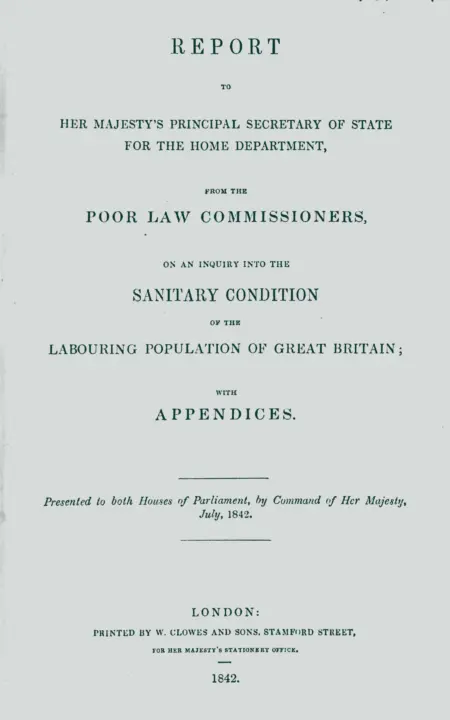
"Report to Her Majesty's Principal Secretary of State For the Home Department" by Edwin Chadwick is a scientific publication written in the early 19th century. This report addresses the sanitary conditions of the laboring population in Great Britain, focusing on the causes of disease and the potential improvements that could be made in their living conditions. It highlights the relationship between poverty, living conditions, and public health, aiming to provide evidence to support legislative reforms for the benefit of the working classes. At the start of the report, Edwin Chadwick outlines the context of a series of inquiries undertaken by the Poor Law Commissioners at the behest of Lord John Russell in 1839. These inquiries were prompted by the alarming prevalence of diseases among the laboring classes, particularly in urban areas. The text details the systematic approach taken to gather data from various unions, medical professionals, and local authorities regarding the living conditions and health impacts on the laboring population. The tone is formal, presenting preliminary statistics and testimonies about the dismal state of housing, hygiene, and public health, setting the stage for a thorough examination of the societal factors contributing to health disparities in Britain.
Introduction adapted from the source catalogue; source summaries may be automatically generated.
Free to read · English · 254,670 words · No account needed
MAKE TIME FOR A GOOD BOOK
On by default. Untick to stop anonymous reading totals. Each page counts after 10 seconds in view. How this works.
Anonymous counting is on unless you have switched it off.
I would here request attention to a suggestion which appears to me to arise from a consideration of the evils above displayed, (and that will receive further corroboration in the course of this report,) that if there were a regular system of periodical inspection of the places of work or places of large assemblage, it would be attended with great advantage to the lower orders of the community, in which the other classes could not fail to participate.
One most important result of such investigations would be to disabuse the popular mind of much prejudice against particular branches of industry arising from the belief that causes of ill health really accidental and removable, and sometimes unconnected, are essentials to the employment itself. By pointing out the real causes, warning will be given for their avoidance, and indications extended for the application of more certain remedies. Medical men who see only a few patients of the same occupation at distant intervals; who see them in their own dispensaries or in the hospitals, and who have no opportunities of observing such patients under the varied circumstances in which the disease may have been contracted, are left to mere guesses as to its cause. A working person of any of the classes whose condition I have described, presenting himself with the symptoms of a consumption, the medical man has no means of detecting the one of many causes by which it may have been occasioned, and the individual patient himself is more likely to mislead than to inform him. Unless his attention were accidentally directed to it, or unless the medical investigator had himself the means of observing the different personal condition of the different sets of persons following the same occupation in town and in country, it is highly probable that the evidence that the disease is not essential to the occupation would escape him. Thus, between different sets of workmen who work at the same descriptions of work during the same hours, and in the same town, but in well or in ill-ventilated factories a marked difference in the personal condition and general health of the workpeople has been perceived. Great differences are perceptible in the general personal condition of persons working during the same hours in cotton-mills in town, and in cotton-mills in rural districts, where they have not only a purer atmosphere, but commonly larger and more commodious places of abode. The factory superintendents generally state that the workers in the country mills are distinguishable at sight by their more healthy appearance, and by the increased proportions amongst them who have florid complexions. Very lately the attention of the Austrian government was called to the labour of the persons working in the cotton-factories in the neighbourhood of Vienna.[14] One half, perhaps, of the mills are of the ordinary construction of the cotton-mills in England of from thirty to forty years’ date, and they work on the average as much as fifteen hours per diem. But it appears that the houses in which the workers live belong to the capitalists who own the mills, many of whom have displayed a desire to ensure, as far as the state of the private residences can ensure, the comfort of those whom they employ, and they have accordingly built for them a superior description of tenements. It is stated that the result of the inquiry conducted by the government physicians was, that the average health enjoyed by the workers in those mills is greater than that of any other class of workpeople in the neighbourhood where the mills are situate, and where the general condition of the population is deemed good; the difference in the general health of the two classes (indicated by the proportions of death—of 1 in 27 of the general population, and 1 in 31 of the manufacturing population), was ascribed to the difference of the residences. My colleagues and myself of the central board of the Factory Commission of Inquiry were fully sensible that the effect of one cause on the health of the working population could not fairly be judged of unless its operation was observed under various circumstances, and unless amongst them the influence of the domestic circumstances, as well as the nature of the work and the place of work, were duly examined. We could not but deem it important that the state of the dwellings of the workpeople, who were the subject of inquiry, should also be investigated; and we gave instructions with that view to the district medical commissioners; but the limited time allowed by Parliament for the investigation, prevented its being made as we desired, a circumstance that, for the sake of the workpeople, is much to be regretted, as great injury is done to them by attention being diverted, as it commonly has been, from the real means of prevention.[15]
Your reading position is saved on this browser. Take it to another device with a library code. Reading pages adapt to text, rather than matching a printed edition.
BEHIND THE BOOK
This eBook is for the use of anyone anywhere in the United States and most other parts of the world at no cost and with almost no restrictions whatsoever. You may copy it, give it away or re-use it under the terms of the Project Gutenberg License included with this eBook or online at www.gutenberg.org. If you are not located in the United States, you will have to check the laws of the country where you are located before using this eBook. Read the source licence.
The original source file, including credits and licence, is retained by this library. Request an original-format copy at no charge. Please include the book title and Project Gutenberg identifier #65090.
KEEP YOUR CURIOSITY GOING
Cécile Tormay

Moritz Busch
John L. Ransom
Frances Wright
Cécile Tormay

Mabel Potter Daggett