
An Artist’s Letters from Japan
John La Farge
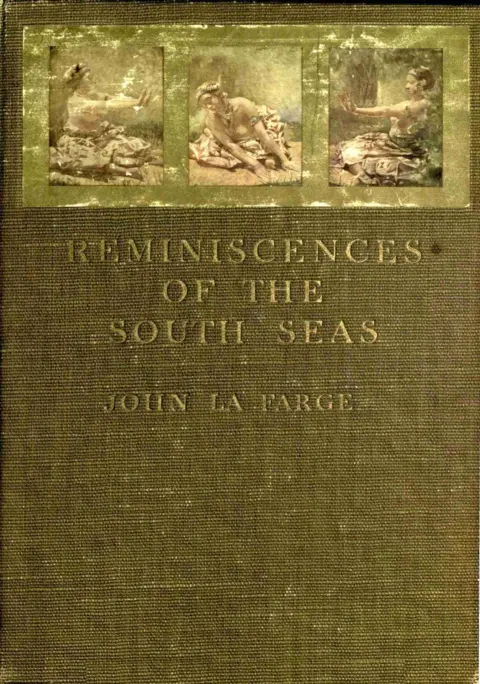
THE CLASSIC COLLECTION · 1901
"Reminiscences of the South Seas" by John La Farge is a travel narrative written in the early 20th century, capturing the author's experiences and observations during his journey through the Pacific Islands. La Farge, a painter and writer, illustrates not only the beautiful landscapes and cultures he encounters but also shares reflections on life and nature that enrich his storytelling. Through this work, readers can expect a vivid and personal exploration of the South Seas, blending art and literature. The opening of the narrative sets the stage for La Farge’s journey, beginning as he departs from San Francisco. He captures the contrast between the familiar city life and the adventure that awaits him in the tropical lands he is heading towards. As he describes his thoughts aboard the ship, La Farge offers sensory impressions of the sea, sky, and the people he encounters—his keen observational skills allow readers to almost visualize the vibrant scenes. The narrative quickly delves into the lush environments of Hawaii, highlighting the unique cultural interactions and the picturesque beauty La Farge finds along the way, all while contemplating the deeper meanings of his experiences in this serene, yet foreign, world.
Introduction adapted from the source catalogue; source summaries may be automatically generated.
Free to read · English · 120,236 words · No account needed
MAKE TIME FOR A GOOD BOOK
On by default. Untick to stop anonymous reading totals. Each page counts after 10 seconds in view. How this works.
Anonymous counting is on unless you have switched it off.
The place was just what you might imagine; a little amphitheatre of green, the high reddish rocks standing on each side at the entrance, and between them, a great bank of rock, over which the surf broke so as to hide the little break through which we had come.
As we looked, three great palms stood up against this distance, planted on the higher ground that is all green, and leaning toward the sea as is their (loving) habit. Huts stood about with bread-fruit trees, and further back we were led to a little pool that supplied the place with scant water. Further back yet, the slope was all covered with trees, and after walking a little way, slipping along the greasy banks, and walking up the sloping timber notched with cuts to make stairs, and returning by another that made a level bridge across an empty channel, I sat down to wait for Mr. Sewall, who had walked up to the ridge, and I had time to make a sketch. All this took us a little more than a couple of hours while Seumanu’s boat was beating outside, in a fair N. E. wind. At last we were paddled out in the great wave that washed in and out, and with the swing that belongs to the balancing of a boat in a narrow tide-way. And we kept in the dance until we reached Seumanu’s boat, invisible for some minutes behind the blue waves. Then we ran alongside, and we scrambled in, exchanging good-byes--tofa--with the chief of the lost hand, who had taken us thus far. Within the next hour Seumanu’s boat had come to the outer reef off Savaii, in front of the landing of Iva. But there we had to wait at anchor. The water was too low inside the reef, so that we remained in the thin blue-green tide, that seemed to show everything in it, until a smaller boat came out to us, with Selu, the chief, and we were taken in. We landed among black rocks, within a few feet of a little scanty road, and clambering over a stile of rocks, at some part of the long black fence of stones in front of us, we found a village, which spread higher up and far back behind the trees, with spaces between houses; banana, palm and bread-fruit trees, dispersed as if for ornament or making little patches of plantation. There was a big church of the usual formless kind, not as handsome as the thatched ones with circular ends, that are certainly the types one would prefer. And so we walked up to the house, where we were to listen to speeches and the Consul to make one. Since I have begun to write, all has become more quiet, and I shall merely use my afternoon to make a few notes; we shall sleep in another house belonging to the Governor and be near, I think, to the chief, whose name is or was Selu, for lately he tells me that he has had the name of Anai given him, and we try to make out together just how near these changes come to the forms of the Western world. This is not a title properly, but as it were a name embodying rights that go to descent; for these men with titles apparently elective are noblemen who form an aristocracy of government and are usually to be distinguished externally by their size or manner as well as by little symbols or expressions of superiority. Anai tells me that of the many chiefs here, whom we have seen or will see, he and another, alone are the “political” superiors, as he expresses it; that is to say, he goes on, that they alone talk in public about such matters (I suppose in the way of decision), and that others would be checked if moving. Thus, that to him and to his mate alone the making of war, or as he expresses it, the allowing the “shedding of blood” is devolved. This chief is a most interesting and sympathetic person, speaking English very well, though apparently a little wanting in practice, with a pleasant, handsome face, resembling some Japanese types, interested in missionary matters, a strict church member, and showing much interest in foreign matters throughout the world; we talked of the civil war, and of the prospects of the republic in France, and of the universal “striking” now going on, as we might anywhere; and I am sure that Anai was “posted” to a later date than we, for the Consul had handed to him the files of the Herald for the last few months, while we had almost entirely abstained from that indigestive form of reading. Anai has explained to us that this being Sunday we shall have no reception, but that to-morrow there will be a formal reception, called talolo, and giving of presents, and that there will be dances. So that we shall spend this evening quietly, with a bath in the pool of fresh water, that is open to the sea, and try to rest.
Your reading position is saved on this browser. Take it to another device with a library code. Reading pages adapt to text, rather than matching a printed edition.
John La Farge
BEHIND THE BOOK
This eBook is for the use of anyone anywhere in the United States and most other parts of the world at no cost and with almost no restrictions whatsoever. You may copy it, give it away or re-use it under the terms of the Project Gutenberg License included with this eBook or online at www.gutenberg.org. If you are not located in the United States, you will have to check the laws of the country where you are located before using this eBook. Read the source licence.
The original source file, including credits and licence, is retained by this library. Request an original-format copy at no charge. Please include the book title and Project Gutenberg identifier #75551.
KEEP YOUR CURIOSITY GOING
Wilfrid Scawen Blunt
Wilfrid Scawen Blunt

E. W. (Edgar Watson) Howe
Francis Greenleaf Allinson & Anne C. E. (Anne Crosby Emery) Allinson
Cyrenus Cole

John Martineau