
An Artist’s Letters from Japan
John La Farge
THE CLASSIC COLLECTION · 1901
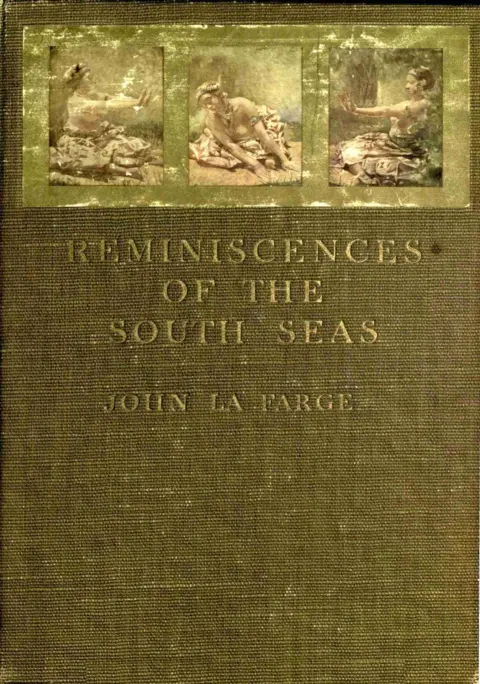
"Reminiscences of the South Seas" by John La Farge is a travel narrative written in the early 20th century, capturing the author's experiences and observations during his journey through the Pacific Islands. La Farge, a painter and writer, illustrates not only the beautiful landscapes and cultures he encounters but also shares reflections on life and nature that enrich his storytelling. Through this work, readers can expect a vivid and personal exploration of the South Seas, blending art and literature. The opening of the narrative sets the stage for La Farge’s journey, beginning as he departs from San Francisco. He captures the contrast between the familiar city life and the adventure that awaits him in the tropical lands he is heading towards. As he describes his thoughts aboard the ship, La Farge offers sensory impressions of the sea, sky, and the people he encounters—his keen observational skills allow readers to almost visualize the vibrant scenes. The narrative quickly delves into the lush environments of Hawaii, highlighting the unique cultural interactions and the picturesque beauty La Farge finds along the way, all while contemplating the deeper meanings of his experiences in this serene, yet foreign, world.
Introduction adapted from the source catalogue; source summaries may be automatically generated.
Free to read · English · 120,236 words · No account needed
MAKE TIME FOR A GOOD BOOK
On by default. Untick to stop anonymous reading totals. Each page counts after 10 seconds in view. How this works.
Anonymous counting is on unless you have switched it off.
I am troubled also at writing about things and ideas, and using words which have grown out of things and ideas extremely different and often contradictory. As the Christian terminology, the very language of the Gospels, was perforce made up of pagan forms and terms, so to-day, I shall have to describe what might be called pagan forms and ideas in a terminology now influenced by Christianity, and saturated with problems connected with it, so that probably Greek or Latin would be more natural, though even they, you know, are read by us with a bias that their authors never dreamed of.
But as long as I do not write, it is pleasant to see the ideas without words, and perhaps descriptions may not have been the worst way to give them.
25th Oct., 1890.
Malanga, written malaga, is a trip, a voyage where one puts up with friends, etc.; one of the fundamental social institutions of Samoa.
WHAT SEUMANU’s BOAT WAS
“Secretary of the Navy to the Secretary of State. Acknowledging assistance by natives of Samoa.
“Navy Department,
“Washington, D. C., April 27, 1889.
“SIR: In a report dated Apia, Samoa, March 26, 1889, from Rear-Admiral L. H. Kimberly, U. S. Navy, commanding the United States naval force on the Pacific Station, the Navy Department is informed that invaluable assistance was rendered by certain natives of Apia, during the storm of Saturday, the 16th March.
“Rear-Admiral Kimberly calls particular attention to Seumanu Tafa, chief of Apia, who was the first to man a boat and go to the Trenton after she struck the reef, and who also rendered material aid in directing the natives engaged in taking our people and public property on shore on the 17th and 18th.
“Special recommendation also is given to the men composing the boat’s crew, as follows: Muniaga, Anapu, son of Seumanu, Taupau, chief of Manono, Mose, Fuapopo, Tete, Pita, Ionia, Apiti, Auvaa, Alo, Tepa.
“The Department has the honour to request that you will express to the authorities of Samoa, through the proper channels its high sense of the courage and self devotion of Chief Seumanu and his fellow countrymen, in their risking their lives to rescue the shipwrecked officers and crew of the Trenton from their position of peril and distress; and that you will, at the same time, inform them of its intention to send to the Chief Seumanu in accordance with the recommendation of Rear-Admiral Kimberly, and as a mark of its appreciation, a double-banked whaleboat, with its fittings, and to reward suitably the men composing his crew, for their brave and disinterested service. I have the honour to be, sir, very respectfully, your obedient servant,
Your reading position is saved on this browser. Take it to another device with a library code. Reading pages adapt to text, rather than matching a printed edition.
John La Farge
BEHIND THE BOOK
This eBook is for the use of anyone anywhere in the United States and most other parts of the world at no cost and with almost no restrictions whatsoever. You may copy it, give it away or re-use it under the terms of the Project Gutenberg License included with this eBook or online at www.gutenberg.org. If you are not located in the United States, you will have to check the laws of the country where you are located before using this eBook. Read the source licence.
The original source file, including credits and licence, is retained by this library. Request an original-format copy at no charge. Please include the book title and Project Gutenberg identifier #75551.
KEEP YOUR CURIOSITY GOING
Wilfrid Scawen Blunt
Wilfrid Scawen Blunt

E. W. (Edgar Watson) Howe
Francis Greenleaf Allinson & Anne C. E. (Anne Crosby Emery) Allinson
Cyrenus Cole

John Martineau