
An Artist’s Letters from Japan
John La Farge
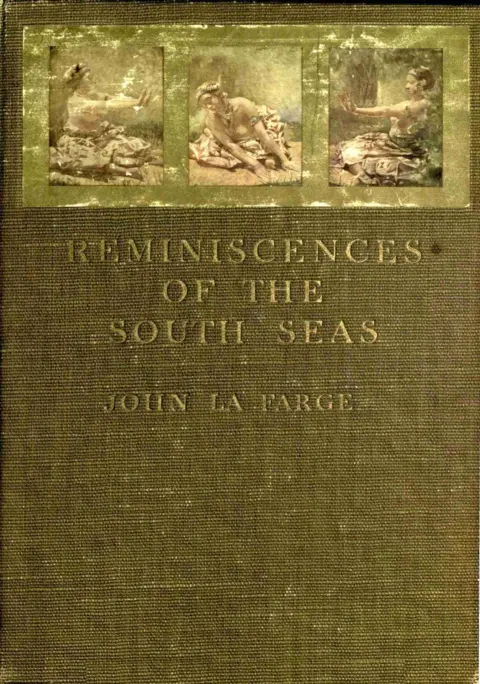
THE CLASSIC COLLECTION · 1901
"Reminiscences of the South Seas" by John La Farge is a travel narrative written in the early 20th century, capturing the author's experiences and observations during his journey through the Pacific Islands. La Farge, a painter and writer, illustrates not only the beautiful landscapes and cultures he encounters but also shares reflections on life and nature that enrich his storytelling. Through this work, readers can expect a vivid and personal exploration of the South Seas, blending art and literature. The opening of the narrative sets the stage for La Farge’s journey, beginning as he departs from San Francisco. He captures the contrast between the familiar city life and the adventure that awaits him in the tropical lands he is heading towards. As he describes his thoughts aboard the ship, La Farge offers sensory impressions of the sea, sky, and the people he encounters—his keen observational skills allow readers to almost visualize the vibrant scenes. The narrative quickly delves into the lush environments of Hawaii, highlighting the unique cultural interactions and the picturesque beauty La Farge finds along the way, all while contemplating the deeper meanings of his experiences in this serene, yet foreign, world.
Introduction adapted from the source catalogue; source summaries may be automatically generated.
Free to read · English · 120,236 words · No account needed
MAKE TIME FOR A GOOD BOOK
On by default. Untick to stop anonymous reading totals. Each page counts after 10 seconds in view. How this works.
Anonymous counting is on unless you have switched it off.
Meanwhile, I say, Mataafa bides his time. He waits patiently, en évidence, but doing nothing. This will irritate his enemies, but I seem to see that for him there can be no more legal course. As long as he does nothing, and makes only a mute appeal to justice, he is entirely in the right. He is not supposed to accede to the protocol which excluded him. I think I understand somewhat of the absurdly complicated position which his friends or his enemies hold--position based on hereditary rights; long internecine wars; ancient privileges of small places which have rights of election, but which are too weak to enforce them; and, above all, on both sides questions of complicated descent. Even if I were correct, and made no mistakes, which could hardly be, I would not dare to go into a lengthy explanation of the claims on both sides.
One great enmity Mataafa has: more intense than that of the Germans, because partly unconscious and founded on the worst passion of humanity--theological hatred. That enmity is the dislike of the foreign Protestant missionary, who moreover is absolutely English in his ideas, his wishes, his intentions, and has a perpetual political bias. Mataafa is a Catholic, like many of the chiefs. Naturally he has Catholic advisers, and some of them may be--though I don’t know it for sure--tainted by the same politico-religious ideas as their opponents. They probably supply the great chief with information of what the great outside world would do in his favour; opinions based on their wishes, and not on the meanness of mankind, which is the only logical basis of politics.
As a proof of the atrocities to which the religious mind can consent, listen to this charming detail. It belongs to a time when I was no longer in Samoa. I have mentioned in my other journals and letters the names of the Rev. Mr. Claxton of the London Missionary Society; and I can add to what I said that was pleasant that he seemed to be the usual gentle clergyman, with side-whiskers, and sufficiently modern, and that he spoke very nicely, as I thought, of the religious state of the Samoans, and evinced a sense of a certain steadfastness of theirs, which distinguishes them from many of the other varieties of South Sea people. Mr. Claxton also pleased us by recognizing the Samoan dances as not being sinful, by being present at one of them, with Mrs. Claxton. You know that poor Faatulia was excommunicated for attending the Fourth of July dance, which was of course attended by the wives or daughters or aunts of the English or American consuls. The action of our reverend friend was all the more graceful because the dance was in honour of Faatulia’s niece, if I remember. Mrs. Claxton also we hear all sorts of nice things about. She is “Misi Talatoni,” and Meli Hamilton gets a great deal of fun out of her, pretending that we admire her dress much more than Meli’s. Never would you suspect these gentle associations connected with the ideas of mediæval assassination. But in August, our Consul, coming down to Australia, and meeting us on the way to Java, told me the following story because he wished me to take a hand myself. Mataafa’s habits were, as might be expected from his character, particularly steady as belonging to a war chief, a king, and a devout churchman. He went to mass every day, by the same path, and did not flinch or change his track when the Germans fired at him. Somehow or other, as happens to generals and to people who make a good mark, he was never hit. On this peculiarity of Mataafa’s was based a proposition made by the Rev. Mr. Claxton to the Consul. There was now absolute peace; and Mataafa and myself, or you would have a perfect right to walk along the road to church without being fired at. But German discipline has characteristics quite as distinct as Mataafa’s. Might it not be possible, if any German marines were landed by chance, to place some sentries on Mataafa’s road, presumably if he went to evening service? He would suspect no harm, and even if he did, would not move from his path. The German sentinel would by duty be obliged to fire, and consequently no one would be to blame, and Mataafa would be out of the way. This the reverend clergyman thought could be managed. What Consul Sewall wished of me was that I should warn a friend of Mataafa’s, Father Gavet, who lived somewhere along the coast, but whose long acquaintance with Samoan manners would find some way of avoiding the possibility of this little incident. I wrote to Father Gavet, who answered me, at some distance of time, of course, that the plot was understood; for, as Mataafa said to me, “There are no secrets in Samoa,” and the friends of Mataafa had taken necessary precautions. I never heard anything more about it, but I believe that the Reverend Claxton has been withdrawn.
Your reading position is saved on this browser. Take it to another device with a library code. Reading pages adapt to text, rather than matching a printed edition.
John La Farge
BEHIND THE BOOK
This eBook is for the use of anyone anywhere in the United States and most other parts of the world at no cost and with almost no restrictions whatsoever. You may copy it, give it away or re-use it under the terms of the Project Gutenberg License included with this eBook or online at www.gutenberg.org. If you are not located in the United States, you will have to check the laws of the country where you are located before using this eBook. Read the source licence.
The original source file, including credits and licence, is retained by this library. Request an original-format copy at no charge. Please include the book title and Project Gutenberg identifier #75551.
KEEP YOUR CURIOSITY GOING
Wilfrid Scawen Blunt
Wilfrid Scawen Blunt

E. W. (Edgar Watson) Howe
Francis Greenleaf Allinson & Anne C. E. (Anne Crosby Emery) Allinson
Cyrenus Cole

John Martineau