
An Artist’s Letters from Japan
John La Farge
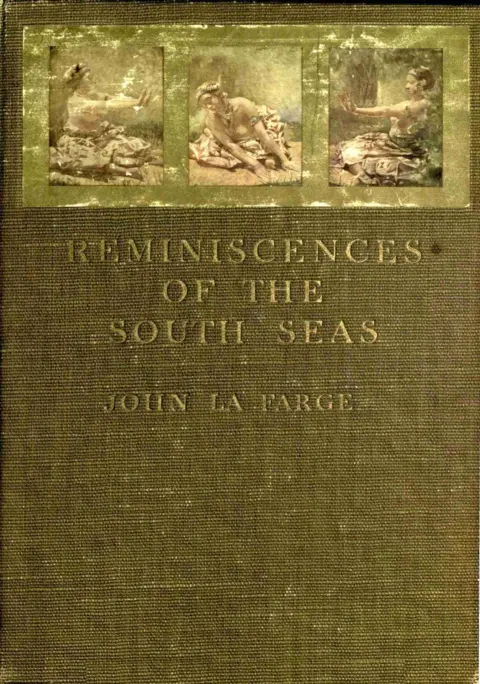
THE CLASSIC COLLECTION · 1901
"Reminiscences of the South Seas" by John La Farge is a travel narrative written in the early 20th century, capturing the author's experiences and observations during his journey through the Pacific Islands. La Farge, a painter and writer, illustrates not only the beautiful landscapes and cultures he encounters but also shares reflections on life and nature that enrich his storytelling. Through this work, readers can expect a vivid and personal exploration of the South Seas, blending art and literature. The opening of the narrative sets the stage for La Farge’s journey, beginning as he departs from San Francisco. He captures the contrast between the familiar city life and the adventure that awaits him in the tropical lands he is heading towards. As he describes his thoughts aboard the ship, La Farge offers sensory impressions of the sea, sky, and the people he encounters—his keen observational skills allow readers to almost visualize the vibrant scenes. The narrative quickly delves into the lush environments of Hawaii, highlighting the unique cultural interactions and the picturesque beauty La Farge finds along the way, all while contemplating the deeper meanings of his experiences in this serene, yet foreign, world.
Introduction adapted from the source catalogue; source summaries may be automatically generated.
Free to read · English · 120,236 words · No account needed
MAKE TIME FOR A GOOD BOOK
On by default. Untick to stop anonymous reading totals. Each page counts after 10 seconds in view. How this works.
Anonymous counting is on unless you have switched it off.
On Thursday afternoon we accompanied Sir John on a little trip up the big river Rewa which lies to the east from here. This steam launch carried us over the shallow bar, inside the reef into the broad river which has a rapid current, owing to the tide that runs up far enough for the breakwater to reach some twenty-five miles. The river has also a considerable incline, but the statement made us without guarantees, seemed excessive--fifty feet in those twenty-five miles. The land was low on either side, a great delta, and only occasionally could we see the mountains and hills in the distance. The banks were high, cut by the river, and knobby at spots where the harder clay remaining from the washings made little lumps or eminences. At first we met the mangrove swamps, then by and by banana and cocoanut, and visible here and there bread-fruit outlines against the sky. Then there was not water enough, though the launch draws but one foot, and even with that little had touched at the bar; so that we landed and walked a little way to Rewa the village or town that we were bound for. A pretty little clayey road, like a causeway, better than any in Samoa; plantations and houses from place to place; natives under the trees turned out for the great event of the Governor’s visit; here and there in shady corners groups of young men, putting on the final touches of the decorations in which they were to appear later: red and black paint, great bunches of tappa about them and girdles of black fao, as in Samoa, and titis of white streamers and of many plants. Then we came to a sort of stockade, the compound of the chief, and stepped over his gate, as usual, some stakes planted in the ground, waist high, with a stepping one outside; not in our white ideas a dignified mode of entrance. Inside a pretty arrangement of trees and buildings, with that usual charm that I have wearied you with, of looking as if arranged for effect, while most probably placed merely for most convenience; like that picturesqueness which accompanies our old farms and which seems opposed to most modern things with us. We turned around the main house, and sat down upon mats spread out in front of the river; passing first through two little groups of natives and led by the chief, to whom we were introduced in turn after the captain of the Cordelia. Then a chief or personage of importance addressed the messenger or herald of the Governor, who sat in front of us on the grass, profiled against the river, and with certain forms, presented to him some whale’s teeth tied together, upon which, apparently, everything was to depend. They were accepted, both these gentlemen curled up on the ground and the officer sidled up in what I suppose is due form. Then after a very short speech of the briefest kind, we were led to the big house for kava and we entered on one side, walking up the long plank--and passed through doors of heavy timber, ornamented with sennit in patterns and found a big room covered with many mats, soft and bed-like to the foot. There we sat at the upper end, a little raised and on more mats. At the other end of the one long room were the notables. The chief sat on one side near us; as guests we had his place. Between the two groups a long rope with ends of clustered shells was then laid at right angles to us. This was to mark the division, said my informant, and to enable any one who came late to find his due place. At one end of the rope the Governor’s herald in jacket and yappa sulu, at the other, the young men making the kava (here called yangona), in an enormous bowl. Meanwhile certain persons chanted something, with much swaying and pointing of hands and various gestures, like a rather solemn siva. Among the singers was the next important chief, who led the chant. The singing was the usual Polynesian cadence, stopping abruptly; and after several chants, between which, silence reigned, kava had become ready and was applauded and then poured out. For the first time since Mataafa’s visit I saw the use of the Great Chief’s Cup. The Governor’s herald handed him his own cup, into which the kava bearer poured a part. Then upon the Governor’s drinking and throwing down his bowl, a groan of approval came from the crowd before us. The same for the English Captain (Grenville); the same for Tauraatua and myself--who had the honour of drinking out of the “chiefy” bowl. For others the larger, common bowl was filled; an advantage or not, as one might like to have more or less of the stuff--which on the whole I think I like: that is to say, that one gets accustomed to it, and that it has a clean taste and seems to brace one a little. But evidently the kava here and in Samoa is not the kava of Tahiti, described by Tati, so powerful that such a drink as our little bowl of yesterday held, would have stupefied us surely. That ceremony over, a short speech was made, very different from the long orations of the Samoan tulafale. It was answered by the herald and the meeting was over. Then we walked out of the chief’s compound to the open space, where a dance was to be given. We sat under a canopy of mats, comfortably out of the sunlight that filled the open space edged on one side, between trees, by a long building quite high, with many doorways, all high up in the wall windows. This is a guest house, divided by posts into partitions that serve for each party of travellers. As they arrive they take up such a division for their use. Between it and the next is a narrower one occupied by a hearth, serving the parties on both sides with the economical fire that all other people than white people make. There, when they are settled the village sends them the necessary food.
Your reading position is saved on this browser. Take it to another device with a library code. Reading pages adapt to text, rather than matching a printed edition.
John La Farge
BEHIND THE BOOK
This eBook is for the use of anyone anywhere in the United States and most other parts of the world at no cost and with almost no restrictions whatsoever. You may copy it, give it away or re-use it under the terms of the Project Gutenberg License included with this eBook or online at www.gutenberg.org. If you are not located in the United States, you will have to check the laws of the country where you are located before using this eBook. Read the source licence.
The original source file, including credits and licence, is retained by this library. Request an original-format copy at no charge. Please include the book title and Project Gutenberg identifier #75551.
KEEP YOUR CURIOSITY GOING
Wilfrid Scawen Blunt
Wilfrid Scawen Blunt

E. W. (Edgar Watson) Howe
Francis Greenleaf Allinson & Anne C. E. (Anne Crosby Emery) Allinson
Cyrenus Cole

John Martineau