THE CLASSIC COLLECTION✦An outlaw’s diary: the CommuneCLASSIC FREE BOOKS
An outlaw’s diary: the Commune
Cécile Tormay
THE CLASSIC COLLECTION · 1921
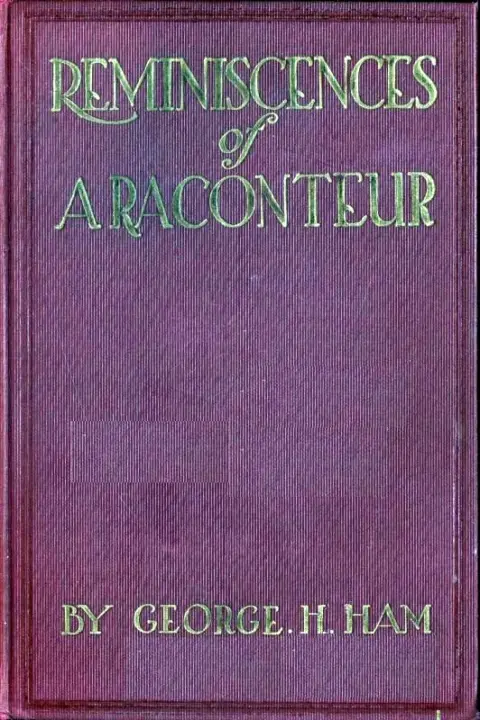
"Reminiscences of a Raconteur, Between the '40s and the '20s" by George H. Ham is a collection of memoirs written in the early 20th century. The book recounts the author’s rich life experiences from his boyhood in Canada through his various occupations as he navigated the changing landscape of society and politics. The narrative paints a vivid picture of the early Canadian experience, complete with personal anecdotes and reflections on the characters and events that shaped the country, particularly in Ontario and Manitoba. The opening portion introduces George H. Ham's early days, detailing his birth in Trenton, Ontario, and his subsequent childhood in Kingston and Whitby. It includes light-hearted anecdotes about his schooling, family interactions, and mischievous exploits. Ham recollects his formative years through playful descriptions of school life, his initial forays into work, and colorful characters from his past, establishing a nostalgic tone that invites readers to explore his later adventures as a reporter and citizen of burgeoning cities like Winnipeg. The blend of humor, fond recollections, and vivid detail promises readers an engaging journey through Canadian history, infused with personal insights.
Introduction adapted from the source catalogue; source summaries may be automatically generated.
Free to read · English · 99,611 words · No account needed
MAKE TIME FOR A GOOD BOOK
On by default. Untick to stop anonymous reading totals. Each page counts after 10 seconds in view. How this works.
Anonymous counting is on unless you have switched it off.
Then there was Sir George Foster, from Kings, N.B., who is still in harness, and after nearly forty years’ service delivered a magnificent speech in the House last year with all the vigor and eloquence of his early days. By the way, Sir George, like a good old scout, has surprised the boys by again jumping the broomstick—the bride being Miss Jessie Allen, who is a lady of high attainments.
Others were J. G. H. Bergeron, the boy orator of Beauharnois, Sir John Macdonald’s special pet, who died while postmaster of Montreal; Dalton McCarthy, from Simcoe, who broke away from his party on the Manitoba School question, an able lawyer, who was the father of the McCarthy liquor license act, which was declared ultra vires a week after it came into operation; Hon. Edward Dewdney, a member of the Government, who chose Pile-of-Bones Creek, on the wide, treeless prairie, as the capital of the Northwest Territories, and named it Regina; Hon. Sidney Fisher, from Brome, a gentleman farmer, who was Minister of Agriculture in the Laurier Administration; Walter Shanly from Grenville, a great engineer, who built in the wonderful Hoosac tunnel, and who was a warm friend of my father and myself; Pat Purcell, from Glengarry, whose body was stolen by ghouls from a vault east of Cornwall and was recovered near Stanley Island, the grave robbers being sorely disappointed in not securing the blackmail they expected for its return; Hon. J. C. Patterson, who afterwards became Lieut-Governor of Manitoba; Harry Ward, of Port Hope—“Handsome Harry,” he was called—one of the most popular members of his time; Hon. Desire Girouard, of Jacques Cartier, who defeated that strong fighting Liberal, Hon. R. Laflamme, and who retired from politics to take a seat on the bench of the Supreme Court of Canada. Mr. Justice Girouard was the author of a most interesting book, “Lake St. Louis and the Parishes Around,” which is a historical work of great value; “Bob” Watson, from Marquette, now Senator Watson, who had the distinction for years of being the only Liberal from west of the Great Lakes; Joe Kinney, who was the only Conservative elected in Yarmouth in forty-four years; Hon. J. J. Curran, afterwards Judge Curran, who could sit up later hours, sing “Old King Cole” more acceptably, and be brighter next morning with nothing stronger than ginger ale as a stimulant than any other person I ever knew; M. H. Gault was also a distinguished member of the House; James Innis, from South Wellington, one of the old stock, whose paper, the Guelph Mercury, is still prospering under the guidance of his nephew, Innis McIntosh; John Charlton, of North Norfolk, who was one of the big guns and most effective speakers of the Liberal party; Capt. Walsh, from Prince Edward Island, whose hospitality was unbounded, and who told the Minister of Customs, whom he was entertaining at his residence with a lot of the rest of us, that his liquor had never passed through the gauger’s hands. A blue flag off the mouth of Montague River showed an excellent fishing spot, and by pulling up the flag up would come a keg of rare old vintage. Dr. Jenkins was another Prince Edward Islander, whom it was a delight to know, and who was a high class physician. At any rate he cured a gnarled muscle in my left hand by giving it a quick, smashing blow, the operation taking place on the front street of Charlottetown. “Doc” Jenkins was a brawny athlete in his younger days. While in the House he always captained the Parliamentary cricket team which annually tried conclusions with the Press Gallery. I recall an amusing incident which happened one Saturday just before the annual match commenced. There was a great crowd of spectators and it was difficult to keep them off the field of play. Mr. Kimber, the little gentleman usher of the Black Rod, who thought he owned the Parliament buildings, strenuously resented being ordered behind the ropes and the crowd of onlookers greatly enjoyed the polite but forcible way in which Dr. Jenkins enforced the rules against the irate little gentleman. Then there was S. J. Dawson, “Smooth Bore” Dawson, they called him, for the quiet slickness of his speech, who was the builder of the Dawson Road, which first opened the way from the head of Lake Superior through hundreds of miles of wilderness to the Red River. There was also J. Israel Tarte, who, when a Conservative, was defeated in Quebec, if I remember aright, by his Liberal opponents scattering thousands of his photographs with him wearing a masonic apron. One of Mr. Tarte’s trite sayings was, when accused of corrupting a constituency, “Elections are not won with prayers.”
Your reading position is saved on this browser. Take it to another device with a library code. Reading pages adapt to text, rather than matching a printed edition.
BEHIND THE BOOK
This eBook is for the use of anyone anywhere in the United States and most other parts of the world at no cost and with almost no restrictions whatsoever. You may copy it, give it away or re-use it under the terms of the Project Gutenberg License included with this eBook or online at www.gutenberg.org. If you are not located in the United States, you will have to check the laws of the country where you are located before using this eBook. Read the source licence.
The original source file, including credits and licence, is retained by this library. Request an original-format copy at no charge. Please include the book title and Project Gutenberg identifier #59962.
KEEP YOUR CURIOSITY GOING
Cécile Tormay

Moritz Busch
John L. Ransom
Frances Wright
Cécile Tormay

Mabel Potter Daggett