THE CLASSIC COLLECTION✦An outlaw’s diary: the CommuneCLASSIC FREE BOOKS
An outlaw’s diary: the Commune
Cécile Tormay
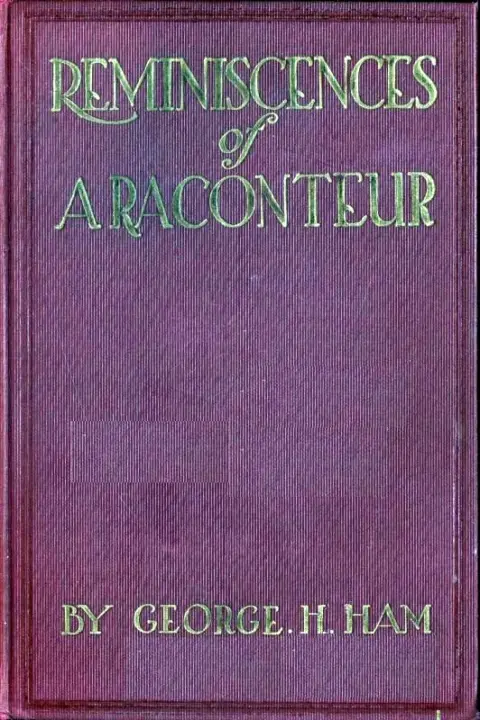
THE CLASSIC COLLECTION · 1921
"Reminiscences of a Raconteur, Between the '40s and the '20s" by George H. Ham is a collection of memoirs written in the early 20th century. The book recounts the author’s rich life experiences from his boyhood in Canada through his various occupations as he navigated the changing landscape of society and politics. The narrative paints a vivid picture of the early Canadian experience, complete with personal anecdotes and reflections on the characters and events that shaped the country, particularly in Ontario and Manitoba. The opening portion introduces George H. Ham's early days, detailing his birth in Trenton, Ontario, and his subsequent childhood in Kingston and Whitby. It includes light-hearted anecdotes about his schooling, family interactions, and mischievous exploits. Ham recollects his formative years through playful descriptions of school life, his initial forays into work, and colorful characters from his past, establishing a nostalgic tone that invites readers to explore his later adventures as a reporter and citizen of burgeoning cities like Winnipeg. The blend of humor, fond recollections, and vivid detail promises readers an engaging journey through Canadian history, infused with personal insights.
Introduction adapted from the source catalogue; source summaries may be automatically generated.
Free to read · English · 99,611 words · No account needed
MAKE TIME FOR A GOOD BOOK
On by default. Untick to stop anonymous reading totals. Each page counts after 10 seconds in view. How this works.
Anonymous counting is on unless you have switched it off.
Assistant Commissioner W. H. Herchmer was dearly beloved in the force as a dare-devil and there was considerable expression of surprise in some quarters when his brother, Lawrence Herchmer, was made Commissioner in 1886, instead of him. “Old Bill” Herchmer, as he was known, came into public notice first as commanding officer of Lord Lorne’s escort on his western tour, and again attracted attention as Chief of Staff to Colonel Otter during the 1885 campaign. He commanded for many years at Calgary, where his sadly tragic death was deeply regretted.
Inspector G. A. Brisbois was known in the force as the founder of Calgary. He commanded B Division under Col. French and was sent up to the forks of the Bow and Elbow to watch some trading posts established near there. He had rough barracks built, which were the first permanent buildings on the site of the present city. Inspector Brisbois dated his first official report in 1875 from “Fort Brisbois,” and for some time the barracks were so designated. Popularly Calgary was known by a variety of names as “The Mouth,” “Elbow River,” “The Junction,” etc. Confusion resulting, Colonel Macleod was deputed by Sir John Macdonald to confer a name on the post and he called it by the name of his paternal home in Scotland, “Calgarry,” which is Gaelic for “Clear Running Water.” The spelling reformer has since been busy, and so we now have the name with the single “r.”
Of course, there are many others of the former officers and men of the force one could and would like to write about did space permit—men like Supt. Griesbach, the first to join the ranks as a buck policeman, and whose son is now representative of Edmonton in the Dominion parliament; Lawrence Fortesque, C.M.G., I.S.O., who enlisted as a buck policeman and rose to the comptrollership of the force—he is now retired and living in England, but he pays occasional visits to Canada and I had the pleasure of renewing old acquaintance with him the other day in Ottawa; Major Winder; Jacob Carvell; Dalrymple Clarke, a nephew of Sir John Macdonald; Supt. Shortcliffe; Capt. Jack French, who was shot at Batoche in ’85, while attacking a Metis stronghold, and whose posthumous son is an officer of the force and won the I.S.O. for service in the arctic regions; Dr. Kittson, the original surgeon, a member of Commodore Kittson’s family; Dr. G. H. Kennedy, from Dundas, Ont., who succeeded Dr. Kittson; Dr. Dodds; Dr. Jukes, who was possessed of a remarkable memory, and had high literary tastes; Veterinary Surgeon Burnett, who has been 34 years with the force and is a horseman with very few equals anywhere; Supt. Gagnon, 27 years in the force, who married Hon. Joseph Royal’s daughter, who received the surrender of Big Bear and distinguished himself overseas; Supt. L. N. F. Crozier, who commanded at the action at Duck Lake in 1885, and whose reports to the Government previous to the rebellion, if acted upon, might have prevented any uprising; Inspector Joe Howe, the nephew of the great Nova Scotia statesman, who was wounded at Duck Lake and later rendered distinguished service in South Africa; Assistant Commissioner “Zack” Wood, who was an officer in the 90th in 1885, did great service in the Yukon, and is now stationed in the arctic regions; Charlie Constantine; Wroughton; Belcher; Shortcliffe, Morris, who commanded the post at Battleford during the Riel trouble; Routledge; Supt. Alfred Dickens, son of the distinguished Loyalist, who held Fort Pitt to the last and then escaped the Indians by rafting down the river; Strickland; poor Chalmers, who died a hero’s death while trying to save the life of his comrade Saunders in South Africa; Jack Cotton; Inspector Jack Allen, who figured in the final incident of the “Almighty Voice” tragedy in May, 1897, was a born fighter, and has seen service since the early sixties—at Windsor (Ont.) border, during the Civil War, and during the Fenian raid in ’66, and was through the South African war and did great service in Great Britain during the recent Great War; Supt. Cecil R. Denny, of a distinguished Irish family; Col. Osborne Smith, after whom Fort Osborne in Winnipeg was named, and who was temporary commissioner of the force for a brief period in 1873, Major Charles F. Young, a British officer who fought in the Maori war in New Zealand, and is now police magistrate in Prince Albert, (a man of convivial habits, but with a stern sense of duty—a sort of kind-hearted official who would shed tears when illicit liquor was destroyed at his command); Asst. Commissioner John A. McGibbon, from Montreal; J. O. Wilson, of Dundas, Ont., who did excellent service in the Riel rebellion; Inspector Cuthbert, whose father was one of the seigneurs of the province of Quebec; Supt. Snider from Peterborough, who made a high reputation in different parts of the country; Supt. Primrose, from Pictou, N.S., who is now a police magistrate at Edmonton; Supt. Moffat, of Toronto; Inspector Antrobus; Charlie Wood, who rose from a buck policeman to be editor of the Macleod Gazette, and is now a judge in Saskatchewan; Supt. E. W. Jarvis, who later was a member of the lumber firm of Macauley & Jarvis in Winnipeg, and commanded the Winnipeg Field Battery during the Riel Rebellion; Victor Williams, who won honor and fame during the late world war and was a worthy son of a distinguished father, Col. Williams of Port Hope, Ont., who died at the front in ’85; Asst. Commissioner Routledge, of Sydney, C.B., who died in 1919; Inspector Ed. Allen—and others whose names are deserving of recognition in the scroll of fame, but memory fails me, I regret. But some day when a full and complete history of the force is written, they will not be forgotten.
Your reading position is saved on this browser. Take it to another device with a library code. Reading pages adapt to text, rather than matching a printed edition.
BEHIND THE BOOK
This eBook is for the use of anyone anywhere in the United States and most other parts of the world at no cost and with almost no restrictions whatsoever. You may copy it, give it away or re-use it under the terms of the Project Gutenberg License included with this eBook or online at www.gutenberg.org. If you are not located in the United States, you will have to check the laws of the country where you are located before using this eBook. Read the source licence.
The original source file, including credits and licence, is retained by this library. Request an original-format copy at no charge. Please include the book title and Project Gutenberg identifier #59962.
KEEP YOUR CURIOSITY GOING
Cécile Tormay

Moritz Busch
John L. Ransom
Frances Wright
Cécile Tormay

Mabel Potter Daggett