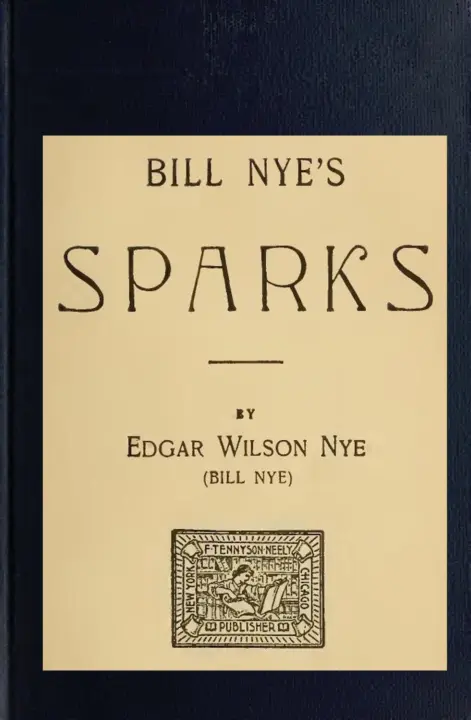
Bill Nye’s Sparks
Bill Nye
THE CLASSIC COLLECTION · 1886
"Remarks" by Bill Nye is a humorous collection of essays and anecdotes written during the late 19th century. The book is presented in a light-hearted, satirical style reminiscent of the author’s stage performances, engaging the reader with Nye's witty observations on a variety of topics ranging from personal reflections and societal norms to historical figures and events. The opening of the book introduces Bill Nye's humorous tone as he reflects on the origins of his literary journey and addresses the nature of the work he has compiled. He shares amusing stories from his educational past, recounting moments like his reliance on a knot-hole to aid his memory in school and the competitive spirit he encountered with classmates. Nye's writing is characterized by lively anecdotes, such as his somnambulistic adventures and a tongue-in-cheek critique of Noah Webster's dictionary, which he wittily suggests lacks the engaging narrative qualities found in his own literary endeavors. The opening sets the stage for a light-hearted exploration of various subjects, promising readers an entertaining and insightful journey through Nye's unique perspective on life and literature.
Introduction adapted from the source catalogue; source summaries may be automatically generated.
Free to read · English · 163,080 words · No account needed
MAKE TIME FOR A GOOD BOOK
On by default. Untick to stop anonymous reading totals. Each page counts after 10 seconds in view. How this works.
Anonymous counting is on unless you have switched it off.
He will now enter upon a theological course of ten years and fit himself thoroughly to speak intelligently of the various creeds and religions of the world. Ignorance or the part of an editor is almost a crime, and when he closes a powerful editorial with the familiar quotation, “It is the early bird that catches the worm,” and attributes it to St. Paul instead of Deuteronomy, it makes me blush for the profession.
The last ten years may be profitably devoted to the acquisition of a practical knowledge of cutting cordwood, baking beans, making shirts, lecturing, turning double handsprings, being shot out of a catapult at a circus, learning how to make a good adhesive paste that will not sour in hot weather, grinding scissors, punctuating, capitalization, condemnation, syntax, plain sewing, music and dancing, sculpting, etiquette, prosody, how to win the affections of the opposite sex and evade a malignant case of breach of promise, the ten commandments, every man his own tooter on the flute, croquet, rules of the prize ring, rhetoric, parlor magic, calisthenics, penmanship, how to run a jack from the bottom of the pack without getting shot, civil engineering, decorative art, kalsomining, bicycling, base ball, hydraulics, botany, poker, international law, high-low-jack, drawing and painting, faro, vocal music, driving, breaking team, fifteen ball pool, how to remove grease spots from last year's pantaloons, horsemanship, coupling freight cars, riding on a rail, riding on a pass, feeding threshing machines, how to wean a calf from the parent stem, teaching school, bull-whacking, plastering, waltzing, vaccination, autopsy, how to win the affections of your wife's mother, every man his own washerwoman, or how to wash underclothes so they will not shrink, etc., etc.
But time forbids anything like a thorough list of what a young man should study in order to fully understand all that he may be called upon to express an opinion about in his actual experience as a journalist. There are a thousand little matters which every editor should know; such, for instance, as the construction of roller composition. Many newspaper men can write a good editorial on Asiatic cholera, but their roller composition is not fit to eat.
With the course of study that I have mapped out, the young student would emerge from the college of journalism at the age of 95 or 96, ready to take off his coat and write an article on almost any subject. He would be a little giddy at first, and the office boy would have to see that he went to bed at a proper time each night, but aside from that, he would be a good man to feed a waste paper basket.
Your reading position is saved on this browser. Take it to another device with a library code. Reading pages adapt to text, rather than matching a printed edition.
BEHIND THE BOOK
This eBook is for the use of anyone anywhere in the United States and most other parts of the world at no cost and with almost no restrictions whatsoever. You may copy it, give it away or re-use it under the terms of the Project Gutenberg License included with this eBook or online at www.gutenberg.org. If you are not located in the United States, you will have to check the laws of the country where you are located before using this eBook. Read the source licence.
The original source file, including credits and licence, is retained by this library. Request an original-format copy at no charge. Please include the book title and Project Gutenberg identifier #8220.
KEEP YOUR CURIOSITY GOING

David Patterson (Spirit) Hatch

David Patterson (Spirit) Hatch

David Patterson (Spirit) Hatch

Ralph Waldo Emerson

Maurice Baring

Oscar Wilde & James McNeill Whistler