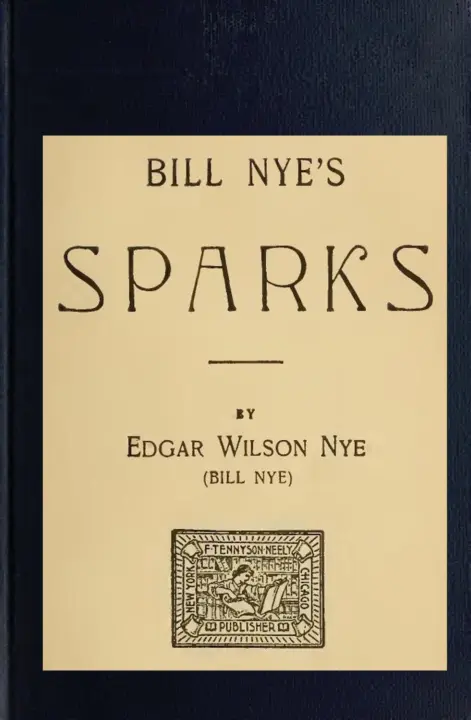
Bill Nye’s Sparks
Bill Nye
THE CLASSIC COLLECTION · 1886
"Remarks" by Bill Nye is a humorous collection of essays and anecdotes written during the late 19th century. The book is presented in a light-hearted, satirical style reminiscent of the author’s stage performances, engaging the reader with Nye's witty observations on a variety of topics ranging from personal reflections and societal norms to historical figures and events. The opening of the book introduces Bill Nye's humorous tone as he reflects on the origins of his literary journey and addresses the nature of the work he has compiled. He shares amusing stories from his educational past, recounting moments like his reliance on a knot-hole to aid his memory in school and the competitive spirit he encountered with classmates. Nye's writing is characterized by lively anecdotes, such as his somnambulistic adventures and a tongue-in-cheek critique of Noah Webster's dictionary, which he wittily suggests lacks the engaging narrative qualities found in his own literary endeavors. The opening sets the stage for a light-hearted exploration of various subjects, promising readers an entertaining and insightful journey through Nye's unique perspective on life and literature.
Introduction adapted from the source catalogue; source summaries may be automatically generated.
Free to read · English · 163,080 words · No account needed
MAKE TIME FOR A GOOD BOOK
On by default. Untick to stop anonymous reading totals. Each page counts after 10 seconds in view. How this works.
Anonymous counting is on unless you have switched it off.
A young man, one spring, plowed a pocket-book and $30 in greenbacks under, and by a singular coincidence the next spring it was plowed out, and, though rotten clear through, was sent to the Treasury, where it was discovered that the bills were on a Michigan National Bank, whither they were sent and redeemed.
I lost a roll of a hundred dollars the spring of '82, and hunted my house and the office through, in search for it, in vain. I went over the road between the office and the house twenty times, but it was useless. I then advertised the loss of the money, giving the different denominations of the bills and stating, as was the case, that there was an elastic band around the roll when lost. The paper had not been issued more than an hour before I got my money, every dollar of it. It was in the pocket of my other vest.
This should teach us, first, the value of advertising, and, secondly, the utter folly of two vests at the same time.
Apropos of recent bank failures, I want to tell this one on James S. Kelley, commonly called “Black Jim.” He failed himself along in the fifties, and by a big struggle had made out to pay everybody but Lo Bartlett, to whom he was indebted in the sum of $18. He got this money, finally, and as Lo wasn't in town, Black Jim put it in a bank, the name of which has long ago sunk into oblivion. In fact, it began the oblivion business about forty-eight hours after Jim had put his funds in there.
Meeting Lo on the street, Jim said:
“Your money is up in the Wild Oat Bank, Lo. I'll give you a check for it.”
“No use, old man, she's gone up.”
“No!!”
“Yes, she's a total wreck.”
Jim went over to the president's room. He knocked as easy as he could, considering that his breath was coming so hard.
“Who's there?”
“It's Jim Kelley, Black Jim, and I'm in something of a hurry.”
“Well, I'm very busy, Mr. Kelley. Come again this afternoon.”
“That will be too remote. I am very busy myself. Now is the accepted time. Will you open the door or shall I open it.”
The president opened it because it was a good door and he wanted to
preserve it.
Black Jim turned the key in the door and sat down.
“What did you want of me?” says the president
“I wanted to see you about a certificate of deposit I've got here on your bank for eighteen dollars.”
“We can't pay it. Everything is gone.”
Your reading position is saved on this browser. Take it to another device with a library code. Reading pages adapt to text, rather than matching a printed edition.
BEHIND THE BOOK
This eBook is for the use of anyone anywhere in the United States and most other parts of the world at no cost and with almost no restrictions whatsoever. You may copy it, give it away or re-use it under the terms of the Project Gutenberg License included with this eBook or online at www.gutenberg.org. If you are not located in the United States, you will have to check the laws of the country where you are located before using this eBook. Read the source licence.
The original source file, including credits and licence, is retained by this library. Request an original-format copy at no charge. Please include the book title and Project Gutenberg identifier #8220.
KEEP YOUR CURIOSITY GOING

David Patterson (Spirit) Hatch

David Patterson (Spirit) Hatch

David Patterson (Spirit) Hatch

Ralph Waldo Emerson

Maurice Baring

Oscar Wilde & James McNeill Whistler