THE CLASSIC COLLECTION✦Notes and Letters on the Natural History of Norfolk More Especially on the Birds and FishesCLASSIC FREE BOOKS
Notes and Letters on the Natural History of Norfolk More Especially on the Birds and Fishes
Thomas, Sir Browne
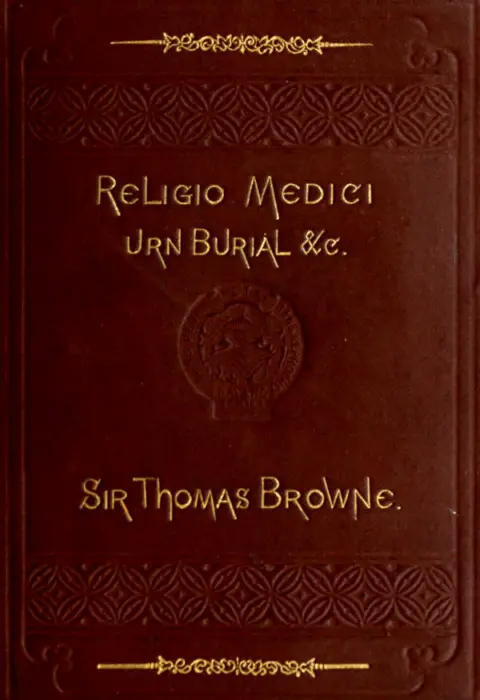
THE CLASSIC COLLECTION · 1690
"Religio Medici, Hydriotaphia, and the Letter to a Friend" by Sir Thomas Browne is a collection of philosophical and religious essays written in the 17th century. The work is significant for its exploration of spirituality, mortality, and the human condition, reflecting the complexity of Browne's thoughts as a physician and a thinker during a transformative period in history. The opening portion of the collection delves deep into Browne’s personal reflections on his faith and the philosophical underpinnings of his beliefs. He begins by asserting his Christian identity despite facing doubts from others due to his profession and demeanor. Browne emphasizes the importance of reason and personal interpretation of faith, advocating for an understanding of religion that transcends dogma. He discusses the relevance of charity and openness towards others’ beliefs and the historical context of varying Christian doctrines. Through a mixture of prose, reason, and introspective contemplation, he illustrates a mind grappling with the eternal themes of existence and divinity, setting the stage for the subsequent essays in the collection.
Introduction adapted from the source catalogue; source summaries may be automatically generated.
Free to read · English · 59,570 words · No account needed
MAKE TIME FOR A GOOD BOOK
On by default. Untick to stop anonymous reading totals. Each page counts after 10 seconds in view. How this works.
Anonymous counting is on unless you have switched it off.
[R] “Cic. de Off.,” 1. iii.
Sect. 11.--Now for my life, it is a miracle of thirty years, which to relate, were not a history, but a piece of poetry, and would sound to common ears like a fable. For the world, I count it not an inn, but an hospital; and a place not to live, but to die in. The world that I regard is myself; it is the microcosm of my own frame that I cast mine eye on: for the other, I use it but like my globe, and turn it round sometimes for my recreation. Men that look upon my outside, perusing only my condition and fortunes, do err in my altitude; for I am above Atlas’s shoulders.[98] The earth is a point not only in respect of the heavens above us, but of the heavenly and celestial part within us. That mass of flesh that circumscribes me limits not my mind. That surface that tells the heavens it hath an end cannot persuade me I have any. I take my circle to be above three hundred and sixty. Though the number of the ark do measure my body, it comprehendeth not my mind. Whilst I study to find how I am a microcosm, or little world, I find myself something more than the great. There is surely a piece of divinity in us; something that was before the elements, and owes no homage unto the sun. Nature tells me, I am the image of God, as well as Scripture. He that understands not thus much hath not his introduction or first lesson, and is yet to begin the alphabet of man. Let me not injure the felicity of others, if I say I am as happy as any. “Ruat cœlum, fiat voluntas tua,” salveth all; so that, whatsoever happens, it is but what our daily prayers desire. In brief, I am content; and what should providence add more? Surely this is it we call happiness, and this do I enjoy; with this I am happy in a dream, and as content to enjoy a happiness in a fancy, as others in a more apparent truth and reality. There is surely a nearer apprehension of anything that delights us, in our dreams, than in our waked senses. Without this I were unhappy; for my awaked judgment discontents me, ever whispering unto me that I am from my friend, but my friendly dreams in the night requite me, and make me think I am within his arms. I thank God for my happy dreams, as I do for my good rest; for there is a satisfaction in them unto reasonable desires, and such as can be content with a fit of happiness. And surely it is not a melancholy conceit to think we are all asleep in this world, and that the conceits of this life are as mere dreams, to those of the next, as the phantasms of the night, to the conceits of the day. There is an equal delusion in both; and the one doth but seem to be the emblem or picture of the other. We are somewhat more than ourselves in our sleeps; and the slumber of the body seems to be but the waking of the soul. It is the ligation of sense, but the liberty of reason; and our waking conceptions do not match the fancies of our sleeps. At my nativity, my ascendant was the watery sign of Scorpio. I was born in the planetary hour of Saturn, and I think I have a piece of that leaden planet in me. I am no way facetious, nor disposed for the mirth and galliardise[99] of company; yet in one dream I can compose a whole comedy, behold the action, apprehend the jests, and laugh myself awake at the conceits thereof. Were my memory as faithful as my reason is then fruitful, I would never study but in my dreams, and this time also would I choose for my devotions: but our grosser memories have then so little hold of our abstracted understandings, that they forget the story, and can only relate to our awaked souls a confused and broken tale of that which hath passed. Aristotle, who hath written a singular tract of sleep, hath not, methinks, thoroughly defined it; nor yet Galen, though he seem to have corrected it; for those noctambulos and night-walkers, though in their sleep, do yet enjoy the action of their senses. We must therefore say that there is something in us that is not in the jurisdiction of Morpheus; and that those abstracted and ecstatick souls do walk about in their own corpses, as spirits with the bodies they assume, wherein they seem to hear, see, and feel, though indeed the organs are destitute of sense, and their natures of those faculties that should inform them. Thus it is observed, that men sometimes, upon the hour of their departure, do speak and reason above themselves. For then the soul beginning to be freed from the ligaments of the body, begins to reason like herself, and to discourse in a strain above mortality.
Your reading position is saved on this browser. Take it to another device with a library code. Reading pages adapt to text, rather than matching a printed edition.
BEHIND THE BOOK
This eBook is for the use of anyone anywhere in the United States and most other parts of the world at no cost and with almost no restrictions whatsoever. You may copy it, give it away or re-use it under the terms of the Project Gutenberg License included with this eBook or online at www.gutenberg.org. If you are not located in the United States, you will have to check the laws of the country where you are located before using this eBook. Read the source licence.
The original source file, including credits and licence, is retained by this library. Request an original-format copy at no charge. Please include the book title and Project Gutenberg identifier #586.
KEEP YOUR CURIOSITY GOING

David Patterson (Spirit) Hatch

David Patterson (Spirit) Hatch

David Patterson (Spirit) Hatch
Cécile Tormay

Moritz Busch
Coulson Kernahan