THE CLASSIC COLLECTION✦Notes and Letters on the Natural History of Norfolk More Especially on the Birds and FishesCLASSIC FREE BOOKS
Notes and Letters on the Natural History of Norfolk More Especially on the Birds and Fishes
Thomas, Sir Browne
THE CLASSIC COLLECTION · 1690
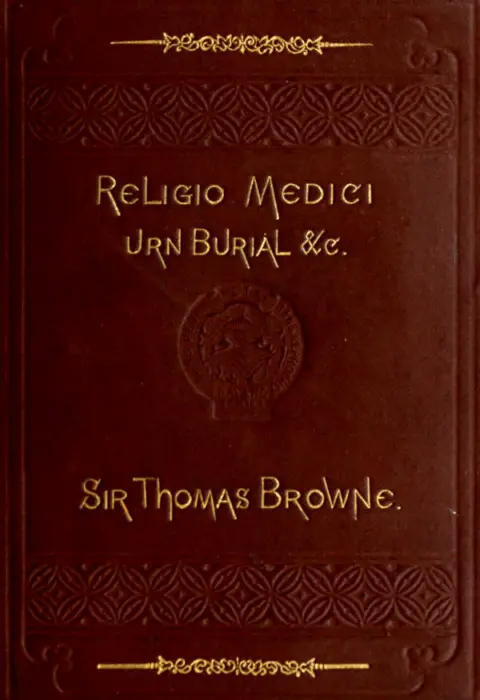
"Religio Medici, Hydriotaphia, and the Letter to a Friend" by Sir Thomas Browne is a collection of philosophical and religious essays written in the 17th century. The work is significant for its exploration of spirituality, mortality, and the human condition, reflecting the complexity of Browne's thoughts as a physician and a thinker during a transformative period in history. The opening portion of the collection delves deep into Browne’s personal reflections on his faith and the philosophical underpinnings of his beliefs. He begins by asserting his Christian identity despite facing doubts from others due to his profession and demeanor. Browne emphasizes the importance of reason and personal interpretation of faith, advocating for an understanding of religion that transcends dogma. He discusses the relevance of charity and openness towards others’ beliefs and the historical context of varying Christian doctrines. Through a mixture of prose, reason, and introspective contemplation, he illustrates a mind grappling with the eternal themes of existence and divinity, setting the stage for the subsequent essays in the collection.
Introduction adapted from the source catalogue; source summaries may be automatically generated.
Free to read · English · 59,570 words · No account needed
MAKE TIME FOR A GOOD BOOK
On by default. Untick to stop anonymous reading totals. Each page counts after 10 seconds in view. How this works.
Anonymous counting is on unless you have switched it off.
Sect. 9.--I was never yet once, and commend their resolutions who never marry twice. Not that I disallow of second marriage; as neither in all cases of polygamy, which considering some times, and the unequal number of both sexes, may be also necessary. The whole world was made for man, but the twelfth part of man for woman. Man is the whole world, and the breath of God; woman the rib and crooked piece of man. I could be content that we might procreate like trees, without conjunction, or that there were any way to perpetuate the world without this trivial and vulgar way of coition: it is the foolishest act a wise man commits in all his life, nor is there anything that will more deject his cooled imagination, when he shall consider what an odd and unworthy piece of folly he hath committed. I speak not in prejudice, nor am averse from that sweet sex, but naturally amorous of all that is beautiful. I can look a whole day with delight upon a handsome picture, though it be but of an horse. It is my temper, and I like it the better, to affect all harmony; and sure there is musick, even in the beauty and the silent note which Cupid strikes, far sweeter than the sound of an instrument. For there is a musick wherever there is a harmony, order, or proportion; and thus far we may maintain “the musick of the spheres:” for those well-ordered motions, and regular paces, though they give no sound unto the ear, yet to the understanding they strike a note most full of harmony. Whatsoever is harmonically composed delights in harmony, which makes me much distrust the symmetry of those heads which declaim against all church-musick. For myself, not only from my obedience but my particular genius I do embrace it: for even that vulgar and tavern-musick which makes one man merry, another mad, strikes in me a deep fit of devotion, and a profound contemplation of the first composer. There is something in it of divinity more than the ear discovers: it is an hieroglyphical and shadowed lesson of the whole world, and creatures of God,--such a melody to the ear, as the whole world, well understood, would afford the understanding. In brief, it is a sensible fit of that harmony which intellectually sounds in the ears of God. I will not say, with Plato, the soul is an harmony, but harmonical, and hath its nearest sympathy unto musick: thus some, whose temper of body agrees, and humours the constitution of their souls, are born poets, though indeed all are naturally inclined unto rhythm. This made Tacitus, in the very first line of his story, fall upon a verse;[P] and Cicero, the worst of poets, but declaiming for a poet, falls in the very first sentence upon a perfect hexameter.[Q] I feel not in me those sordid and unchristian desires of my profession; I do not secretly implore and wish for plagues, rejoice at famines, revolve ephemerides and almanacks in expectation of malignant aspects, fatal conjunctions, and eclipses. I rejoice not at unwholesome springs nor unseasonable winters: my prayer goes with the husbandman’s; I desire everything in its proper season, that neither men nor the times be out of temper. Let me be sick myself, if sometimes the malady of my patient be not a disease unto me. I desire rather to cure his infirmities than my own necessities. Where I do him no good, methinks it is scarce honest gain, though I confess ’tis but the worthy salary of our well intended endeavours. I am not only ashamed but heartily sorry, that, besides death, there are diseases incurable; yet not for my own sake or that they be beyond my art, but for the general cause and sake of humanity, whose common cause I apprehend as mine own. And, to speak more generally, those three noble professions which all civil commonwealths do honour, are raised upon the fall of Adam, and are not any way exempt from their infirmities. There are not only diseases incurable in physick, but cases indissolvable in law, vices incorrigible in divinity. If general councils may err, I do not see why particular courts should be infallible: their perfectest rules are raised upon the erroneous reasons of man, and the laws of one do but condemn the rules of another; as Aristotle ofttimes the opinions of his predecessors, because, though agreeable to reason, yet were not consonant to his own rules and the logick of his proper principles. Again,--to speak nothing of the sin against the Holy Ghost, whose cure not only, but whose nature is unknown,--I can cure the gout or stone in some, sooner than divinity, pride, or avarice in others. I can cure vices by physick when they remain incurable by divinity, and they shall obey my pills when they contemn their precepts. I boast nothing, but plainly say, we all labour against our own cure; for death is the cure of all diseases. There is no catholicon or universal remedy I know, but this, which though nauseous to queasy stomachs, yet to prepared appetites is nectar, and a pleasant potion of immortality.
Your reading position is saved on this browser. Take it to another device with a library code. Reading pages adapt to text, rather than matching a printed edition.
BEHIND THE BOOK
This eBook is for the use of anyone anywhere in the United States and most other parts of the world at no cost and with almost no restrictions whatsoever. You may copy it, give it away or re-use it under the terms of the Project Gutenberg License included with this eBook or online at www.gutenberg.org. If you are not located in the United States, you will have to check the laws of the country where you are located before using this eBook. Read the source licence.
The original source file, including credits and licence, is retained by this library. Request an original-format copy at no charge. Please include the book title and Project Gutenberg identifier #586.
KEEP YOUR CURIOSITY GOING

David Patterson (Spirit) Hatch

David Patterson (Spirit) Hatch

David Patterson (Spirit) Hatch
Cécile Tormay

Moritz Busch
Coulson Kernahan