THE CLASSIC COLLECTION✦Notes and Letters on the Natural History of Norfolk More Especially on the Birds and FishesCLASSIC FREE BOOKS
Notes and Letters on the Natural History of Norfolk More Especially on the Birds and Fishes
Thomas, Sir Browne
THE CLASSIC COLLECTION · 1690
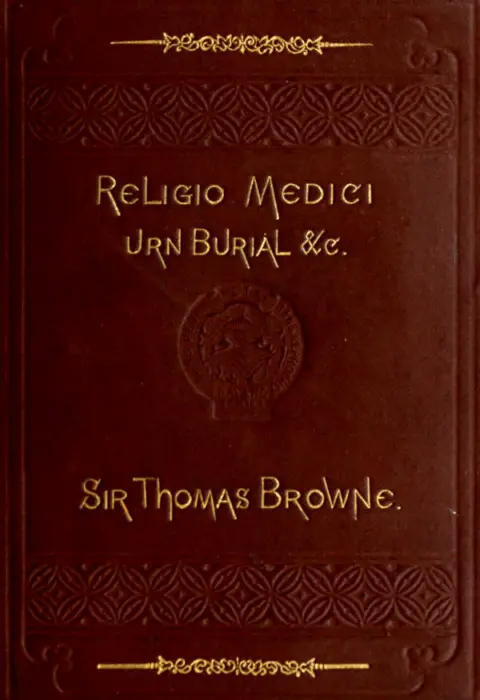
"Religio Medici, Hydriotaphia, and the Letter to a Friend" by Sir Thomas Browne is a collection of philosophical and religious essays written in the 17th century. The work is significant for its exploration of spirituality, mortality, and the human condition, reflecting the complexity of Browne's thoughts as a physician and a thinker during a transformative period in history. The opening portion of the collection delves deep into Browne’s personal reflections on his faith and the philosophical underpinnings of his beliefs. He begins by asserting his Christian identity despite facing doubts from others due to his profession and demeanor. Browne emphasizes the importance of reason and personal interpretation of faith, advocating for an understanding of religion that transcends dogma. He discusses the relevance of charity and openness towards others’ beliefs and the historical context of varying Christian doctrines. Through a mixture of prose, reason, and introspective contemplation, he illustrates a mind grappling with the eternal themes of existence and divinity, setting the stage for the subsequent essays in the collection.
Introduction adapted from the source catalogue; source summaries may be automatically generated.
Free to read · English · 59,570 words · No account needed
MAKE TIME FOR A GOOD BOOK
On by default. Untick to stop anonymous reading totals. Each page counts after 10 seconds in view. How this works.
Anonymous counting is on unless you have switched it off.
“As when the labouring sun hath wrought his track
Up to the top of lofty Cancer’s back,
The icy ocean cracks, the frozen pole
Thaws with the heat of the celestial coal;
So when thy absent beams begin t’ impart
Again a solstice on my frozen heart,
My winter’s o’er, my drooping spirits sing,
And every part revives into a spring.
But if thy quickening beams a while decline,
And with their light bless not this orb of mine,
A chilly frost surpriseth every member.
And in the midst of June I feel December.
Oh how this earthly temper doth debase
The noble soul, in this her humble place!
Whose wingy nature ever doth aspire
To reach that place whence first it took its fire.
These flames I feel, which in my heart do dwell,
Are not thy beams, but take their fire from hell.
Oh quench them all! and let thy Light divine
Be as the sun to this poor orb of mine!
And to thy sacred Spirit convert those fires,
Whose earthly fumes choke my devout aspires!”
Sect. 33.--Therefore, for spirits, I am so far from denying their existence, that I could easily believe, that not only whole countries, but particular persons, have their tutelary and guardian angels. It is not a new opinion of the Church of Rome, but an old one of Pythagoras and Plato: there is no heresy in it: and if not manifestly defined in Scripture, yet it is an opinion of a good and wholesome use in the course and actions of a man’s life; and would serve as an hypothesis to salve many doubts, whereof common philosophy affordeth no solution. Now, if you demand my opinion and metaphysicks of their natures, I confess them very shallow; most of them in a negative way, like that of God; or in a comparative, between ourselves and fellow-creatures: for there is in this universe a stair, or manifest scale, of creatures, rising not disorderly, or in confusion, but with a comely method and proportion. Between creatures of mere existence and things of life there is a large disproportion of nature: between plants and animals, or creatures of sense, a wider difference: between them and man, a far greater: and if the proportion hold on, between man and angels there should be yet a greater. We do not comprehend their natures, who retain the first definition of Porphyry;[48] and distinguish them from ourselves by immortality: for, before his fall, man also was immortal: yet must we needs affirm that he had a different essence from the angels. Having, therefore, no certain knowledge of their nature, ’tis no bad method of the schools, whatsoever perfection we find obscurely in ourselves, in a more complete and absolute way to ascribe unto them. I believe they have an extemporary knowledge, and, upon the first motion of their reason, do what we cannot without study or deliberation: that they know things by their forms, and define, by specifical difference what we describe by accidents and properties: and therefore probabilities to us may be demonstrations unto them: that they have knowledge not only of the specifical, but numerical, forms of individuals, and understand by what reserved difference each single hypostatis (besides the relation to its species) becomes its numerical self: that, as the soul hath a power to move the body it informs, so there’s a faculty to move any, though inform none: ours upon restraint of time, place, and distance: but that invisible hand that conveyed Habakkuk to the lion’s den, or Philip to Azotus, infringeth this rule, and hath a secret conveyance, wherewith mortality is not acquainted. If they have that intuitive knowledge, whereby, as in reflection, they behold the thoughts of one another, I cannot peremptorily deny but they know a great part of ours. They that, to refute the invocation of saints, have denied that they have any knowledge of our affairs below, have proceeded too far, and must pardon my opinion, till I can thoroughly answer that piece of Scripture, “At the conversion of a sinner, the angels in heaven rejoice.” I cannot, with those in that great father,[49] securely interpret the work of the first day, fiat lux, to the creation of angels; though I confess there is not any creature that hath so near a glimpse of their nature as light in the sun and elements: we style it a bare accident; but, where it subsists alone, ’tis a spiritual substance, and may be an angel: in brief, conceive light invisible, and that is a spirit.
Your reading position is saved on this browser. Take it to another device with a library code. Reading pages adapt to text, rather than matching a printed edition.
BEHIND THE BOOK
This eBook is for the use of anyone anywhere in the United States and most other parts of the world at no cost and with almost no restrictions whatsoever. You may copy it, give it away or re-use it under the terms of the Project Gutenberg License included with this eBook or online at www.gutenberg.org. If you are not located in the United States, you will have to check the laws of the country where you are located before using this eBook. Read the source licence.
The original source file, including credits and licence, is retained by this library. Request an original-format copy at no charge. Please include the book title and Project Gutenberg identifier #586.
KEEP YOUR CURIOSITY GOING

David Patterson (Spirit) Hatch

David Patterson (Spirit) Hatch

David Patterson (Spirit) Hatch
Cécile Tormay

Moritz Busch
Coulson Kernahan