THE CLASSIC COLLECTION✦Notes and Letters on the Natural History of Norfolk More Especially on the Birds and FishesCLASSIC FREE BOOKS
Notes and Letters on the Natural History of Norfolk More Especially on the Birds and Fishes
Thomas, Sir Browne
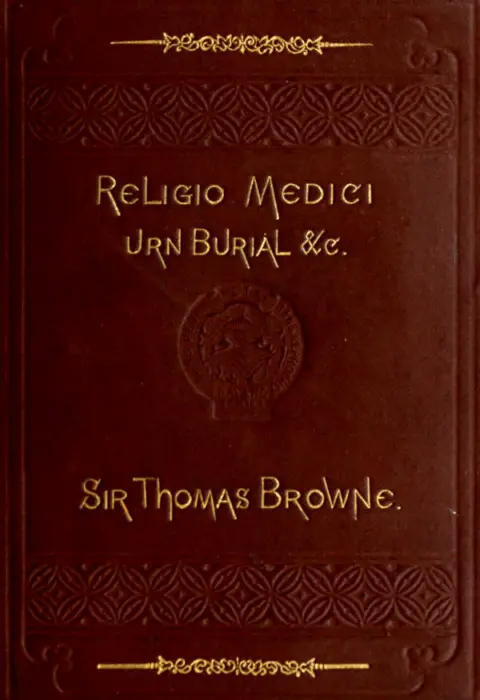
THE CLASSIC COLLECTION · 1690
"Religio Medici, Hydriotaphia, and the Letter to a Friend" by Sir Thomas Browne is a collection of philosophical and religious essays written in the 17th century. The work is significant for its exploration of spirituality, mortality, and the human condition, reflecting the complexity of Browne's thoughts as a physician and a thinker during a transformative period in history. The opening portion of the collection delves deep into Browne’s personal reflections on his faith and the philosophical underpinnings of his beliefs. He begins by asserting his Christian identity despite facing doubts from others due to his profession and demeanor. Browne emphasizes the importance of reason and personal interpretation of faith, advocating for an understanding of religion that transcends dogma. He discusses the relevance of charity and openness towards others’ beliefs and the historical context of varying Christian doctrines. Through a mixture of prose, reason, and introspective contemplation, he illustrates a mind grappling with the eternal themes of existence and divinity, setting the stage for the subsequent essays in the collection.
Introduction adapted from the source catalogue; source summaries may be automatically generated.
Free to read · English · 59,570 words · No account needed
MAKE TIME FOR A GOOD BOOK
On by default. Untick to stop anonymous reading totals. Each page counts after 10 seconds in view. How this works.
Anonymous counting is on unless you have switched it off.
Sect. 12.--There is no attribute that adds more difficulty to the mystery of the Trinity, where, though in a relative way of Father and Son, we must deny a priority. I wonder how Aristotle could conceive the world eternal, or how he could make good two eternities. His similitude, of a triangle comprehended in a square, doth somewhat illustrate the trinity of our souls, and that the triple unity of God; for there is in us not three, but a trinity of, souls; because there is in us, if not three distinct souls, yet differing faculties, that can and do subsist apart in different subjects, and yet in us are thus united as to make but one soul and substance. If one soul were so perfect as to inform three distinct bodies, that were a pretty trinity. Conceive the distinct number of three, not divided nor separated by the intellect, but actually comprehended in its unity, and that a perfect trinity. I have often admired the mystical way of Pythagoras, and the secret magick of numbers. “Beware of philosophy,” is a precept not to be received in too large a sense: for, in this mass of nature, there is a set of things that carry in their front, though not in capital letters, yet in stenography and short characters, something of divinity; which, to wiser reasons, serve as luminaries in the abyss of knowledge, and, to judicious beliefs, as scales and roundles to mount the pinnacles and highest pieces of divinity. The severe schools shall never laugh me out of the philosophy of Hermes, that this visible world is but a picture of the invisible, wherein, as in a portrait, things are not truly, but in equivocal shapes, and as they counterfeit some real substance in that invisible fabrick.
Sect. 13.--That other attribute, wherewith I recreate my devotion, is his wisdom, in which I am happy; and for the contemplation of this only do not repent me that I was bred in the way of study. The advantage I have therein, is an ample recompense for all my endeavours, in what part of knowledge soever. Wisdom is his most beauteous attribute: no man can attain unto it: yet Solomon pleased God when he desired it. He is wise, because he knows all things; and he knoweth all things, because he made them all: but his greatest knowledge is in comprehending that he made not, that is, himself. And this is also the greatest knowledge in man. For this do I honour my own profession, and embrace the counsel even of the devil himself: had he read such a lecture in Paradise as he did at Delphos,[D][13] we had better known ourselves; nor had we stood in fear to know him. I know God is wise in all; wonderful in what we conceive, but far more in what we comprehend not: for we behold him but asquint, upon reflex or shadow; our understanding is dimmer than Moses’s eye; we are ignorant of the back parts or lower side of his divinity; therefore, to pry into the maze of his counsels, is not only folly in man, but presumption even in angels. Like us, they are his servants, not his senators; he holds no counsel, but that mystical one of the Trinity, wherein, though there be three persons, there is but one mind that decrees without contradiction. Nor needs he any; his actions are not begot with deliberation; his wisdom naturally knows what’s best: his intellect stands ready fraught with the superlative and purest ideas of goodness, consultations, and election, which are two motions in us, make but one in him: his actions springing from his power at the first touch of his will. These are contemplations metaphysical: my humble speculations have another method, and are content to trace and discover those expressions he hath left in his creatures, and the obvious effects of nature. There is no danger to profound[14] these mysteries, no sanctum sanctorum in philosophy. The world was made to be inhabited by beasts, but studied and contemplated by man: ’tis the debt of our reason we owe unto God, and the homage we pay for not being beasts. Without this, the world is still as though it had not been, or as it was before the sixth day, when as yet there was not a creature that could conceive or say there was a world. The wisdom of God receives small honour from those vulgar heads that rudely stare about, and with a gross rusticity admire his works. Those highly magnify him, whose judicious enquiry into his acts, and deliberate research into his creatures, return the duty of a devout and learned admiration. Therefore,
Your reading position is saved on this browser. Take it to another device with a library code. Reading pages adapt to text, rather than matching a printed edition.
BEHIND THE BOOK
This eBook is for the use of anyone anywhere in the United States and most other parts of the world at no cost and with almost no restrictions whatsoever. You may copy it, give it away or re-use it under the terms of the Project Gutenberg License included with this eBook or online at www.gutenberg.org. If you are not located in the United States, you will have to check the laws of the country where you are located before using this eBook. Read the source licence.
The original source file, including credits and licence, is retained by this library. Request an original-format copy at no charge. Please include the book title and Project Gutenberg identifier #586.
KEEP YOUR CURIOSITY GOING

David Patterson (Spirit) Hatch

David Patterson (Spirit) Hatch

David Patterson (Spirit) Hatch
Cécile Tormay

Moritz Busch
Coulson Kernahan