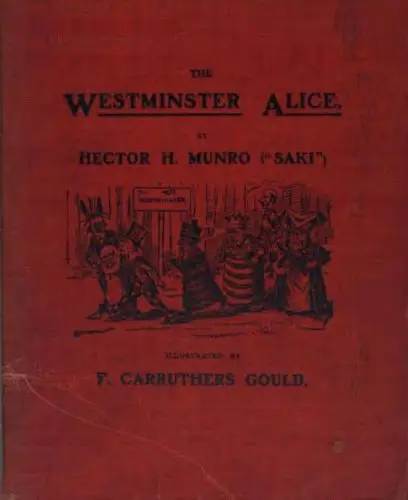
The Westminster Alice
Saki
THE CLASSIC COLLECTION · 1904
"Reginald" by Saki (H.H. Munro) is a collection of short stories written during the early 20th century. Set against the backdrop of Edwardian society, the book explores the humorous and often satirical observations of the protagonist, Reginald, as he interacts with various characters in his life. The central theme revolves around social conventions, the absurdities of social engagements, and the whimsical nature of human behavior. In this collection, Reginald navigates a range of scenarios, from garden parties and Christmas festivities to discussions about art, literature, and the complexities of life. His sharp wit and irreverent demeanor often lead to chaotic yet comedic situations, exposing the folly of those around him and highlighting the eccentricities of upper-class society. Throughout the stories, Reginald's reflections on the triviality of social norms and his disdain for pretense serve as a vehicle for Saki's commentary on human nature and societal expectations, creating a delightful blend of humor and insight that continues to resonate with readers today.
Introduction adapted from the source catalogue; source summaries may be automatically generated.
Free to read · English · 13,867 words · No account needed
MAKE TIME FOR A GOOD BOOK
On by default. Untick to stop anonymous reading totals. Each page counts after 10 seconds in view. How this works.
Anonymous counting is on unless you have switched it off.
"Now we are only nice. One must specialise in these days. Which reminds me of the man I read of in some sacred book who was given a choice of what he most desired. And because he didn't ask for titles and honours and dignities, but only for immense wealth, these other things came to him also."
"I am sure you didn't read about him in any sacred book."
"Yes; I fancy you will find him in Debrett."
"I'm writing a poem on Peace," said Reginald, emerging from a sweeping operation through a tin of mixed biscuits, in whose depths a macaroon or two might yet be lurking.
"Something of the kind seems to have been attempted already," said the
Other.
"Oh, I know; but I may never have the chance again. Besides, I've got a new fountain pen. I don't pretend to have gone on any very original lines; in writing about Peace the thing is to say what everybody else is saying, only to say it better. It begins with the usual ornithological emotion--
'When the widgeon westward winging
Heard the folk Vereeniginging,
Heard the shouting and the singing'"--
"Vereeniginging is good, but why widgeon?"
"Why not? Anything that winged westward would naturally begin with a
w."
"Need it wing westward?"
"The bird must go somewhere. You wouldn't have it hang around and look foolish. Then I've brought in something about the heedless hartebeest galloping over the deserted veldt."
"Of course you know it's practically extinct in those regions?"
"I can't help that, it gallops so nicely. I make it have all sorts of
unexpected yearnings--
'Mother, may I go and maffick,
Tear around and hinder traffic?'
Of course you'll say there would be no traffic worth bothering about on the bare and sun-scorched veldt, but there's no other word that rhymes with maffick."
"Seraphic?"
Reginald considered. "It might do, but I've got a lot about angels later on. You must have angels in a Peace poem; I know dreadfully little about their habits."
"They can do unexpected things, like the hartebeest."
"Of course. Then I turn on London, the City of Dreadful Nocturnes, resonant with hymns of joy and thanksgiving--
'And the sleeper, eye unlidding,
Heard a voice for ever bidding
Much farewell to Dolly Gray;
Turning weary on his truckle-
Bed he heard the honey-suckle
Lauded in apiarian lay.'
Longfellow at his best wrote nothing like that."
"I agree with you."
"I wish you wouldn't. I've a sweet temper, but I can't stand being agreed with. And I'm so worried about the aasvogel."
Reginald stared dismally at the biscuit-tin, which now presented an unattractive array of rejected cracknels.
Your reading position is saved on this browser. Take it to another device with a library code. Reading pages adapt to text, rather than matching a printed edition.
Saki
Saki
Saki
Saki
BEHIND THE BOOK
This eBook is for the use of anyone anywhere in the United States and most other parts of the world at no cost and with almost no restrictions whatsoever. You may copy it, give it away or re-use it under the terms of the Project Gutenberg License included with this eBook or online at www.gutenberg.org. If you are not located in the United States, you will have to check the laws of the country where you are located before using this eBook. Read the source licence.
The original source file, including credits and licence, is retained by this library. Request an original-format copy at no charge. Please include the book title and Project Gutenberg identifier #2830.
KEEP YOUR CURIOSITY GOING
Coulson Kernahan

Maurice Baring
Frances Wright
Cécile Tormay

Frederic Jesup Stimson

W. H. P. (William Henry Pope) Jarvis