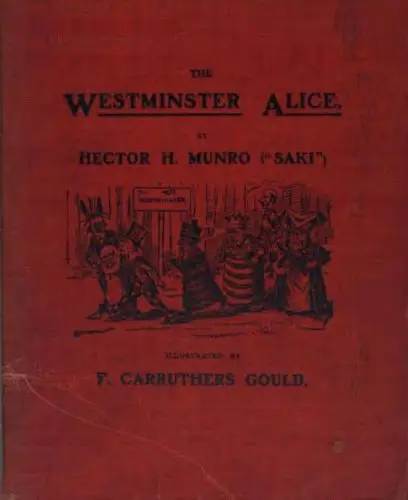
The Westminster Alice
Saki
THE CLASSIC COLLECTION · 1910
"Reginald in Russia, and Other Sketches" by Saki is a collection of short stories written in the early 20th century. The book features the character Reginald, who navigates the quirks and contradictions of society, particularly in relation to his encounters in Russia. Through a mix of humor and sharp social commentary, the stories explore the clash between cultures and the absurdities of human behavior. At the start of the collection, Reginald appears in a Russian Princess's salon, where he observes and critiques the peculiarities of his surroundings, including the decor and the princess's opinions. He engages in witty banter, revealing both his frivolous nature and a keen insight into social injustice. The exchanges between Reginald and the Princess highlight cultural misunderstandings and the inherent contradictions in their worldviews, paving the way for a humorous yet poignant critique of society's norms. The opening portion sets the tone for the subsequent sketches, showcasing Saki's astute satire and entertaining storytelling.
Introduction adapted from the source catalogue; source summaries may be automatically generated.
Free to read · English · 22,128 words · No account needed
MAKE TIME FOR A GOOD BOOK
On by default. Untick to stop anonymous reading totals. Each page counts after 10 seconds in view. How this works.
Anonymous counting is on unless you have switched it off.
Em.: I wouldn't trust a child with any one who had a temper like hers. Oh, Dickie, why did you go and have such a large family? You always said you wanted me to be the mother of your children.
Maj.: I wasn't going to wait while you were founding and fostering dynasties in other directions. Why you couldn't be content to have children of your own, without collecting them like batches of postage stamps I can't think. The idea of marrying a man with four children!
Em.: Well, you're asking me to marry one with five.
Maj.: Five! (Springing to his feet) Did I say five?
Em.: You certainly said five.
Maj.: Oh, Emily, supposing I've miscounted them! Listen now, keep count with me. Richard--that's after me, of course.
Em.: One.
Maj.: Albert-Victor--that must have been in Coronation year.
Em.: Two!
Maj.: Maud. She's called after--
Em.: Never mind who's she's called after. Three!
Maj.: And Gerald.
Em.: Four!
Maj.: That's the lot.
Em.: Are you sure?
Maj.: I swear that's the lot. I must have counted Albert-Victor as
two.
Em.: Richard!
Maj.: Emily!
(They embrace.)
Theodoric Voler had been brought up, from infancy to the confines of middle age, by a fond mother whose chief solicitude had been to keep him screened from what she called the coarser realities of life. When she died she left Theodoric alone in a world that was as real as ever, and a good deal coarser than he considered it had any need to be. To a man of his temperament and upbringing even a simple railway journey was crammed with petty annoyances and minor discords, and as he settled himself down in a second-class compartment one September morning he was conscious of ruffled feelings and general mental discomposure. He had been staying at a country vicarage, the inmates of which had been certainly neither brutal nor bacchanalian, but their supervision of the domestic establishment had been of that lax order which invites disaster. The pony carriage that was to take him to the station had never been properly ordered, and when the moment for his departure drew near the handy-man who should have produced the required article was nowhere to be found. In this emergency Theodoric, to his mute but very intense disgust, found himself obliged to collaborate with the vicar's daughter in the task of harnessing the pony, which necessitated groping about in an ill-lighted outhouse called a stable, and smelling very like one--except in patches where it smelt of mice. Without being actually afraid of mice, Theodoric classed them among the coarser incidents of life, and considered that Providence, with a little exercise of moral courage, might long ago have recognised that they were not indispensable, and have withdrawn them from circulation. As the train glided out of the station Theodoric's nervous imagination accused himself of exhaling a weak odour of stable-yard, and possibly of displaying a mouldy straw or two on his usually well-brushed garments. Fortunately the only other occupant of the compartment, a lady of about the same age as himself, seemed inclined for slumber rather than scrutiny; the train was not due to stop till the terminus was reached, in about an hour's time, and the carriage was of the old-fashioned sort, that held no communication with a corridor, therefore no further travelling companions were likely to intrude on Theodoric's semi-privacy. And yet the train had scarcely attained its normal speed before he became reluctantly but vividly aware that he was not alone with the slumbering lady; he was not even alone in his own clothes. A warm, creeping movement over his flesh betrayed the unwelcome and highly resented presence, unseen but poignant, of a strayed mouse, that had evidently dashed into its present retreat during the episode of the pony harnessing. Furtive stamps and shakes and wildly directed pinches failed to dislodge the intruder, whose motto, indeed, seemed to be Excelsior; and the lawful occupant of the clothes lay back against the cushions and endeavoured rapidly to evolve some means for putting an end to the dual ownership. It was unthinkable that he should continue for the space of a whole hour in the horrible position of a Rowton House for vagrant mice (already his imagination had at least doubled the numbers of the alien invasion). On the other hand, nothing less drastic than partial disrobing would ease him of his tormentor, and to undress in the presence of a lady, even for so laudable a purpose, was an idea that made his eartips tingle in a blush of abject shame. He had never been able to bring himself even to the mild exposure of open-work socks in the presence of the fair sex. And yet--the lady in this case was to all appearances soundly and securely asleep; the mouse, on the other hand, seemed to be trying to crowd a Wanderjahr into a few strenuous minutes. If there is any truth in the theory of transmigration, this particular mouse must certainly have been in a former state a member of the Alpine Club. Sometimes in its eagerness it lost its footing and slipped for half an inch or so; and then, in fright, or more probably temper, it bit. Theodoric was goaded into the most audacious undertaking of his life. Crimsoning to the hue of a beetroot and keeping an agonised watch on his slumbering fellow-traveller, he swiftly and noiselessly secured the ends of his railway-rug to the racks on either side of the carriage, so that a substantial curtain hung athwart the compartment. In the narrow dressing-room that he had thus improvised he proceeded with violent haste to extricate himself partially and the mouse entirely from the surrounding casings of tweed and half-wool. As the unravelled mouse gave a wild leap to the floor, the rug, slipping its fastening at either end, also came down with a heart-curdling flop, and almost simultaneously the awakened sleeper opened her eyes. With a movement almost quicker than the mouse's, Theodoric pounced on the rug, and hauled its ample folds chin-high over his dismantled person as he collapsed into the further corner of the carriage. The blood raced and beat in the veins of his neck and forehead, while he waited dumbly for the communication-cord to be pulled. The lady, however, contented herself with a silent stare at her strangely muffled companion. How much had she seen, Theodoric queried to himself, and in any case what on earth must she think of his present posture?
Your reading position is saved on this browser. Take it to another device with a library code. Reading pages adapt to text, rather than matching a printed edition.
BEHIND THE BOOK
This eBook is for the use of anyone anywhere in the United States and most other parts of the world at no cost and with almost no restrictions whatsoever. You may copy it, give it away or re-use it under the terms of the Project Gutenberg License included with this eBook or online at www.gutenberg.org. If you are not located in the United States, you will have to check the laws of the country where you are located before using this eBook. Read the source licence.
The original source file, including credits and licence, is retained by this library. Request an original-format copy at no charge. Please include the book title and Project Gutenberg identifier #1870.
KEEP YOUR CURIOSITY GOING
Coulson Kernahan

Maurice Baring
Frances Wright
Cécile Tormay

Frederic Jesup Stimson

W. H. P. (William Henry Pope) Jarvis