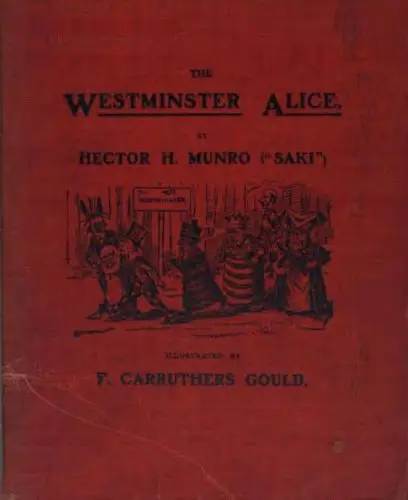
The Westminster Alice
Saki
THE CLASSIC COLLECTION · 1910
"Reginald in Russia, and Other Sketches" by Saki is a collection of short stories written in the early 20th century. The book features the character Reginald, who navigates the quirks and contradictions of society, particularly in relation to his encounters in Russia. Through a mix of humor and sharp social commentary, the stories explore the clash between cultures and the absurdities of human behavior. At the start of the collection, Reginald appears in a Russian Princess's salon, where he observes and critiques the peculiarities of his surroundings, including the decor and the princess's opinions. He engages in witty banter, revealing both his frivolous nature and a keen insight into social injustice. The exchanges between Reginald and the Princess highlight cultural misunderstandings and the inherent contradictions in their worldviews, paving the way for a humorous yet poignant critique of society's norms. The opening portion sets the tone for the subsequent sketches, showcasing Saki's astute satire and entertaining storytelling.
Introduction adapted from the source catalogue; source summaries may be automatically generated.
Free to read · English · 22,128 words · No account needed
MAKE TIME FOR A GOOD BOOK
On by default. Untick to stop anonymous reading totals. Each page counts after 10 seconds in view. How this works.
Anonymous counting is on unless you have switched it off.
Em.: Forgotten what?
Maj.: The children. I ought to have told you. Do you mind children?
Em.: Not in moderate quantities. How many have you got?
Maj. (counting hurriedly on his fingers): Five.
Em.: Five!
Maj. (anxiously): Is that too many?
Em.: It's rather a number. The worst of it is, I've some myself.
Maj.: Many?
Em.: Eight.
Maj.: Eight in six years! Oh, Emily!
Em.: Only four were my own. The other four were by my husband's first marriage. Still, that practically makes eight.
Maj.: And eight and five make thirteen. We can't start our married life with thirteen children; it would be most unlucky. (Walks up and down in agitation.) Some way must be found out of this. If we could only bring them down to twelve. Thirteen is so horribly unlucky.
Em.: Isn't there some way by which we could part with one or two? Don't the French want more children? I've often seen articles about it in the Figaro.
Maj.: I fancy they want French children. Mine don't even speak French.
Em.: There's always a chance that one of them might turn out depraved and vicious, and then you could disown him. I've heard of that being done.
Maj.: But, good gracious, you've got to educate him first. You can't expect a boy to be vicious till he's been to a good school.
Em.: Why couldn't he be naturally depraved? Lots of boys are.
Maj.: Only when they inherit it from depraved parents. You don't suppose there's any depravity in me, do you?
Em.: It sometimes skips a generation, you know. Weren't any of your
family bad?
Maj.: There was an aunt who was never spoken of.
Em.: There you are!
Maj.: But one can't build too much on that. In mid-Victorian days they labelled all sorts of things as unspeakable that we should speak about quite tolerantly. I dare say this particular aunt had only married a Unitarian, or rode to hounds on both sides of her horse, or something of that sort. Anyhow, we can't wait indefinitely for one of the children to take after a doubtfully depraved great-aunt. Something else must be thought of.
Em.: Don't people ever adopt children from other families?
Maj.: I've heard of it being done by childless couples, and those sort
of people--
Em.: Hush! Some one's coming. Who is it?
Maj.: Mrs. Paly-Paget.
Em.: The very person!
Maj.: What, to adopt a child? Hasn't she got any?
Em.: Only one miserable hen-baby.
Maj.: Let's sound her on the subject.
(Enter Mrs. Paly-Paget, R.)
Ah, good morning. Mrs. Paly-Paget. I was just wondering at breakfast
where did we meet last?
Mrs. P.-P.: At the Criterion, wasn't it?
Your reading position is saved on this browser. Take it to another device with a library code. Reading pages adapt to text, rather than matching a printed edition.
BEHIND THE BOOK
This eBook is for the use of anyone anywhere in the United States and most other parts of the world at no cost and with almost no restrictions whatsoever. You may copy it, give it away or re-use it under the terms of the Project Gutenberg License included with this eBook or online at www.gutenberg.org. If you are not located in the United States, you will have to check the laws of the country where you are located before using this eBook. Read the source licence.
The original source file, including credits and licence, is retained by this library. Request an original-format copy at no charge. Please include the book title and Project Gutenberg identifier #1870.
KEEP YOUR CURIOSITY GOING
Coulson Kernahan

Maurice Baring
Frances Wright
Cécile Tormay

Frederic Jesup Stimson

W. H. P. (William Henry Pope) Jarvis