
Last letters from the living dead man
David Patterson (Spirit) Hatch
THE CLASSIC COLLECTION · 1759
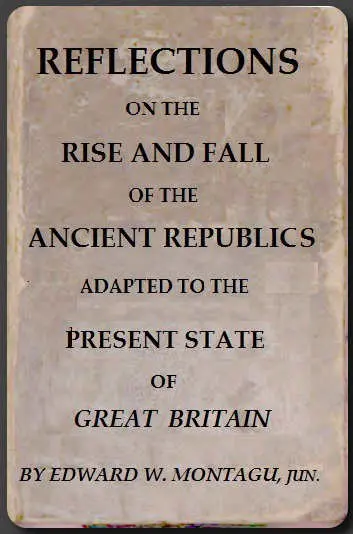
"Reflections on the Rise and Fall of the Ancient Republicks" by Edward W. Montagu is a historical account written in the early 19th century. The work examines the ancient republics such as Sparta, Athens, and Rome, drawing lessons that relate to the political climate of Great Britain at the time. Montagu aims to explore the factors that contributed to the rise and decline of these states, suggesting that contemporary issues in Britain resonate with those of the past. The opening portion of the book sets the stage for Montagu's exploration by introducing the historical context of various republics, particularly focusing on the governance of Sparta under Lycurgus. It discusses how Lycurgus addressed the deep-rooted issues of civil strife and inequality in Spartan society, ultimately leading to his significant reforms that promoted equality and a strong sense of civic duty among citizens. Montagu emphasizes the importance of unity and public virtue to maintain a free state, warning against the disunity that plagued ancient republics as a precursor to their downfall. The narrative establishes a foundation for Montagu's reflections, highlighting the dangers of neglecting the lessons of history in the face of contemporary political turmoil.
Introduction adapted from the source catalogue; source summaries may be automatically generated.
Free to read · English · 84,030 words · No account needed
MAKE TIME FOR A GOOD BOOK
On by default. Untick to stop anonymous reading totals. Each page counts after 10 seconds in view. How this works.
Anonymous counting is on unless you have switched it off.
The erection of the tribunitial-power, which happened about seventeen years after the expulsion of the kings, is certainly the æra from which the liberty of the Roman people ought properly to be dated. All the neighbouring states were at that time subject to aristocracy, where the people had little or no share in the government, and it appears evidently from the Roman historians that the Romans intended to establish the same form of government at Rome after the abolition of monarchy. For the senate, as Livy informs us,[259] gave a loose to that unbounded joy which the death of Tarquin inspired, and begun to oppress and injure the people, whom until that time they had courted with the utmost assiduity. But Sallust is more full and explicit. For he affirms,[260] “that after the expulsion of the kings, as long as the fear of Tarquin and the burdensome war with the Etrurians kept the Romans in suspense, the government was administered with equity and moderation. But as soon as ever the dread of those impending dangers was removed, the senate begun to domineer over the people and treat them as slaves; inflicting death or scourging after the arbitrary manner of despotick tyrants; expelling them from their lands, and arrogating the whole power of government to themselves, without communicating the least share of it to the Plebeians.” Thus the people, before the creation of this magistracy, were amused with the name of liberty, whilst in fact they had only changed the tyranny of one, for the more galling yoke of three hundred. But the tribunicial-power proved an invincible obstacle to the arbitrary schemes of the aristocratick faction, and at last introduced that due admixture of democracy, which is so essentially necessary to the constitution of a well regulated republick.
As a minute detail of a history so well known as that of the Romans would be quite superfluous, I shall only observe, that the democratick power in that republick did not arrive at its just state of independence, until the Plebeians were not only entitled to the highest posts and dignities, equally with the Patricians, but until the plebiscita or decrees made by the people in their assembly by tribes,[261] were confirmed to be equally binding as those made in their assembly by centuries. This law was first made when the tyranny of the decemvirs was abolished by the second secession of the people to the Sacred Mountain, but was perpetually violated by the over-bearing power of the aristocracy. But an event similar to that which occasioned the first secession of the people, to which they properly owed the origin of their liberty, was the cause of the third and last secession, which fully completed that liberty, and gave the fatal blow to the arbitrary aristocratick faction. Veturius, the son of Titus Veturius, who had been consul and died insolvent, borrowed a sum of money of one Plotius to defray the expenses of his father’s funeral. As the father was greatly indebted to the same Plotius, he demanded of young Veturius the payment of both debts which his father and he himself had contracted. As the unhappy young man was utterly unable to satisfy the demand, Plotius seized his unfortunate debtor, and confined him to the work of a slave, until he had discharged both principal and interest. Veturius bore his servitude with patience, and did his utmost to please his creditor. But as he refused to gratify the detestable passion of the infamous Plotius he treated him with the utmost inhumanity to force him to a compliance. One day he had the good fortune to escape out of the house of his merciless creditor, and fled to the forum, where he showed his back torn with stripes and his body covered with blood, and explained the reason of his shocking treatment. The people, enraged at so dreadful a spectacle, demanded an absolute security against that law, which gave the creditors such a shameful power over their insolvent debtors. For though that law had been abolished near forty years before upon a like occasion, yet the Patricians, by their superior power, had again revived it. The consuls reported the affair to the senate, who committed Plotius to prison, and ordered all those who were in custody for debt to be set at liberty. The Plebeians, not satisfied with these trifling concessions, insisted upon the absolute abolition of that inhuman law; but they were opposed with equal animosity by the Patricians. Despairing therefore of gaining their point by entreaties and remonstrances, they retired in a body to the Janiculum, resolutely determined never to enter the city, until they had received full satisfaction. The senate, alarmed at this secession, had recourse to their last resource in all desperate cases, the creation of a dictator. Q. Hortensius was nominated dictator upon this occasion, a man of great temper and prudence, and a real friend to liberty. As he was vested with absolute power by virtue of his office, he totally abolished that law which had given such just cause of uneasiness, and notwithstanding all the opposition of the senate, revived and confirmed two laws which had been formerly made, though constantly violated by the Patricians. One was, “that the decrees made by the Plebeians should be equally obligatory to the Patricians:” the other, “that all laws passed in the senate should be laid before the comitia, or assemblies of the people, either to be confirmed or rejected.” Thus the liberty, which the Plebeians had acquired by the first secession, was confirmed in the plainest and strongest manner by the last, which happened about two hundred and six years after. For the Patricians, from that memorable æra, had scarce any other advantage over the Plebeians, except what arose from their superior wealth, and that respect which is naturally paid by inferiors to men of superior birth.
Your reading position is saved on this browser. Take it to another device with a library code. Reading pages adapt to text, rather than matching a printed edition.
BEHIND THE BOOK
This eBook is for the use of anyone anywhere in the United States and most other parts of the world at no cost and with almost no restrictions whatsoever. You may copy it, give it away or re-use it under the terms of the Project Gutenberg License included with this eBook or online at www.gutenberg.org. If you are not located in the United States, you will have to check the laws of the country where you are located before using this eBook. Read the source licence.
The original source file, including credits and licence, is retained by this library. Request an original-format copy at no charge. Please include the book title and Project Gutenberg identifier #45592.
KEEP YOUR CURIOSITY GOING
David Patterson (Spirit) Hatch
Cécile Tormay

Moritz Busch
Coulson Kernahan
John L. Ransom

Ralph Waldo Emerson