
Last letters from the living dead man
David Patterson (Spirit) Hatch
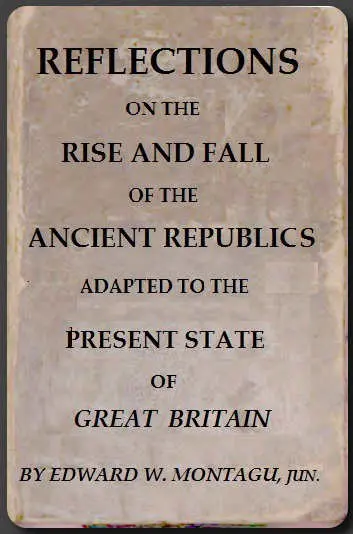
THE CLASSIC COLLECTION · 1759
"Reflections on the Rise and Fall of the Ancient Republicks" by Edward W. Montagu is a historical account written in the early 19th century. The work examines the ancient republics such as Sparta, Athens, and Rome, drawing lessons that relate to the political climate of Great Britain at the time. Montagu aims to explore the factors that contributed to the rise and decline of these states, suggesting that contemporary issues in Britain resonate with those of the past. The opening portion of the book sets the stage for Montagu's exploration by introducing the historical context of various republics, particularly focusing on the governance of Sparta under Lycurgus. It discusses how Lycurgus addressed the deep-rooted issues of civil strife and inequality in Spartan society, ultimately leading to his significant reforms that promoted equality and a strong sense of civic duty among citizens. Montagu emphasizes the importance of unity and public virtue to maintain a free state, warning against the disunity that plagued ancient republics as a precursor to their downfall. The narrative establishes a foundation for Montagu's reflections, highlighting the dangers of neglecting the lessons of history in the face of contemporary political turmoil.
Introduction adapted from the source catalogue; source summaries may be automatically generated.
Free to read · English · 84,030 words · No account needed
MAKE TIME FOR A GOOD BOOK
On by default. Untick to stop anonymous reading totals. Each page counts after 10 seconds in view. How this works.
Anonymous counting is on unless you have switched it off.
The honest citizens, who had fled Athens, enraged to see their country thus tricked out of her liberty, and groaning under the most ignominious servitude, determined to set her free, or perish in so glorious an attempt. The scheme was well concerted, and as boldly executed by Pelopidas, who entering the city with a small number of the most resolute of his party in disguise, destroyed Leontidas and his colleague Archias, with the most dangerous of his faction; and, by the assistance of Epaminondas and his friends,[186] with the additional aid of a large body of Athenians, recovered the citadel. The Spartans,[187] at the first news of this surprising event, entered the Theban territories with a powerful army to take vengeance of the authors of this rebellion, as they termed it, and to reduce Thebes to its former subjection. The Athenians, conscious of their own weakness, and the mighty power of Sparta, which they were by no means able to cope with, not only renounced all friendship with the Thebans, but proceeded with the utmost severity against such of their citizens as favoured that people. Thus the Thebans, deserted by their allies, and destitute of friends, appeared to the rest of Greece as devoted to inevitable destruction. In this desperate situation of affairs, the virtue and abilities of these two great men shone forth with greater lustre. They began by training their countrymen to the use of arms as well as the shortness of the time would permit, and inspiring them with a hatred of servitude, and the generous resolution of dying in defence of the liberty and glory of their country. As they judged it imprudent to hazard a decisive battle against the best troops in the world, with their new raised militia, they harrassed the Spartans with daily skirmishes to instruct their men in military discipline, and the trade of war. By this method they animated the minds of their people with the love of glory, and inured their bodies to the fatigues of war by exercise and labour, whilst they acquired experience and courage by those frequent encounters. Thus, as Plutarch remarks, when these able generals, by never engaging rashly, but watching every favourable opportunity, had fleshed the Thebans, like young stag-hounds, upon their enemies, and rendered them staunch by tasting the sweets of victory, and bringing them off in safety, they made them fond of the sport, and eager after the most arduous enterprises. By this able management they defeated the Spartans at Platea and Thespia,[188] where they killed Phæbidas who had before so treacherously surprised their citadel, and again routed them at Tenagra, the Spartan general himself falling by the hand of Pelopidas. Flushed with this success, the Thebans feared no enemy, however superior in number; and the battle of Tegyra soon after raised the reputation of their arms to a degree unknown before.[189] In this action the brave Pelopidas, with a small body of horse, and no more than three hundred foot, broke through, and dispersed a body of Spartans consisting of above three times that number, made a terrible slaughter of the enemy, killed both their generals upon the spot, took the spoils of the dead, raised a trophy on the field of battle, and brought his little army home in triumph. Here the astonished Greeks first saw the Spartans defeated by a much inferior number, and by an enemy too whom they had always held in the greatest contempt. They had never, until that time, been beaten by equal, and rarely by much superior numbers, and, until that fatal day, were justly reputed invincible. But this action was only the prelude to that decisive stroke at Leuctra, which gave a fatal turn to the Spartan affairs, and stripped them of that dominion which they had so long exercised over the rest of Greece. For this series of success, though it greatly elated the Thebans, yet rather enraged than discouraged the Spartans. The Athenians, jealous of the growing power of Thebes, struck up a peace with their ancient rivals, in which all the Grecian states were included, except the Thebans, who were given up a sacrifice to the Spartan vengeance. Cleombrotus, joint king with Agesilaus, entered Bœotia with the largest, and finest army the Spartans had ever sent into the field. The great Epaminondas engaged them at Leuctra with a body of six thousand Thebans, which scarce equalled a third part of their enemies, but the admirable disposition he made, joined to the skill and dexterity of Pelopidas, and the bravery of their troops supplied the defect of numbers. Cleombrotus was slain on the spot, his army totally routed, and the greatest slaughter made of the native Spartans that had ever happened until that day, with the loss only of three hundred Thebans. Diodorus Siculus gives a concise account of this action in these remarkable words,[190] “that Epaminondas, being reduced to the necessity of engaging the whole confederate force of the Lacedæmonians, and their allies, with only a handful of his city militia, gained so complete a victory over those hitherto invincible warriors, that he slew their king Cleombrotus, and cut off the Spartan division, which was opposed to him, almost to a man.”
Your reading position is saved on this browser. Take it to another device with a library code. Reading pages adapt to text, rather than matching a printed edition.
BEHIND THE BOOK
This eBook is for the use of anyone anywhere in the United States and most other parts of the world at no cost and with almost no restrictions whatsoever. You may copy it, give it away or re-use it under the terms of the Project Gutenberg License included with this eBook or online at www.gutenberg.org. If you are not located in the United States, you will have to check the laws of the country where you are located before using this eBook. Read the source licence.
The original source file, including credits and licence, is retained by this library. Request an original-format copy at no charge. Please include the book title and Project Gutenberg identifier #45592.
KEEP YOUR CURIOSITY GOING
David Patterson (Spirit) Hatch
Cécile Tormay

Moritz Busch
Coulson Kernahan
John L. Ransom

Ralph Waldo Emerson