
Last letters from the living dead man
David Patterson (Spirit) Hatch
THE CLASSIC COLLECTION · 1759
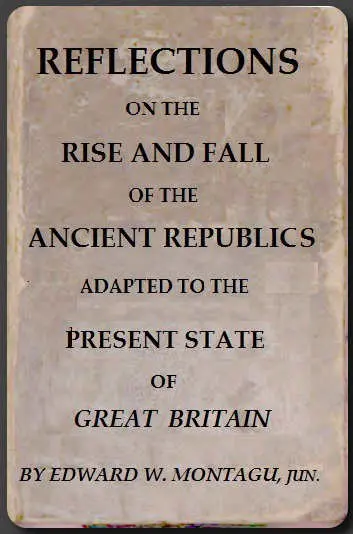
"Reflections on the Rise and Fall of the Ancient Republicks" by Edward W. Montagu is a historical account written in the early 19th century. The work examines the ancient republics such as Sparta, Athens, and Rome, drawing lessons that relate to the political climate of Great Britain at the time. Montagu aims to explore the factors that contributed to the rise and decline of these states, suggesting that contemporary issues in Britain resonate with those of the past. The opening portion of the book sets the stage for Montagu's exploration by introducing the historical context of various republics, particularly focusing on the governance of Sparta under Lycurgus. It discusses how Lycurgus addressed the deep-rooted issues of civil strife and inequality in Spartan society, ultimately leading to his significant reforms that promoted equality and a strong sense of civic duty among citizens. Montagu emphasizes the importance of unity and public virtue to maintain a free state, warning against the disunity that plagued ancient republics as a precursor to their downfall. The narrative establishes a foundation for Montagu's reflections, highlighting the dangers of neglecting the lessons of history in the face of contemporary political turmoil.
Introduction adapted from the source catalogue; source summaries may be automatically generated.
Free to read · English · 84,030 words · No account needed
MAKE TIME FOR A GOOD BOOK
On by default. Untick to stop anonymous reading totals. Each page counts after 10 seconds in view. How this works.
Anonymous counting is on unless you have switched it off.
That luxury and corruption, encouraged and propagated by a most abandoned faction, have made an alarming progress in our nation, is a truth too evident to be denied. The effects have been too sensibly felt during the course of the late and present wars, which, until the last campaign, were the most expensive, and the least successful of any we ever yet engaged in. But a late signal change must convince our enemies, that we have a fund of publick virtue still remaining capable of vindicating our just rights, and raising us out of that calamitous situation, into which we were plunged, under some late administrations. When the publick imagined the helm in the hands of corruption, pusillanimity and ignorance, they transferred it to a virtuous citizen, possessed, in their opinion, of the zeal and eloquence of Demosthenes, joined to the publick economy, incorrupt honesty, and immovable fortitude of Aristides and Phocion. The numerous disinterested marks of approbation, so lately given from every part of this kingdom, demonstrate the resolution and ability of the publick to support that minister, as long as he pursues his upright plan of conduct with undeviating firmness.
From the time of Phocion, the Athenian history affords little more than a detail of scandalous decrees, and despicable instances of the levity and servile adulation of that abject people.[179] Reduced at last to a province of the Romans, Athens contributed her taste for arts and sciences towards polishing, and her passion for theatrical performances towards corrupting the manners of that warlike people.
[48] Vita Solon, p. 85. lit. D.
[49] The time of the first institution of this court (so denominated from Ἄρειος πάγος, i. e. Hill of Mars, an eminence where they always assembled) is quite uncertain; nor are the historians at all agreed about the number of the members of which it was composed. However this was the supreme court, which had cognizance of wilful murders, and all matters which were of the greatest consequence to the republick. Suidas. They had also cognizance of all matters of religion, as we find by the instance of St. Paul.
[50] Plut. 85. lit. A.
[51] Plut. in Vit. Solon, p. 86. lit. C.
[52] Plut. in Vit. Solon, p. 81. lit. B.
[53] Plut. in Vit. Solon, p. 88. lit. D.
[54] The new Senate, which he had instituted.
[55] Which he had revived. Vide note p. 76.
[56] Ibid. p. 87. lit. E.
[57] Ibid. p. 81. lit. A.
[58] Ibid. p. 81.
[59] Solon in his letter to Epimenides, says 400, which seems
most probable. Diog. Laert.
[60] Thucyd.
[61] Thucid. lib. 6. p. 415. sect. 60.
[62] Xenoph. de Republ. Athen. p. 55. Edit. Luvenel. Bas. 1572.
[63] Miltiades, Themistocles, Aristides, Cimon, Thucydides the
historian, &c.
[64] Socrates, Phocion, &c.
[65] Thucyd. edit. Duker. lib. 1. p. 58. sect. 88.
[66] Thucyd. lib. 1. p. 82. sect. 127, 128.
[67] Thucyd. lib. 2. p. 98. sect. 2, 3, 4, et sequent.
Your reading position is saved on this browser. Take it to another device with a library code. Reading pages adapt to text, rather than matching a printed edition.
BEHIND THE BOOK
This eBook is for the use of anyone anywhere in the United States and most other parts of the world at no cost and with almost no restrictions whatsoever. You may copy it, give it away or re-use it under the terms of the Project Gutenberg License included with this eBook or online at www.gutenberg.org. If you are not located in the United States, you will have to check the laws of the country where you are located before using this eBook. Read the source licence.
The original source file, including credits and licence, is retained by this library. Request an original-format copy at no charge. Please include the book title and Project Gutenberg identifier #45592.
KEEP YOUR CURIOSITY GOING
David Patterson (Spirit) Hatch
Cécile Tormay

Moritz Busch
Coulson Kernahan
John L. Ransom

Ralph Waldo Emerson